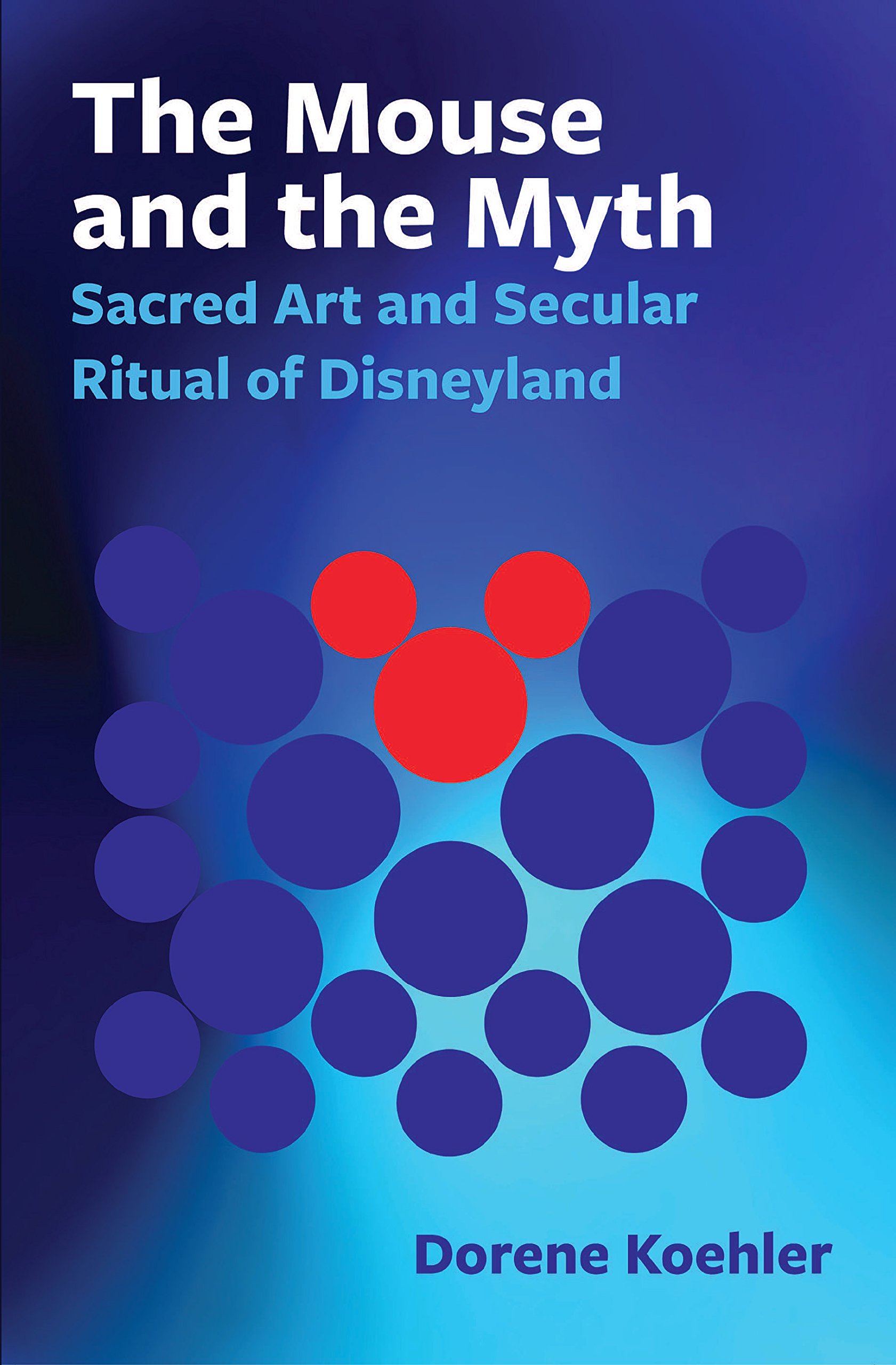
The Mouse and the Myth: Sacred Art and Secular Ritual of Disneyland
$18.97
by Dorene Koehler



The rituals that bond humanity create our most transcendent and meaningful experiences, especially the sacred rituals of play. Although we may fail to recognize rites of play, they are always present in culture, providing a kind of psychological release for child and adult participants. Disneyland is an example of the kind of metaphorical container necessary for the construction of rituals of play. This work explores the original Disney theme park in Anaheim and challenges the disciplines of mythological studies, religious studies, film studies, and depth psychology to broaden traditional definitions of the kind of cultural apparatus that constitute temple culture and ritual by suggesting that Hollywood's entertainment industry has developed a platform for mythic ritual. After setting the ritualized "stage", this book turns to the practices in Disneyland proper, analyzing the patrons' traditions within the framework of the park and beyond. It explores Disneyland's spectacles, through selected shows and parades, and concludes with an exploration of the park's participation in ritual renewal. "[T]here is much to commend in Koehler's study. The Mouse and the My th does exhibit a very deep understanding of Disneyland history as well as the park's myths and rituals. . . .Surely, her work should encourage others to examine myth construction and sacred-secular rituals in popular culture."― H-Celebration Dori Koehler, PhD holds degrees in Mythological Studies with emphasis in Depth Psychology from Pacifica Graduate Institute. Her main area of research is American popular culture, particularly Disney studies. She presents periodically at the Popular Culture Association's National Conference and the Film and History conference through the University of Wisconsin at Osh Kosh. She also presented at the first Discussing Disney conference held in 2014 through the University of Hull. Her most recent article on Walt Disney as a manifestation of the trickster archetype grew out of that presentation and will be published in a forthcoming collection of essays. Dr. Koehler writes a blog fusing popular culture with archetypal theory at www.mythicbliss.wordpress.com The Mouse and The Myth Sacred Art and Secular Ritual at Disneyland By Dori Koehler Indiana University Press Copyright © 2017 John Libbey Publishing Ltd. All rights reserved. ISBN: 978-0-86196-727-8 Contents Chapter 1 Tell Us a Myth, Wendy-Lady!, 1, Chapter 2 The Pilgrimage to Psyche-Land, 19, Chapter 3 The Evolution of Disney's Temple to Entertainment, 53, Chapter 4 Disneyland as the Work of Worship, 87, Chapter 5 Spectacular Spectacle, 119, Chapter 6 Renewing the Magic, 135, Epilogue To the Diamond Celebration and Beyond: Disneyland at 60, 167, Bibliography, 173, Index, 179, CHAPTER 1 Tell Us a Myth, Wendy-Lady! All Disneyland really is, you see, is a projection outward of the phenomenology of the imagination. And, if they can't go into their own imaginations, they might just as well go into Walt Disney's and he'll help them. And that's what religions have done all the time. – Joseph Campbell The test of psychology is not, does it work? The test of psychology is: Is it fun? Does it amuse you? Does it delight you? Does it wake you up? Does it talk to your soul? Does it say anything to your soul that makes you see further or feel deeper or are inspired more ... or that the world around you is more animated or that you are more animated or that there is some beauty, or some love or some tragedy; some real things happening [...]. – James Hillman Introduction In the academic discourse between myth studies and archetypal theory, many are quick to accept a conventional attitude that contemporary popular culture is antithetical to the development of a psychologically fulfilling relationship with the imagination. These critics seem convinced that this is especially true of American popular culture. And frankly, they're not entirely wrong. The frenetic pace of contemporary life can keep humanity disconnected from each other, a state that leads to both alienation from and negligence of the imagination. Lack of attention to the imagination is psychologically hazardous, because through it – specifically through its relationship to ritual – one cultivates an authentic connection with what Rudolf Otto refers to as the numinous: the awe-inspiring transcendence humanity has traditionally understood to be the touch of God(s). We yearn for what comparative mythologist Joseph Campbell insists is the most basic of existential needs: the experience of something real, a magical encounter between mundane events and the mysteries that exist beyond our empirical senses. Whether we interpret these numinous moments to be the soul's voice, the mind, or synapses in the brain, we cannot ignore humanity's yearning for them. This need is traditionally expressed, both individually and collectively, through the languages of mythology, theology, and psycho