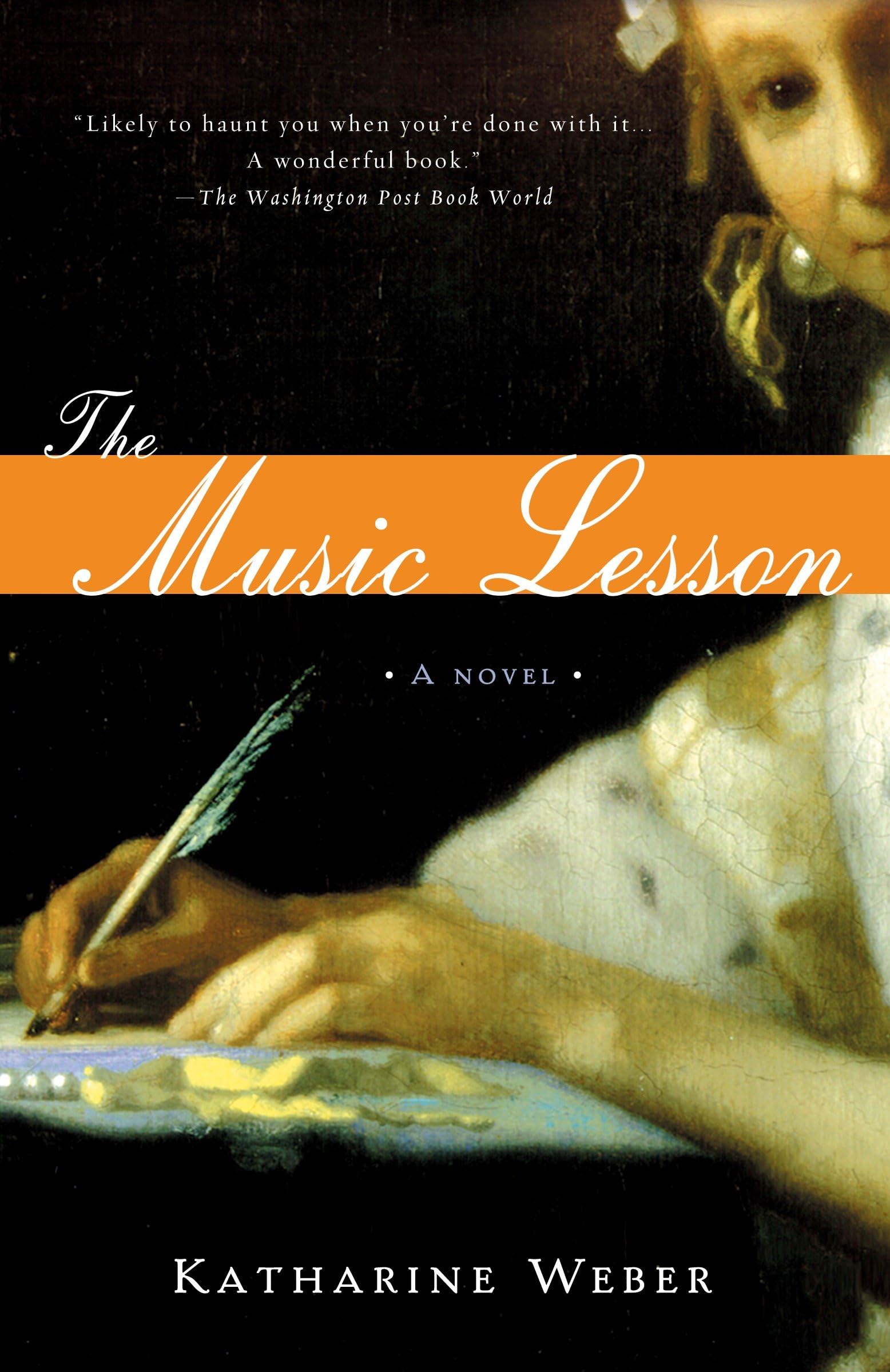



"She's beautiful," writes Irish-American art historian Patricia Dolan in the first of the journal entries that form The Music Lesson. "I look at my face in the mirror and it seems far away, less real than hers." The woman she describes is the subject of the stolen Vermeer of the novel's title. Patricia is alone with this exquisite painting in a remote Irish cottage by the sea. How she arrived in such an unlikely circumstance is one part of the story Patricia tells us: about her father, a policeman who raised her to believe deeply in the cause of a united Ireland; the art history career that has sustained her since the numbing loss of her daughter; and the arrival of Mickey O'Driscoll, her dangerously charming, young Irish cousin, which has led to her involvement in this high-stakes crime. How her sublime vigil becomes a tale of loss, regret, and transformation is the rest of her story. The silent woman in the priceless painting becomes, for Patricia, a tabula rasa, a presence that at different moments seems to judge, to approve, or to offer wisdom. As Patricia immerses herself in the turbulent passions of her Irish heritage and ponders her aesthetic fidelity to the serene and understated pleasures of Dutch art, she discovers, in her silent communion, a growing awareness of all that has been hidden beneath the surface of her own life. And she discovers that she possesses the knowledge of what she must do to preserve the things she values most. KATHARINE WEBER is the author of the novels True Confections , Triangle , The Little Women , and Objects in Mirror Are Closer Than They Appear . She lives in Connecticut, Ireland, and Paris with her husband, the cultural historian Nicholas Fox Weber, and is a thesis advisor in the graduate writing program at Columbia University. Forty-one, Patricia. I can't believe it at all. Look at you. You've been sealed up in some kind of cryogenic storage. In West Cork, the women have no teeth of their own by forty-one, they have chin whiskers, their dugs are down to their waists, they've dried up completely," he said. "When I thought to look up me fancy New York cousin, I never thought I'd be gattlin' after you. I thought you'd remind me of me mam, or me granny, or Sister Margaret from school. She was a terror, that one." These remarks, uttered on our third or fourth night together, might have offended me had they not been murmured by Mickey as he lay sprawled in my bed, idly tracing a line down my bare hip with one intoxicating fingertip. I had been in cold storage, until Mickey. How can I explain what it is about him? How can I describe the attraction in words? It feels so primitive at times that I am almost afraid of it--it, my desire for him, my obsession. Mickey has changed me. Everything has been rearranged. Years ago I saw a television documentary about heart transplants that fascinated me. The donor heart, which has been kept on ice, is warmed up and placed inside the chest where the diseased heart had been moments before. After hours of surgery, the moment of truth comes when the clamps are removed and blood flows into this new heart, which has been chilled and still for several hours. Warmed by the circulating blood, the heart slowly begins to do what a heart is meant to do--it starts to beat again. ********* Now with the deepest evening darkness of late December pressing against the windows, we lay twined together like satiated kittens. I eyed him and put my head back down on the bony indentation below his sternum. "What do you mean, pick one out? One what? A painting?" I listened to the quiet steady thump of his heart. "There's one over there," I said languidly, pointing to the framed poster from the Matisse in Morocco show that hangs on my bedroom wall. "It's very blue that painting. Very Moroccan. Very Matisse." I wasn't really paying attention yet. "What I mean is, on a purely theoretical basis, If I showed you a group of paintings, would you automatically know which one was best?" "Oh Mickey, of course, sure. You bet. The Patricia Dolan prize for excellence is awarded to...this one." I reached up and pressed my fingertips to this philtrum, which is perfectly formed, like that of a Raphael angel. His lips parted a little, and I slid my index finger down and slipped it between them. We were like children, always touching, always playing. He welcomed my finger with a brief touch from the tip of his tongue, just for an instant, but then he pushed my hand and turned his head away, suddenly serious. "Do you think," he asked in a measured voice, very slowly and deliberately, keeping all of his consonants rounded up instead of letting them blur at the edges, "very seriously, Patricia, given your expertise in Dutch paintings of the seventeenth century, that you could pick out the best Vermeer from a group of paintings that are all by Vermeer?" ********* Sometimes I study her for