The Mysteries of Initiation: From Isis to the Holy Grail (CW 144) (Volume 144) (The Collected Works of Rudolf Steiner)
$18.00
by Rudolf Steiner



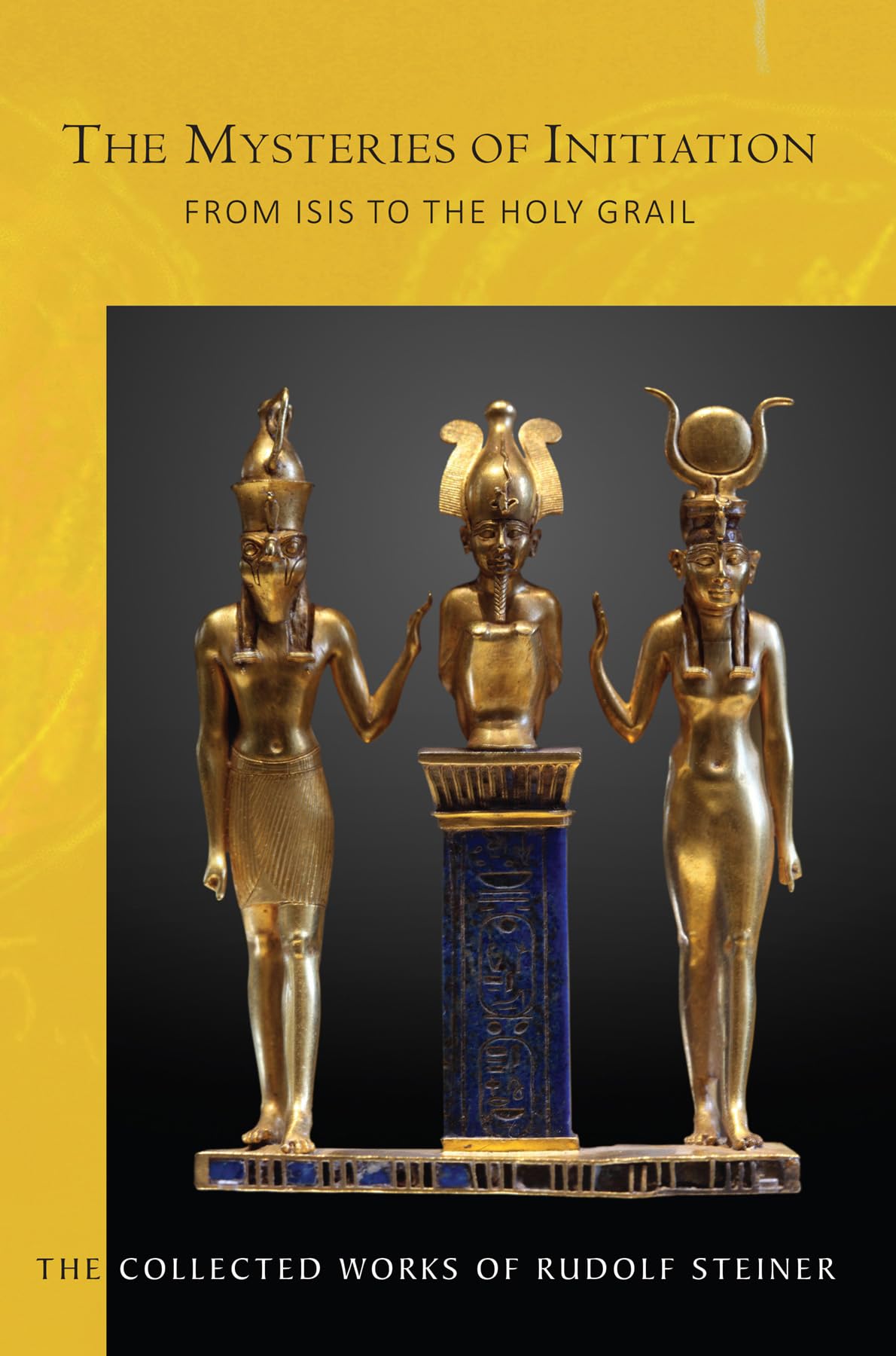
4 lectures, Berlin, February 3–7. 1913 (CW 144) In this concise study, Rudolf Steiner sketches the evolution of the mysteries, from ancient Persia through Egypt and Greece to the present Christian era. He traces the line of initiates from the Egyptian divinities Isis and Osiris to Moses and to King Arthur’s Round Table and the Holy Grail in the twelfth century. Steiner focuses on the process of initiation in historical terms―how initiation worked in ancient Egypt and during the late Middle Ages. However, his inspirational presentation leads to this question: How can we advance to initiation today? He underscores the potential for achieving enlightenment today without an incarnated teacher and explains the four stages of the process toward initiation. He also highlights the need for strenuous efforts to overcome the subtle powers of evil (Lucifer and Ahriman) through selfless effort. These four lectures form an important landmark in Rudolf Steiner’s biography―the first delivered on February 3, 1913, the very day that the Anthroposophical Society was founded. First published in English as The Mysteries of the East and of Christianity and unavailable for many years, this revised edition features appendices, an index, and an introduction by Robert McDermott. The Mysteries of Initiation is a translation from German of Die Mysterien des Morgenlandes und des Christentums (GA 144). A previous edition of this translation was published in 1972 as The Mysteries of the East and of Christianity . Cover image : Osiris on a lapis lazuli pillar in the middle, flanked by Horus on the left and Isis on the right (22nd dynasty, Louvre, Paris). Rudolf Steiner (b. Rudolf Joseph Lorenz Steiner, 1861–1925) was born in the small village of Kraljevec, Austro-Hungarian Empire (now in Croatia), where he grew up. As a young man, he lived in Weimar and Berlin, where he became a well-published scientific, literary, and philosophical scholar, known especially for his work with Goethe’s scientific writings. Steiner termed his spiritual philosophy anthroposophy , meaning “wisdom of the human being.” As an exceptionally developed seer, he based his work on direct knowledge and perception of spiritual dimensions. He initiated a modern, universal “spiritual science” that is accessible to anyone willing to exercise clear and unbiased thinking. From his spiritual investigations, Steiner provided suggestions for the renewal of numerous activities, including education (general and for special needs), agriculture, medicine, economics, architecture, science, philosophy, Christianity, and the arts. There are currently thousands of schools, clinics, farms, and initiatives in other fields that involve practical work based on the principles Steiner developed. His many published works feature his research into the spiritual nature of human beings, the evolution of the world and humanity, and methods for personal development. He wrote some thirty books and delivered more than six thousand lectures throughout much of Europe. In 1924, Steiner founded the General Anthroposophical Society, which today has branches around the world. Robert McDermott , Ph.D., is president emeritus and chair of the Philosophy, Cosmology, and Consciousness Program at the California Institute of Integral Studies (CIIS). His publications include Radhakrishnan (1970); The Essential Aurobindo (1974, 1987); The Essential Steiner (1984); (with Rudolf Steiner) The Bhagavad Gita and the West (2009); and The New Essential Steiner (2009). He has also published on William James, Josiah Royce, M. K. Gandhi, the evolution of consciousness, and American thought. His administrative service includes president of the New York Center for Anthroposophy; president of the Rudolf Steiner [summer] Institute; chair of the board of Sunbridge College (New York) and of Rudolf Steiner College (California). He was a member of the council of the Anthroposophical Society in America (1996–2004). He is the founding chair of the board of the Sophia Project, an anthroposophic home in Oakland, California, for mothers and children at risk of homelessness. He is a Lindisfarne fellow, a Fetzer mentor, and a member of the Esalen Corportion.