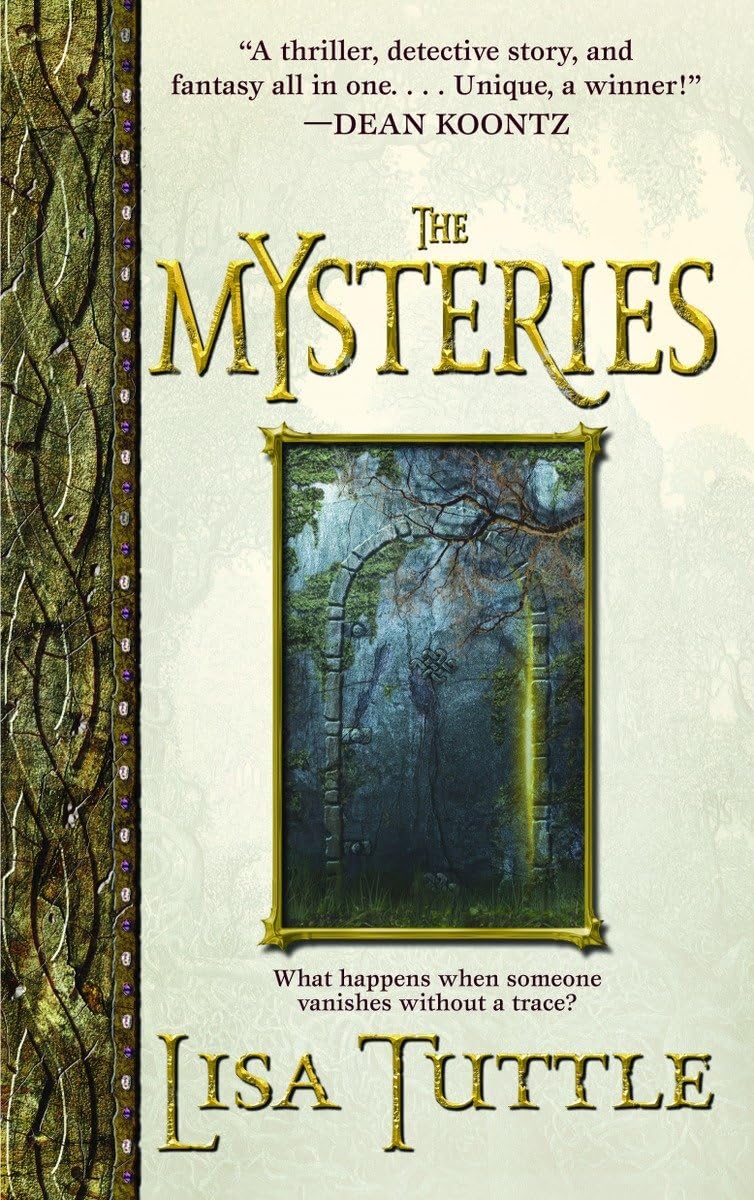



Award-winning author Lisa Tuttle delivers a riveting novel combining one man’s search for a missing woman with history’s most enduring legends of the disappeared. “A thriller, detective story, and fantasy all in one . . . Unique, a winner!”—Dean Koontz What happens when someone vanishes without a trace? Ian Kennedy always had a penchant for stories about missing people—and a knack for finding them. Now a sought-after private investigator, Ian faces a case he fears he cannot solve . . . and one he knows he must. Laura Lensky’s stunning twenty-one-year-old daughter, Peri, has been missing for over two years. But when Ian learns the details of her disappearance, he discovers eerie parallels to an obscure Celtic myth and the haunting case that launched his career—a success he’s never fully been able to explain. Though Ian suspects that Peri chose to vanish, he takes on the search. What follows leads him and those who care for Peri into the Highlands of Scotland, as the unknowns of the past and present merge in the case—and in their lives. Praise for The Mysteries “Lisa Tuttle never disappoints. . . . Richly imagined and beautifully written, The Mysteries lingers in the mind long after the last page is turned.” —George R. R. Martin “A remarkable piece of work . . . Successfully balancing the miraculous and the mundane, The Mysteries offers a variety of unexpected pleasures and marks the overdue return of a stylish, distinctive storyteller.” — Washington Post Book World “Superlative dark fantasy . . . Tuttle has total command of setting, style and her folklore sources.”— Publishers Weekly (starred review) "Superlative dark fantasy.... Tuttle has total command of setting, style and her folklore sources."— Publishers Weekly , starred review. Lisa Tuttle was born and raised in Houston, Texas, won the John W. Campbell Award for Best New Writer in 1974, and now lives with her husband and daughter on the west coast of Scotland. Her first novel, Windhaven, was written with George R. R. Martin. Other novels include Lost Futures, which was short-listed for the Arthur C. Clarke Award, The Pillow Friend , and The Mysteries . Chapter One Joe The strangest memory of my childhood concerns my father's disappearance. This is what I remember: It was late September. I was nine years old, and my sister Heather was seven and a half. Although summer was officially over and we'd been back at school for weeks, the weather continued warm and sunny, fall only the faintest suggestion in the turning of the leaves, and nothing to hint at the long Midwestern winter yet to come. Everybody knew this fine spell couldn't last, and so on Saturday morning my mother announced we were going to go for a picnic in the country. My dad drove, as usual. As we left Milwaukee, the globe compass fixed to the dashboard--to me, an object of lasting fascination--said we were heading north-northwest. I don't know how far we went. In those days, car journeys were always tedious and way too long. But this time, we stopped too soon. Dad pulled over to the side of a country road in the middle of nowhere. There was nothing but empty fields all around. I could see a farmhouse in the distance and some cows grazing in the next field over, but nothing else: no park, no woods, no beach, not even a picnic table. "Are we here?" asked Heather, her voice a whine of disbelief. "No, no, not yet," said our mom, at the same moment as our dad said, "I have to see a man about a horse." "You mean dog ," Heather said. She giggled. "See a man about a dog, not a horse, silly." "This time, it might just be a horse," he said, giving her a wink as he got out of the car. "You kids stay where you are," Mom said sharply. "He won't be long." My hand was already on the door handle, pressing down. "I have to go, too." She sighed. "Oh, all right. Not you, Heather. Stay." "Where's the bathroom?" Heather asked. I was already out of the car and the door closed before I could hear her reply. My father was only a few feet ahead of me, making his way slowly toward the field. He was in no hurry. He even paused and bent down to pick a flower. A car was coming along the road from the other direction: I saw it glinting in the sun, though it was still far away. The land was surprisingly flat and open around here; a strange place to pick for a comfort stop, without even a tree to hide behind, and if my dad was really so desperate, that wasn't obvious from his leisurely pace. I trailed along behind, making no effort to catch up, eyes fixed on his familiar figure as he proceeded to walk into the field. And then, all at once, he wasn't there. I blinked and stared, then broke into a run toward the place where I'd last seen him. The only thing I could think of was that he'd fallen, or maybe even thrown himself, into some hidden ditch or hole. But there was no sign of him, or of any possible hiding place when I reached the spot where he'd vanished. The groun