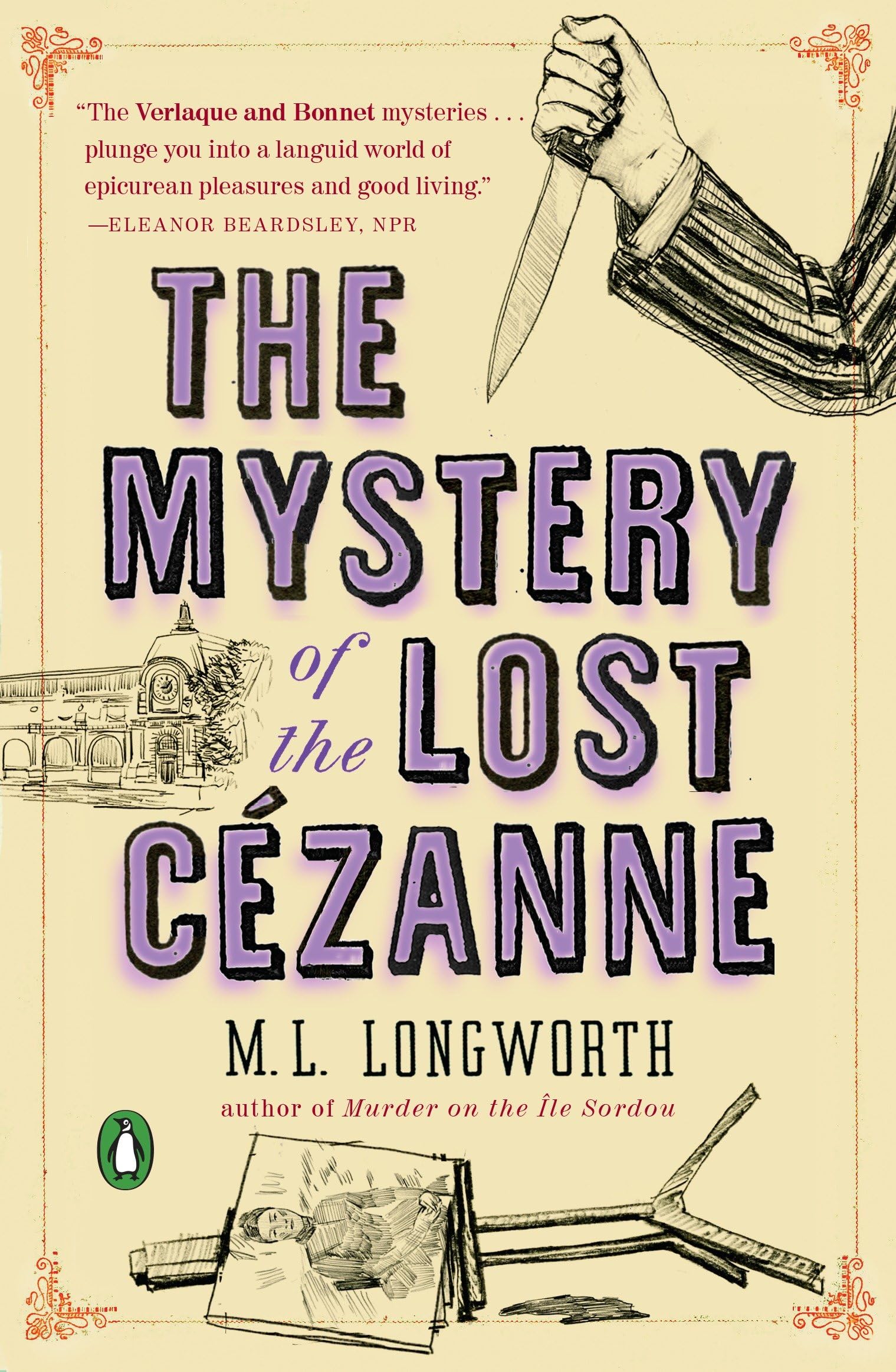



A beguiling mystery that finds Verlaque and Bonnet searching for a murderer —in a crime tied to Provence ’ s greatest artist Provençal Mystery Series #5 Watch the series! Murder in Provence is now on Britbox. A friend in his cigar club asks Antoine Verlaque to visit René Rouquet, a retired postal worker who has found a rolled-up canvas in his apartment. As the apartment once belonged to Paul Cézanne, Rouquet is convinced he’s discovered a treasure. But when Antoine arrives at the apartment, he finds René dead, the canvas missing, and a mysterious art history professor standing over the body. When the painting is finally recovered, the mystery only deepens. The brushwork and color all point to Cézanne. But who is the smiling woman in the painting? She is definitely not the dour Madame Cézanne. Who killed René? Who stole the painting? And what will they do to get it back? Like Donna Leon and Andrea Camilleri, M. L. Longworth’s enchanting mysteries blend clever whodunits with gustatory delights and the timeless romance of Provence. The Mystery of the Lost Cézanne adds a new twist by immersing Antoine and Marine in a clever double narrative that costars Provence’s greatest artist. “Art theft is a hot topic on the mystery scene, and no one’s heist is livelier than Longworth’s.” — Kirkus Reviews Praise for M. L. Longworth’s Provençal Mystery series “The Verlaque and Bonnet mysteries . . . plunge you into a languid world of epicurean pleasures and good living.” —Eleanor Beardsley, NPR “Beguiling . . . Longworth evokes the pleasures of France in delicious detail—great wine, delicious meals, and fine company.” — Publishers Weekly Praise for The Mystery of the Lost Cezanne “Art theft is a hot topic on the mystery scene, and no one’s heist is livelier than Longworth’s.” — Kirkus Reviews “A sure thing for fans of art-themed mysteries.” — Booklist “Enchanting . . . the charming local citizens of Aix-en-Provence provide the true delights in this colorful story.” — Library Journal Praise for Murder on the Île Sordou “Charming.” —Marilyn Stasio, The New York Times Book Review “Thoroughly delightful . . . Longworth deftly handles what is in effect a locked-room mystery, but the book’s real strength lies in the backstories she creates for each of the distinctive characters. The puzzle’s answer, buried in the past, is well prepared by what has come before.” — Publishers Weekly (starred review) “Longworth once again immerses readers in French culture with this whodunit, which will delight Francophiles and fans of Donna Leon and Andrea Camilleri. The setting will also appeal to readers who enjoy trapped-on-the-island mysteries in the tradition of Agatha Christie’s And Then There Were None .” — Library Journal “Longworth’s novels, set in the south of France, are mysteries for foodies, with the plot providing a table upon which the enchanting meals and accompanying wines are served.” — Booklist “[A] charming read with a well-crafted mystery and characters as rich and full-bodied as a Bordeaux.” — Milwaukee Journal Sentinel “A splendid read.” — Mystery Scene “The best thing about each novel in this series is that they are as much about lifestyle in the south of France as they are about a legal tangle, a disappearance or a murder. . . . By this third [novel] in the series, Longworth, shows the reader why those who love Donna Leon’s Brunetti and Martin Walker’s Bruno take up her novels with enthusiasm.” — Kings River Life Magazine “Longworth’s maritime version of a country-house cozy offers genuine pleasures.” — Kirkus Reviews M. L. Longworth has lived in Aix-en-Provence since 1997. She has written about the region for the Washington Post , the Times (London), the Independent (London), and Bon Appétit . She is the author of a bilingual collection of essays, Une Américaine en Provence . She is married and has one daughter. Author’s Note Paul Cézanne did have an affair “with a mysterious Aixoise” in 1885, a curiosity I first read in a New Yorker article, later confirmed when rereading Paul Cézanne: Letters, edited by John Rewald in 1976. Cézanne’s good friends Émile Zola and Philippe Solari did, of course, exist, but all the others have been invented by the author. Chapter One La Fête des Rois January was his favorite month. He loved Provençal winters; they were cold and dry, often with bright-blue skies. The ancient plane trees—so essential in summer to block the sun—now, without their fat leaves, looked like tall knobby sculptures. But their winter bareness revealed the Cours Mirabeau’s soft golden architecture: mansions of the seventeenth century, now banks, law offices, cafés, and the twenty-first-century addition of American chain stores. But most of all, January meant that the commercialism and strain of Christmas was over, and the routine of work, cigar club, and being with Marine could begin anew. This year he would be a better boss, a better friend, a bet