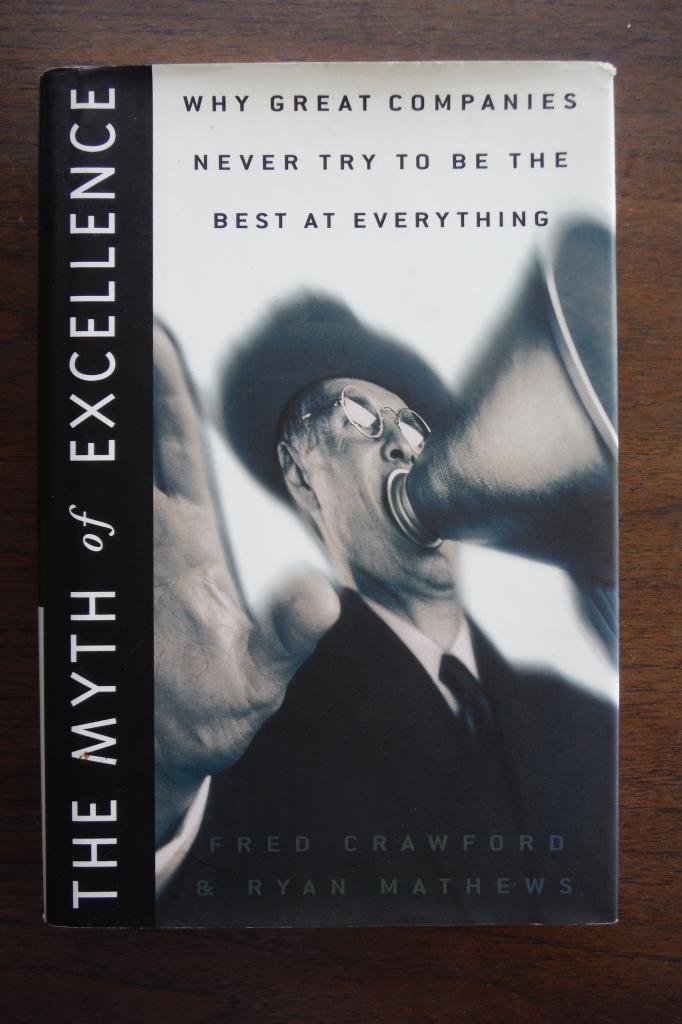
The Myth of Excellence: Why Great Companies Never Try to Be the Best at Everything
$10.99
by Fred Crawford



The Undiscovered Consumer . . .and the Mistake of Universal Excellence What do customers really want? And how can companies best serve them? Fred Crawford and Ryan Mathews set off on what they describe as an "expedition into the commercial wilderness" to find the answers. What they discovered was a new consumer -- one whom very few companies understand, much less manufacture products for or sell products or services to. These consumers are desperately searching for values, a scarce resource in our rapidly changing and challenging world. And increasingly they are turning to business to reaffirm these values. As one consumer put it: "I can find value everywhere but can't find values anywhere." Crawford and Mathews's initial inquiries eventually grew into a major research study involving more than 10,000 consumers, interviews with executives from scores of leading companies around the world, and dozens of international client engagements. Their conclusion: Most companies priding themselves on how well they "know" their customers aren't really listening to them at all. Consumers are fed up with all the fuss about "world-class performance" and "excellence." What they are aggressively demanding is recognition, respect, trust, fairness, and honesty. Believing that they are still in a position to dictate the terms of commercial engagement, businesses have bought into the myth of excellence -- the clearly false and destructive theory that a company ought to be great at everything it does, that is, all the components of every commercial transaction: price, product, access, experience, and service. This is always a mistake because "the predictable outcome [is] that the company ends up world-class at nothing; not well-differentiated and therefore not thought of by consumers at the moment of need." Instead, Crawford and Mathews suggest that companies engage in Consumer Relevancy, a strategy of dominating in one element of a transaction, differentiating on a second, and being at industry par (i.e., average) on the remaining three. It's not necessary for businesses to equally invest time and money on all five attributes, and their customers don't want them to. Imagine the confusion if Tiffany & Co. started offering deep discounts on diamonds and McDonald's began selling free-range chicken and tofu. The Myth of Excellence provides a blueprint for companies seeking to offer values-based products and services and shows how to realize the commercial opportunities that exist just beyond their current grasp -- opportunities to reduce operating costs, boost bottom-line profitability, and, most important, begin to engage in a meaningful dialogue with customers. Crawford and Mathews, marketing consultants with Cap Gemini Ernst & Young (CGEY) and FirstMatter, respectively, break down marketing into five attributes: access, experience, price, product, and service. They argue that successful businesses are those that excel in one of these areas, are good in another, and are at least average in the rest. Wal-Mart, they say, is dominant on price and maintains a good selection of products, while Target excels at product selection and makes price its secondary attribute. The authors conclude that it is both uneconomical and probably impossible to be excellent in all areas. After describing the importance of the five key attributes, the authors explain how a company might evaluate itself to see how well it is doing. The authors' clear writing style and copious use of examples and case studies make their ideas understandable to a wide readership. The book is essential for all academic marketing collections, and it would also be useful in all but the smallest public libraries. Lawrence R. Maxted, Gannon Univ., Erie, PA Copyright 2001 Reed Business Information, Inc. Crawford is the managing director of the consumer products, retail, and distribution practice at the Cap Gemini Ernst & Young consultancy. Mathews is a futurist specializing in demographics and lifestyle analysis at FirstMatter, another consulting firm. To research purchasing behavior, they surveyed 5,000 consumers, but the responses they got surprised them and prompted their title's contrary proposition. Crawford and Mathews found that values (respect, honesty, trust, dignity) were more important to consumers than value . This discovery led the pair to develop a new model of "consumer relevancy." They explain in detail the importance of price, service, quality, access, and experience for the consumer. They then suggest that for companies to be successful they need to dominate on only one of these five factors. On a second of the five they should stand out or differentiate themselves from their competitors; and on the remaining three they need only to be at par with others in their industry. With dozens of examples, Crawford and Mathews demonstrate the validity of their premise. David Rouse Copyright © American Library Association. All rights reserved The Undiscover