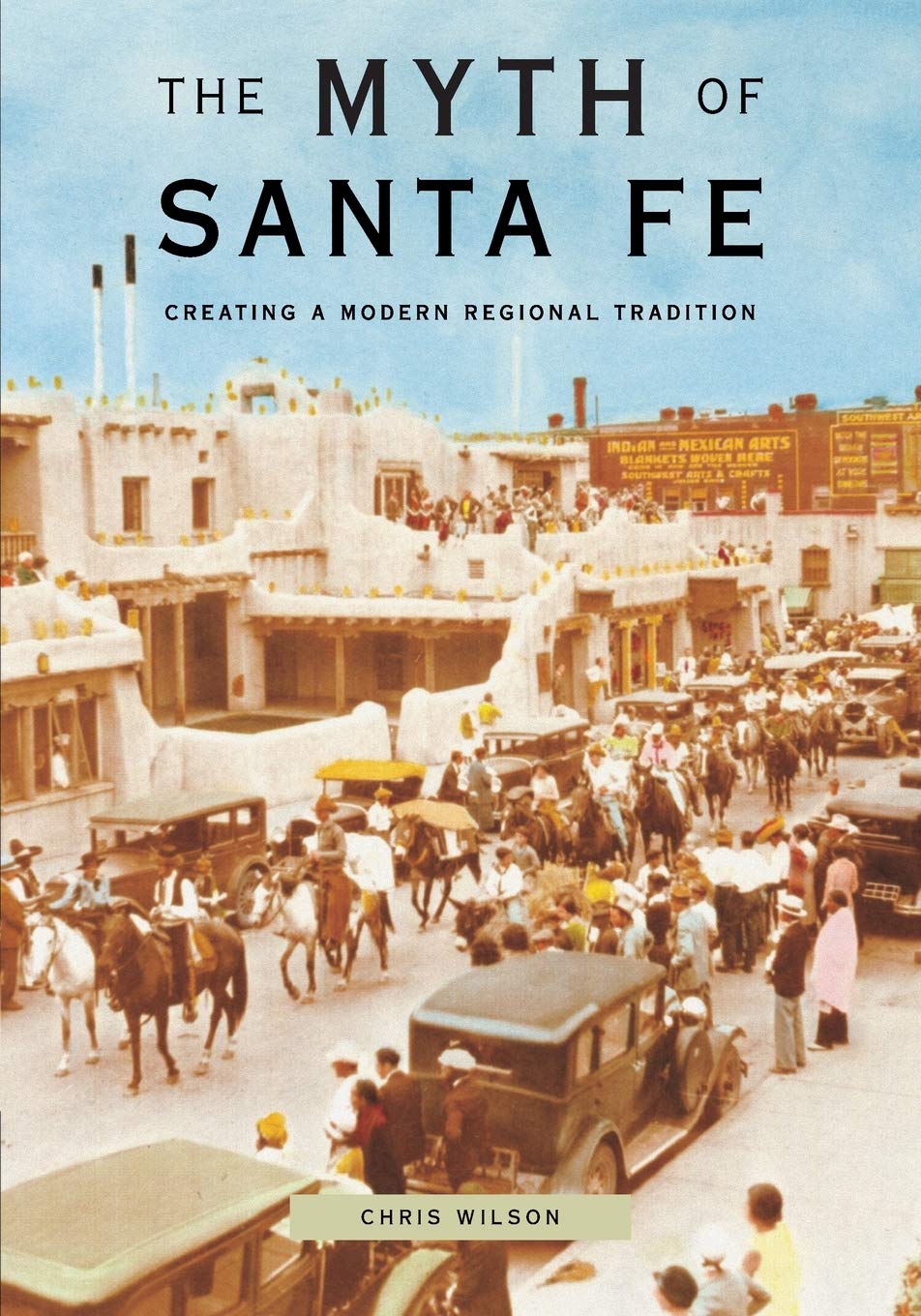



A wave of publicity during the 1980s projected Santa Fe to the world as an exotic tourist destination--America's own Tahiti in the desert. The Myth of Santa Fe goes behind the romantic adobe facades and mass marketing stereotypes to tell the fascinating but little known story of how the city's alluring image was quite consciously created early in this century, primarily by Anglo-American newcomers. By investigating the city's trademark architectural style, public ceremonies, the historic preservation movement, and cultural traditions, Wilson unravels the complex interactions of ethnic identity and tourist image-making. Santa Fe's is a distinctly modern success story--the story of a community that transformed itself from a declining provincial capital of 5,000 in 1912 into an internationally recognized tourist destination. But it is also a cautionary tale about the commodification of Native American and Hispanic cultures, and the social displacement and ethnic animosities that can accompany a tourist boom. Using architecture as a touchstone, Wilson (architecture, Univ. of New Mexico) outlines the architectural, historical, and cultural story of Santa Fe. He delivers a brilliant portrait of a complex and rich cultural heritage, tracing it from its Pueblo and Spanish roots, through its brief but influential Mexican period, to contributions from what he terms the American melting pot. The intricate relations between the ethnic groups that call Santa Fe home are explored in detail and with sympathy for all concerned. Wilson also offers a fascinating nutshell account of the historic preservation movement in America and how it influences the current view of Santa Fe. Through a discussion of the history of Santa Fe's annual Fiesta celebration, he shows how civic boosters have crafted a public image that bears little resemblance to historic reality. Highly recommended for most libraries and particularly architecture and regional history collections.?Martin R. Kalfatovic, Smithsonian Inst. Lib., Washington, D.C. Copyright 1997 Reed Business Information, Inc. "["The Myth of Santa Fe"], in short, is must reading for anyone interested in Santa Fe and New Mexico." "[Wilson] delivers a brilliant portrait of a complex and rich cultuural heritage. . . Highly recommended for most libraries." "I'd have to say really isn't another book like ["The Myth of Santa Fe"]. . . it's essential reading. . . This is a book I will reread many times over the years. It is not only a basic reference, it is also a wise and humane work." "I'd have to say really isn't another book like Ý"The Myth of Santa Fe"¨. . . it's essential reading. . . This is a book I will reread many times over the years. It is not only a basic reference, it is also a wise and humane work." ""The Myth of Santa Fe" is a truly superb book. It deserves a wide and serious reading." "Ý"The Myth of Santa Fe"¨, in short, is must reading for anyone interested in Santa Fe and New Mexico." "ÝWilson¨ delivers a brilliant portrait of a complex and rich cultuural heritage. . . Highly recommended for most libraries." "["The Myth of Santa Fe], in short, is must reading for anyone interested in Santa Fe and New Mexico." A wave of publicity during the 1980's projected Santa Fe to the world as an exotic tourist destination- America's own Tahiti in the desert. The Myth of Santa Fe goes behind the romantic adobe facades and mass marketing stereotypes to tell the fascinating but little known story of how the city's alluring image was quite consciously created early in the century, primarily by Anglo-American newcomers. Chris Wilson lives in Albuquerque, where he is the J. B. Jackson Chair of Cultural Landscape Studies at the University of New Mexico. Used Book in Good Condition