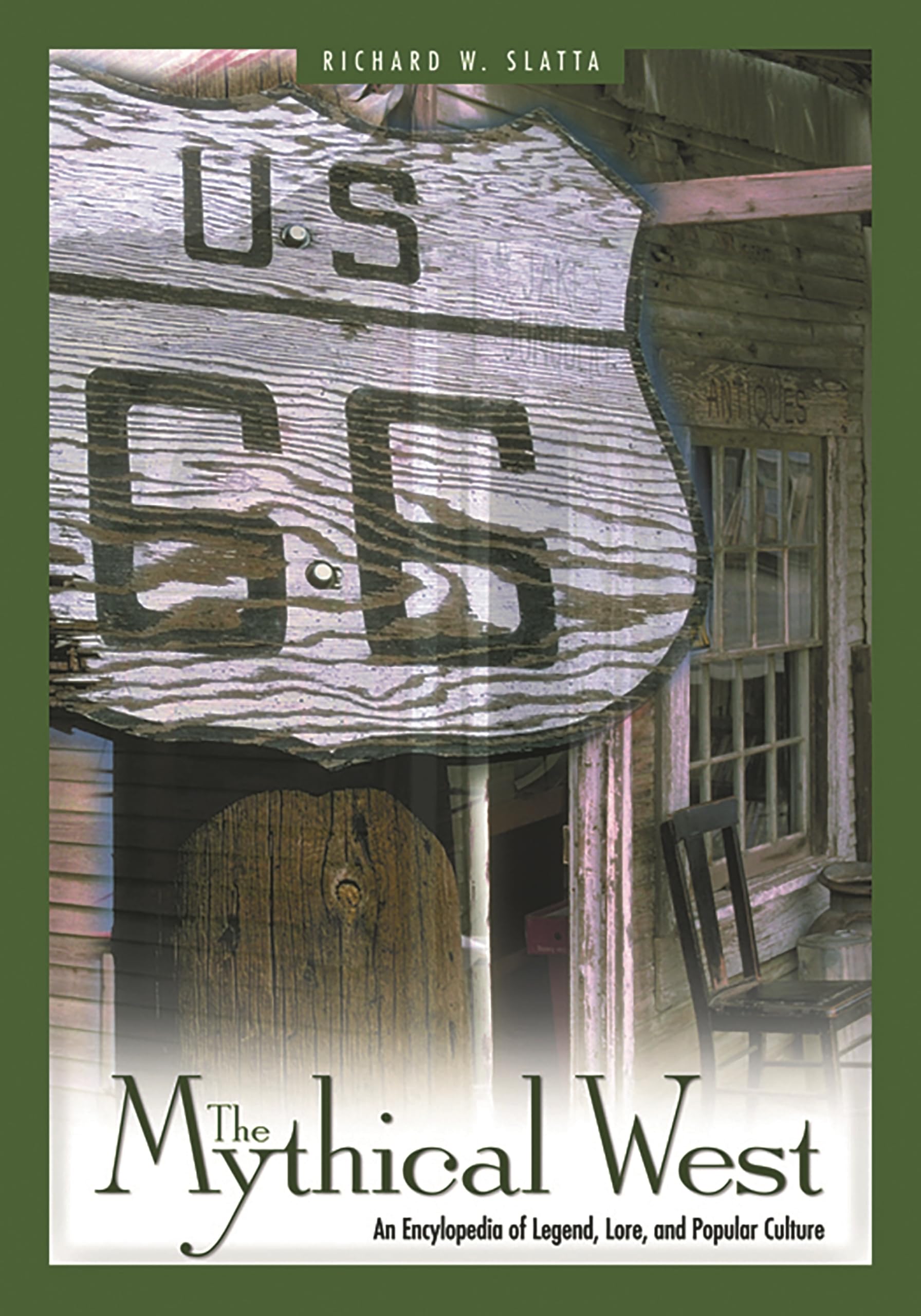
The Mythical West: An Encyclopedia of Legend, Lore, and Popular Culture
$100.00
by Richard W. Slatta



This cultural journey down memory lane showcases how major Western figures, events, and places have been portrayed in folk legends, art, literature, and popular culture. Ever since the days of the 49ers and George Armstrong Custer, the Old West has been America's most potent source of legend. But it is sometimes hard to separate fact from fiction. Did you know, for example, that Annie Oakley was a talented marksman who shot an estimated 40,000 rounds per year while practicing and performing for Buffalo Bill Cody's Wild West Show in the late l800s? Or that many interpreters believe that The Wonderful Wizard of Oz is not just a fairy tale, but also a Populist allegory? These are just two of the folk legends dissected and examined in this veritable cultural geography. The volume covers everything from billionaire Howard Hughes and composer Aaron Copeland to Aztlan (the legendary first city of the Aztecs) and Area 51, the top-secret U.S. Air Force base at Groom Lake, Nevada, that has fascinated UFO and conspiracy buffs. The history and legends of the West are of endless interest to scholars and lay readers alike. This encyclopedia, edited by Slatta (history, North Carolina State Univ.), focuses primarily on the legends the West of fiction, movies, songs, and popular imagination. This is a worthy area of exploration, but the reliability of many of the articles here is questionable. For example, Zane Grey, whose work is widely recognized as commercially successful but of dubious literary value, is portrayed as quite the stylist, and the failure to touch on the blatant racism of his books is also disappointing. The entry on Owen Wister, on the other hand, seems unfairly harsh. There are some entries of interest, such as a long essay on toys, but, in another typical flaw of the book, that entry is listed only under "Action Figures," with no cross reference from "Toys." Finally, the text is both amateurishly written and poorly organized. Recommended only as an optional purchase for libraries that already have The New Encyclopedia of the American West (LJ 9/1/98), a far superior book. Charles V. Cowling, Drake Memorial Lib., Brockport, NY Copyright 2002 Cahners Business Information, Inc. Slatta (a professor of history at North Carolina State University) and his contributors have combed histories, documents, films, and the Internet for legendary images, events, people, and places associated with the American West. The goal is "to identify, describe, and analyze many myths of the Old West and the New so that readers can distinguish them from historical fact." Topics treated include Alamo, Barbecue, Billy the Kid, Cowboy poetry, Ghost towns, Hispanics in Western lore, Lewis and Clark expedition, Television , and Route 66 . Articles range from short paragraphs to several pages. Most list sources, including Web sites, for further reference, with more comprehensive listings following the A-Z entries. The writing style is generally breezy. Slatta notes in his preface that, besides considering whether a subject was mythical or mythologized, he based his selection of topics on how many Internet sites covered them. He also chose not to duplicate coverage available in other ABC-CLIO titles. This may explain why there is no entry for Larry McMurtry, although the article on his son, singer-songwriter James McMurtry, takes up more than two pages. Only Louis L'Amour and Elmer Kelton among contemporary Western writers have their own articles. There are some other surprising omissions. Wild Bill Hickock has no main entry but is discussed in the entry Dead Man's Hand . There are no entries for the Colt .45 or the Winchester. This volume would be an interesting but not essential purchase for academic and large public libraries with western, folklore, or media collections. The emphasis on mythical aspects makes it a complement to The New Encyclopedia of the American West (Yale, 1998), with which it shares some topics. RBB Copyright © American Library Association. All rights reserved “[T]he volume is well organized for easy access to the topics and information selected for inclusion . . . This volume is recommended for high school, academic, and public libraries primarily as enrichment material for reference collections. In addition, those in the field of communications will find it useful in analyzing the symbolic Western references in such presentations as political speeches and corporate advertisements.” ― American Reference Books Annual Richard W. Slatta is professor of history at North Carolina State University, Raleigh, NC. Used Book in Good Condition