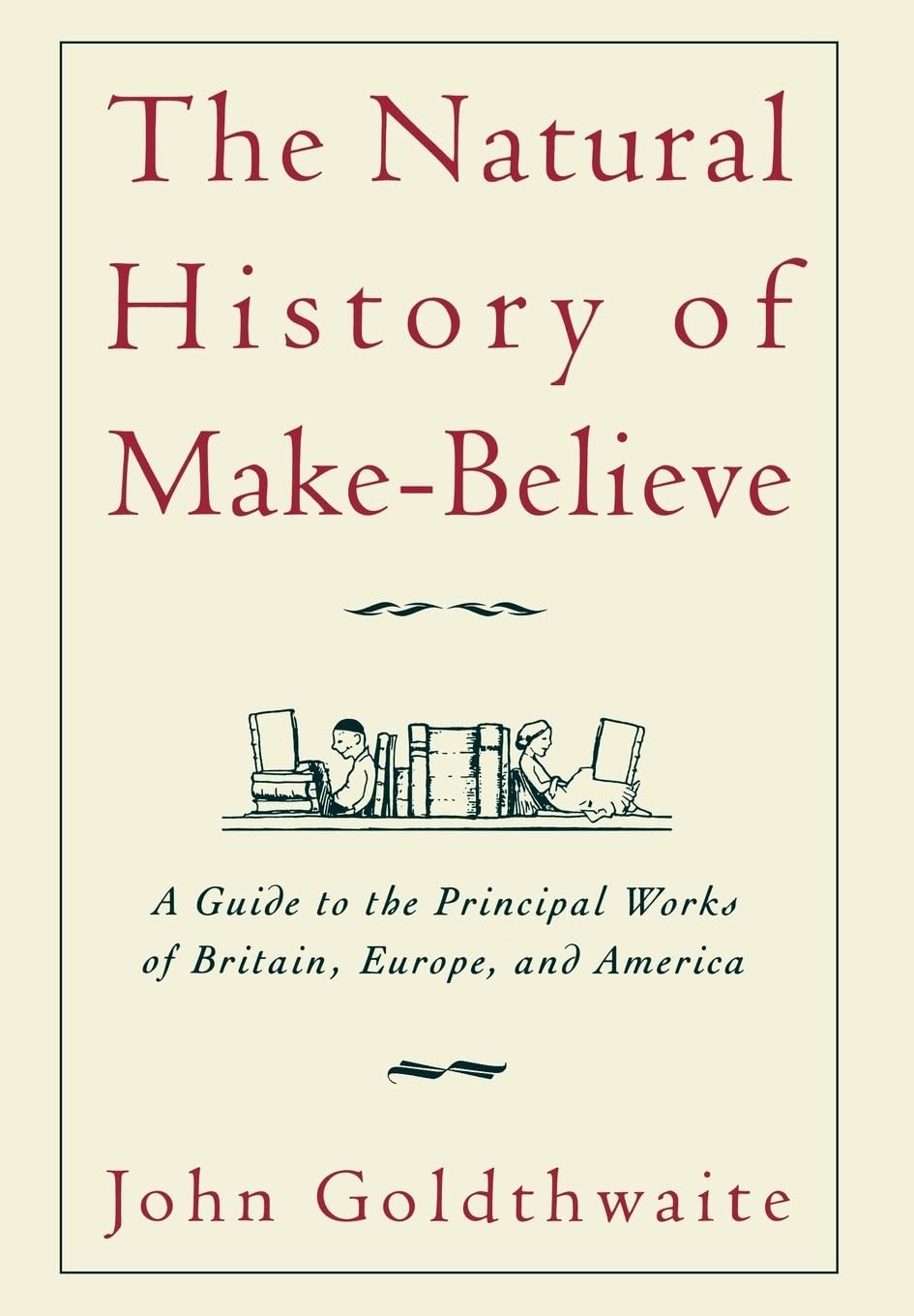
The Natural History of Make-Believe: A Guide to the Principal Works of Britain, Europe, and America
$36.00
by John Goldthwaite



The Man in the Moon has dropped down to earth for a visit. Over the hedge, a rabbit in trousers is having a pipe with his evening paper. Elsewhere, Alice is passing through a looking glass, Dorothy riding a tornado to Oz, and Jack climbing a beanstalk to heaven. To enter the world of children's literature is to journey to a realm where the miraculous and the mundane exist side by side, a world that is at once recognizable and real--and enchanted. Many books have probed the myths and meanings of children's stories, but Goldthwaite's Natural History is the first exclusively to survey the magic that lies at the heart of the literature. From the dish that ran away with the spoon to the antics of Brer Rabbit and Dr. Seuss's Cat in the Hat, Goldthwaite celebrates the craft, the invention, and the inspired silliness that fix these tales in our minds from childhood and leave us in a state of wondering to know how these things can be. Covering the three centuries from the fairy tales of Charles Perrault to Maurice Sendak's Where the Wild Things Are , he gathers together all the major imaginative works of America, Britain, and Europe to show how the nursery rhyme, the fairy tale, and the beast fable have evolved into modern nonsense verse and fantasy. Throughout, he sheds important new light on such stock characters as the fool and the fairy godmother and on the sources of authors as diverse as Carlo Collodi, Lewis Carroll, and Beatrix Potter. His bold claims will inspire some readers and outrage others. He hails Pinocchio , for example, as the greatest of all children's books, but he views C.S. Lewis's The Chronicles of Narnia as a parable that is not only murderously misogynistic, but deeply blasphemous as well. Fresh, incisive, and utterly original, this rich literary history will be required reading for anyone who cares about children's books and their enduring influence on how we come to see the world. Covering three centuries of children's literature, from the fairy tales of Charles Perrault to Maurice Sendak's Where the Wild Things Are , Goldthwaite, a sometime essayist for Harper's and the New York Times , delves into the world of imagination and delivers an opinionated, sometimes dense, but nevertheless thought-provoking work. While shedding new light on the sources of Carlo Collodi, Lewis Carroll, and Beatrix Potter, he suggests how the nursery rhyme, beast fable, and fairy tale have evolved into modern fantasy. Students of children's literature and anyone interested in the world of make-believe will find this stimulating. But when Goldthwaite argues that Pinocchio "stands alone in the literature of its time," some may take up the gauntlet and disagree; however, the author would probably welcome the battle. Barbara Elleman "Not for years has there been such an exhilarating, cranky, passionate, and ambitiously erudite new work of scholarship about children's literature.... John Goldthwaite has paid children's stories the honor of taking them seriously as literature and subjecting them to the tough, informed, and historical scrutiny they deserve. His theories may provoke fierce debate, but they are grounded in deeply humane, intelligently argued and honorable conviction."--The Washington Post Book World"Thought-provoking work. While shedding new light on the sources of Carlo Collodi, Lewis Carroll, and Beatrix Potter, [Goldthwaite] suggests how the nursery rhyme, beast fable, and fairy tale have evolved into modern fantasy. Students of children's literature and anyone interested in the world of make-believe will find this stimulating."--Booklist"In his work John Goldthwaite combines a writer's intention (how to make this story whole) and a scholar's curiosity (how and where do these bits fit) with a reader's love of what reading is good for. The Natural History is passionate, authoritative, unsettling, witty, and, in the words of a Signal reporter, 'hugely mature.'"--Nancy Chambers, Editor, Signal An eye-opening, often idiosyncratic look at the evolution of make-believe John Goldthwaite is a noted children's book author whose essays and reviews have appeared in Signal , Harper's , The New York Times , and New York Magazine .