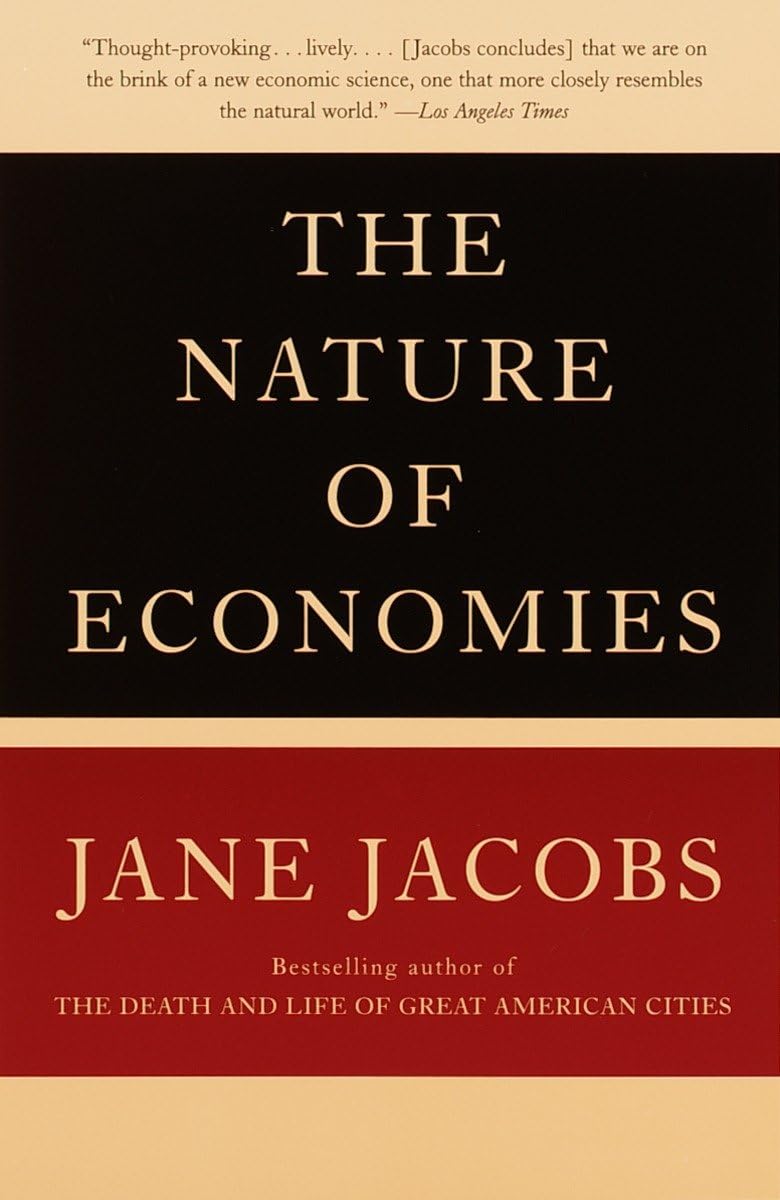



From the revered author of the classic The Death and Life of Great American Cities comes a new book that will revolutionize the way we think about the economy. Starting from the premise that human beings "exist wholly within nature as part of natural order in every respect," Jane Jacobs has focused her singular eye on the natural world in order to discover the fundamental models for a vibrant economy. The lessons she discloses come from fields as diverse as ecology, evolution, and cell biology. Written in the form of a Platonic dialogue among five fictional characters, The Nature of Economies is as astonishingly accessible and clear as it is irrepressibly brilliant and wise–a groundbreaking yet humane study destined to become another world-altering classic. "Provocative...engaging.... [Jacobs] is the archetypal iconoclast."- The Boston Book Review From the revered author of the classic The Death and Life of Great American Cities comes a new book that will revolutionize the way we think about the economy. Starting from the premise that human beings "exist wholly within nature as part of natural order in every respect," Jane Jacobs has focused her singular eye on the natural world in order to discover the fundamental models for a vibrant economy. The lessons she discloses come from fields as diverse as ecology, evolution, and cell biology. Written in the form of a Platonic dialogue among five fictional characters, The Nature of Economies is as astonishingly accessible and clear as it is irrepressibly brilliant and wise?a groundbreaking yet humane study destined to become another world-altering classic. From the revered author of the classic The Death and Life of Great American Cities comes a new book that will revolutionize the way we think about the economy. Starting from the premise that human beings "exist wholly within nature as part of natural order in every respect," Jane Jacobs has focused her singular eye on the natural world in order to discover the fundamental models for a vibrant economy. The lessons she discloses come from fields as diverse as ecology, evolution, and cell biology. Written in the form of a Platonic dialogue among five fictional characters, "The Nature of Economies is as astonishingly accessible and clear as it is irrepressibly brilliant and wise-a groundbreaking yet humane study destined to become another world-altering classic. Jane Jacobs was the legendary author of The Death and Life of Great American Cities , a work that has never gone out of print and that has transformed the disciplines of urban planning and city architecture. Her other major works include The Economy of Cities , Systems of Survival , The Nature of Economies and Dark Age Ahead . She died in 2006. From Chapter One: Damn, Another Ecologist "Hortense and Ben have broken up," said Armbruster, waving a fax at Kate as she slid into the booth, balancing her cup of coffee. "I'm sorry but not surprised," said Kate. "Remember how Ben used to gloat over industrial disasters? He thought everything industrial or technological was unnatural and that everything unnatural was bad." "He meant well," Armbruster said. "We need Jeremiahs, but it must have been depressing for Hortense to live with one. It seems the breakup happened some time ago and she's gotten over it. She's interested in a new man. Mind if I finish this fax? I only got it as I was leaving the house." In late morning they were sitting in an almost-empty coffee shop on lower Fifth Avenue, not far from Armbruster's Gramercy Square apartment. It was an unappealing restaurant in a stretch of New York rapidly going upscale. Armbruster liked it as his morning hangout because its well-deserved unpopularity guaranteed seats for acquaintances dropping by. He lived alone, and since his retirement from a small book publishing company, he missed his work and its daily give-and-take with colleagues. "Damn, Hortense has found another ecologist," Armbruster grumbled as he continued reading the fax. "That's not surprising, either," said Kate. "She's an environmental lawyer, so those are the people she talks to, consorts with. Those and other lawyers." "But listen to this: His name is Hiram Murray IV. The Fourth! What an affectation." "He's not to blame if his family ran out of names." "You drop off the numbers when they die. I dropped off my Junior when my father died. Only kings and popes hang on to numbers." "Maybe the other three are still alive—you don't know." "Let's see," Armbruster mused aloud. "Number two would be his grandfather, and number one—" His eyes widened, exaggerating his customary owlish expression. "Good heavens, Hortense is fifty. You don't suppose—" "No, I don't think Hortense is running around with a kid. Read on." "Well, well, she's planning to come back from California," Armbruster read on. "He has a house in Hoboken. What's an ecologist doing in Hoboken? She says I'll like him and she's bringing him over a week fro