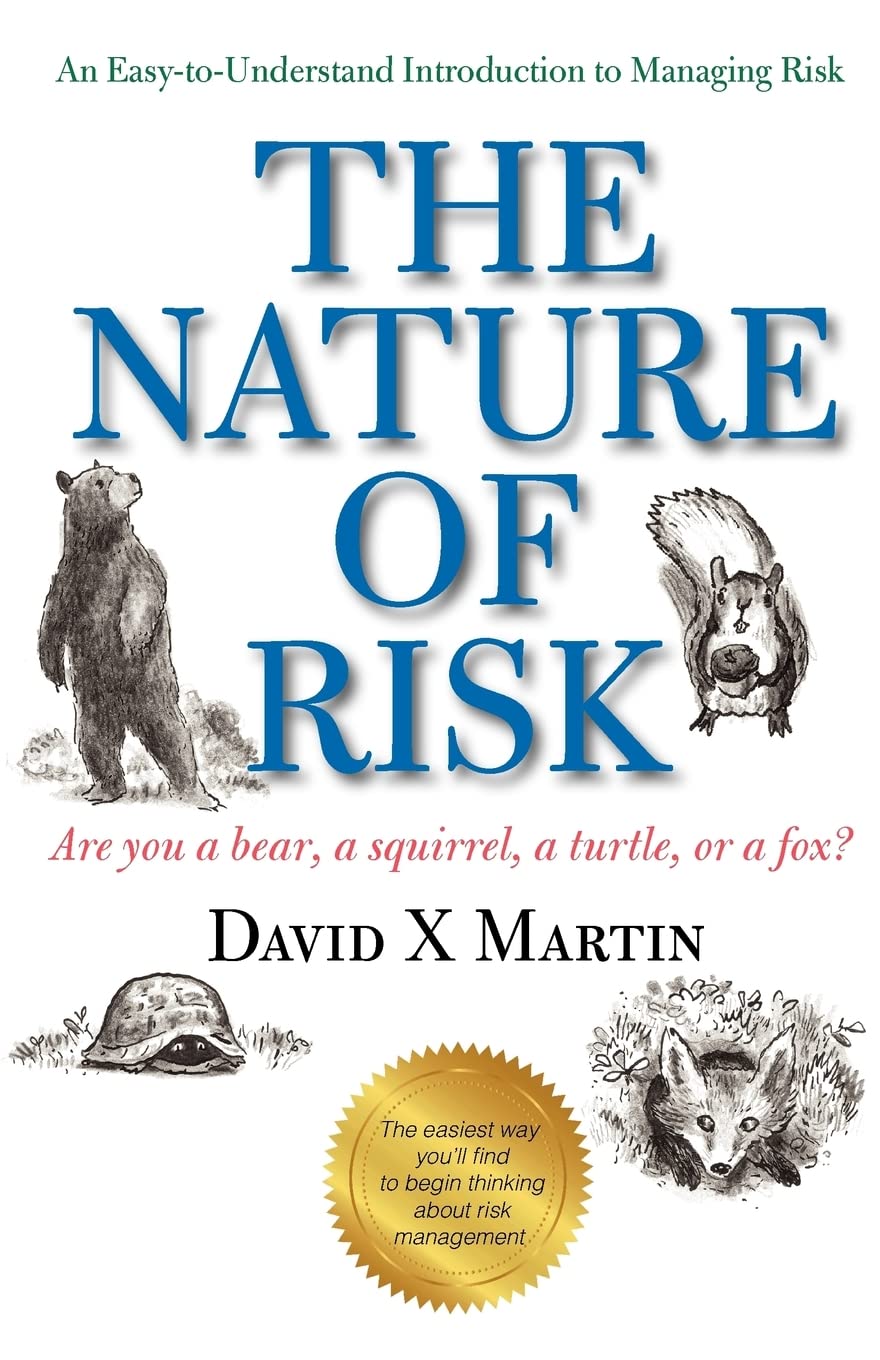



The Nature of Risk is a short, beautifully illustrated and easy-to-understand book written to help readers face one of modern life’s most important and difficult tasks—confronting risk. Free of complicated theories or formulas, The Nature of Risk relies instead on a simple story featuring a cast of familiar, forest-dwelling animals, each of which embodies a different approach to risk management. At least one of these approaches will seem familiar to every reader—whether they knew they had an approach to risk management or not. Then, as the story unfolds, the strengths and weaknesses of each approach will be revealed through a series of "natural" tests. Finally, at the conclusion of the story, readers will come to a short review section designed to help them frame their first attempts at managing risk—with or without professional help. Garrison Keillor once remarked that cats are intended to teach us that not everything in nature has a function, but David X. Martin rounded up a menagerie of forest animals to ferret out the risk function. Described as an easy-to-understand introduction to managing risk, the 67-page book is also quick to read and simple to follow. The merciful brevity of the text is also surprising given the author’s previous roles as founding chairman of the Investment Company Institute’s Risk Committee, chief risk officer at AllianceBernstein, and a Bloomberg Television market commentator, among other things. After wrestling with the bears and running with the bulls of Wall Street for much of his career, Mr. Martin certainly knows his financial wildlife. So with an implicit nod to Aesop’s fables, the author’s tale relies on eight tails—a rabbit and a turtle, a deer and a bear, a red fox and a red squirrel, and a beaver and a gray squirrel—to compare how each of them manages the risk of a forest fire. There’s a second team of creature consultants offering advice, but the rat snake is a fast-talker taking care of #1, and the eagle was flying too high to notice the fire. Only the woodpecker was flying close enough to the ground to offer simple, practical suggestions to his tapped out neighbors. As an introduction to risk, the book should get people thinking about everyday risk around them in the same way that Spencer Johnson’s 1998 Who Moved My Cheese got its readers thinking about the impact of change on them and their careers. Young or old, new or experienced, The Nature of Risk” works as a conversation starter at the next risk roundtable or a pre-reading assignment for an introductory class on risk management. A visit to the author’s website offers some intriguing extras including a link to Edge Magazine’s “The Nature of Risk Quiz” to test readers’ comprehension of the various risk profiles of the animals. The story lacks a quick brown fox to jump over a lazy dog, but it isn’t intended to be a typing test, just a risk primer. Things should be made as simple as possible, but no simpler, Albert Einstein advised. David Martin’s The Nature of Risk meets that standard. -Dev Strischek, The RMA Journal Those who wrangle daily with risk can often provide insight to the broader nature of uncertainty, peril and payoff. In the investment realm, David X Martin, a senior adviser at management consultancy Oliver Wyman, has written…The Nature of Risk, a short parable for newer investors which portrays different types of risk-takers as forest animals, showing the strengths and weaknesses of each. -Sue Shellenbarger, The Wall Street Journal Several weeks ago I read a review of David Martin’s The Nature of Risk in the RMA Journal and bought a copy. It is a brief (75 pages) Aesopian fable on the nature of risk as seen through the eyes of numerous animals: red and gray squirrels, rabbit, beaver, bear, turtle, deer, eagle, rat snake, woodpecker and a fox. Faced with, first, a modest brush fire and, later, a major forest fire, each animal has a story of “instinctual approaches to survival” as they “balance risk and reward,” most poorly and a few well. Some avoid risks, some “run with the herd,” some are oblivious, and some “change their approach so often that they really don’t have an approach at all.” The Red Fox, the heroine (a woman, naturally!), “constantly reassesses the risks” around her and, as well, keeps “an eye out for opportunities.” The Beaver is also an opportunist. Brief, simplistic, but amusing. -Felix Kloman, Seawrack Press David X Martin, an internationally recognized expert on risk management, is a senior consultant at global management consulting firm Oliver Wyman. His long career includes stints at PricewaterhouseCoopers (PWC), Citibank, and AllianceBernstein. He has extensive experience working with regulators and sovereign governments, and at one time or another has been responsible for the oversight of investable assets, investment strategies, operations, quantitative research, distribution channels, trading, and investment banking. He also has extensive experience running fina