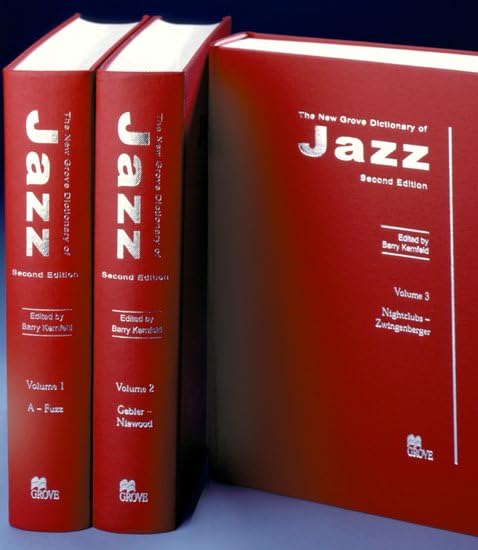



The New Grove Dictionary of Jazz, second edition is the largest, most comprehensive and accurate reference work on jazz ever published, putting the world of jazz at your fingertips. With articles on every aspect of the field, from jazz groups, composers and arrangers to instruments, terms, record labels and venues, the new edition is the ideal companion for scholars and enthusiasts in this rapidly growing field. The first edition of this reference (1988) was the best single source available for several kinds of information about jazz and jazz musicians. Now three volumes instead of two, the greatly expanded second edition succeeds to that distinction, including more than 7750 entries in just under 3000 pages. Kernfeld, editor of the first edition, presents 3000 revised articles and 2750 new entries, more than 2250 of which are biographies, including 1500 on musicians who emerged in the 1980s and 1990s (e.g., Kevin Mahogany and the Mandala Octet). In addition, many new entries can be found under "Nightclubs and Other Venues," which at 155 pages has doubled in size since the first edition. Arranged by city, this section lists current venues as well as places of historical interest (though, unfortunately, Oklahoma City is not included). Some of these clubs and locales are also listed and cross-referenced among the first-order entries, biographical and other. "Other" should be emphasized, because this work encompasses virtually everything else that a researcher might want to investigate jazz styles, instruments, record labels, nicknames, guilds and associations, jazz language, libraries and archives, false fingering techniques for horns, festivals, titles of films containing jazz scenes, a list of contrafacts (melodies built on the chord progressions of other pieces) and even biographies of a few jazz writers and critics. Except for very short entries, every essay is signed and includes, as appropriate, a bibliography, a discography, and a filmography. The biographies are all similarly structured to facilitate the search for specific kinds of information and show few traces of individual style. Contributors are listed at the end of Volume 3, together with the headings of the entries with which they are credited. In view of the assiduous cross-checking of facts and the careful documentation and attribution, there is little room for fault-finding with this resource except, perhaps, to complain that Grove should have made it 12 volumes rather than a paltry three. But if a researcher wants more information about, say, George Shearing than is contained in the pianist's 900-word biography, this is only to acknowledge that no single jazz reference, however monumental, can possibly include everything. Even The New Grove leaves room on the shelves for some smaller, more specialized works, such as Leonard Feather's several jazz encyclopedias, Gunther Schuller's The Swing Era, William Kenney's Chicago Jazz, and Mark Tucker's Ellington. This new edition is highly recommended for public and academic libraries. [In early 2002, this reference will be incorporated into the subscription site newgrove.com, which offers full-text access to the second edition of The New Grove Dictionary of Music and Musicians and The New Grove Dictionary of Opera. Ed.] Harold V. Cordry, Baldwin, KS Copyright 2002 Cahners Business Information, Inc. *Starred Review* The second edition of The New Grove Dictionary of Jazz is finally here. Originally published in 1988 by Grove as a two-volume set (and reprinted in 1994 by St. Martin's Press in a more economical single volume), this revision encompasses three volumes. Although some reviewers quibbled over the exclusion of their pet journeyman jazz musicians in the first edition, everyone recognized the publication as the reigning authority in the world of jazz scholarship. With the new edition, the work supersedes itself as a landmark. Included are more than 2,700 new entries (1,500 of them biographical) and revisions to most preexisting entries. The signed entries, written by jazz scholars worldwide, vary in length from a paragraph to several pages. The organization and scope are the same as in the previous edition: entries are arranged alphabetically and cover individual musicians, bands, concepts, styles, terms, instruments, record labels or companies, and institutions. Each entry ends with chronological lists of selected recordings (where applicable), a bibliography of selected books and articles, and, for the first time, Internet sites. New to this edition are lists of selected jazz films or videos in which artist(s) can be seen either performing or being interviewed. In the back of volume 3 there is a cumulative bibliography, "more than twice the size it was previously," listing reference and general books, discographies, and periodicals. A new calendar of jazz births and deaths is also appended. There is still no index, but there are cross-references throughout. A small number of black-and-wh