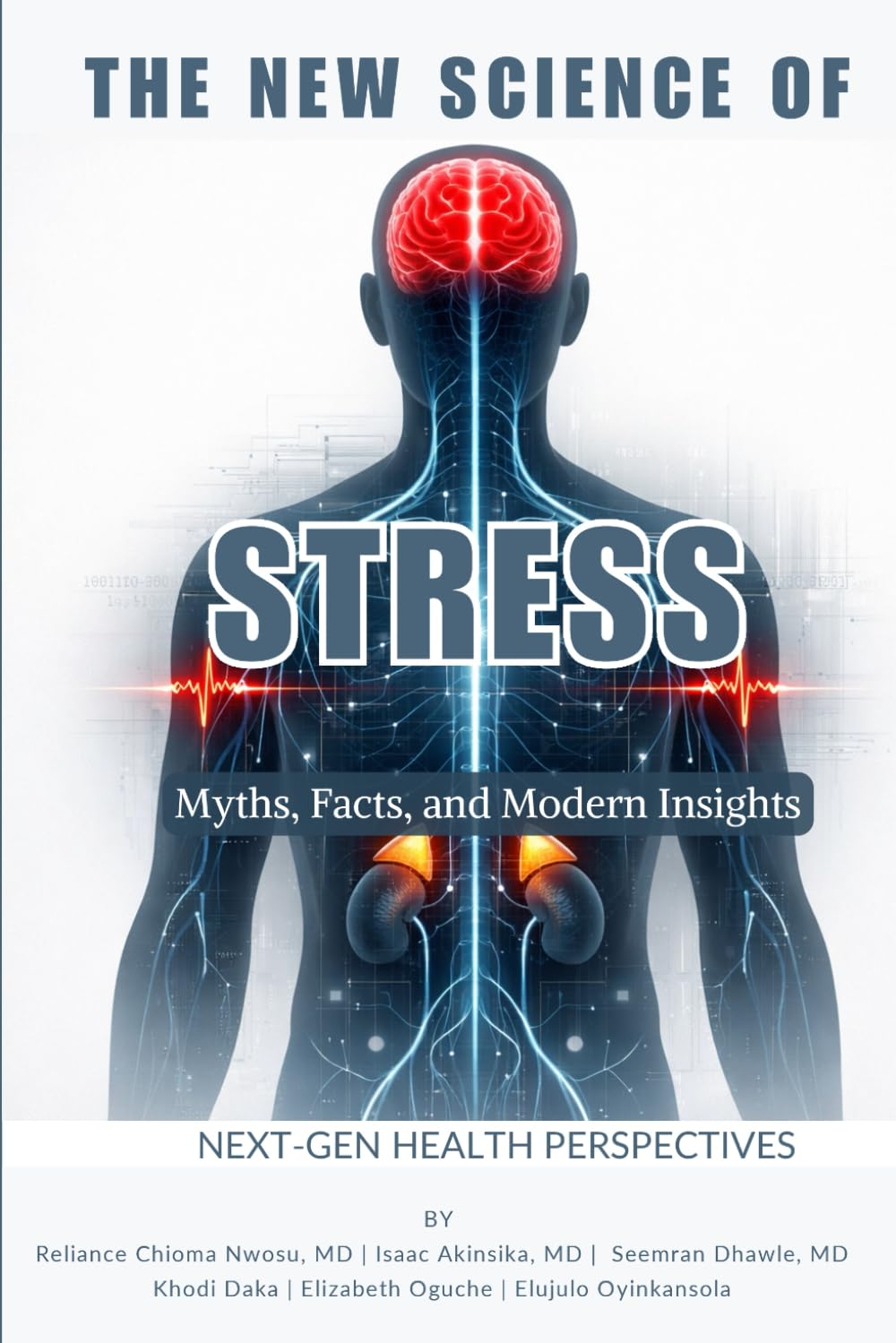
The New Science of Stress: Myths, Facts, and Modern Insights (Next-Gen Health Perspectives)
$8.02
by Reliance Chioma Nwosu MD



The New Science of Stress: Myths, Facts, and Modern Insights Next-Gen Health Perspectives Series Stress is one of the most discussed concepts in modern health — and one of the most misunderstood. It is often reduced to emotions, mindset, or motivation. Labeled as “psychological.” Normalized as part of success. Or treated as something that must be eliminated entirely to be healthy. This book challenges all of those assumptions. The New Science of Stress brings together six authors from different stages of medical and professional practice , each examining stress from a distinct angle — physiological, systemic, digital, financial, behavioral, and lived experience. Instead of forcing a single narrative, this book preserves those differences intentionally, because stress itself is not uniform. What emerges is not theory — but a realistic, layered understanding of how stress actually operates in modern life and healthcare. Inside this book, you will explore: why stress is often biological even when you feel emotionally fine - how long-term stress quietly alters hormones, metabolism, immunity, sleep, and cardiovascular function - why the idea that “stress is only in your head” is a historical myth with real health consequences - the difference between adaptive stress that supports performance and chronic stress that causes damage - how digital overstimulation reshapes the nervous system in ways that did not exist a generation ago - why financial pressure in healthcare creates hidden, systemic stress for both providers and patients - how stress hides behind competence, productivity, and resilience — especially in high-responsibility roles This book is written for healthcare professionals, medical students, and future clinicians who want to understand stress beyond psychology; for high-functioning professionals who appear stable yet live under constant pressure; and for readers experiencing fatigue, sleep disruption, or burnout without clear medical explanations. It is also for those who value scientific clarity over motivational slogans , and who want to understand how modern systems, technology, and expectations reshape the stress response. Each chapter is written in the author’s own voice. Some are analytical and clinical. Others are narrative and experiential. Some focus on mechanisms, others on consequences. This diversity is not a flaw — it is the book’s defining feature. Stress does not come from one source. It does not affect everyone the same way. And it cannot be understood through a single lens. Rather than offering simplistic solutions or mindset-based advice, this book focuses on accurate understanding : how stress forms, how it accumulates, how it manifests physically, and how to recognize when adaptation turns into harm. This is not a self-help manual. It is not a productivity guide. And it does not promise to eliminate stress. It is a modern, science-grounded exploration of stress as a physiological state shaped by environment, systems, technology, and pressure — examined honestly by six contributors who see it from different angles. For readers who want clarity instead of slogans, biology instead of blame, and reality instead of oversimplification, The New Science of Stress offers what a single author never could: understanding through perspective.