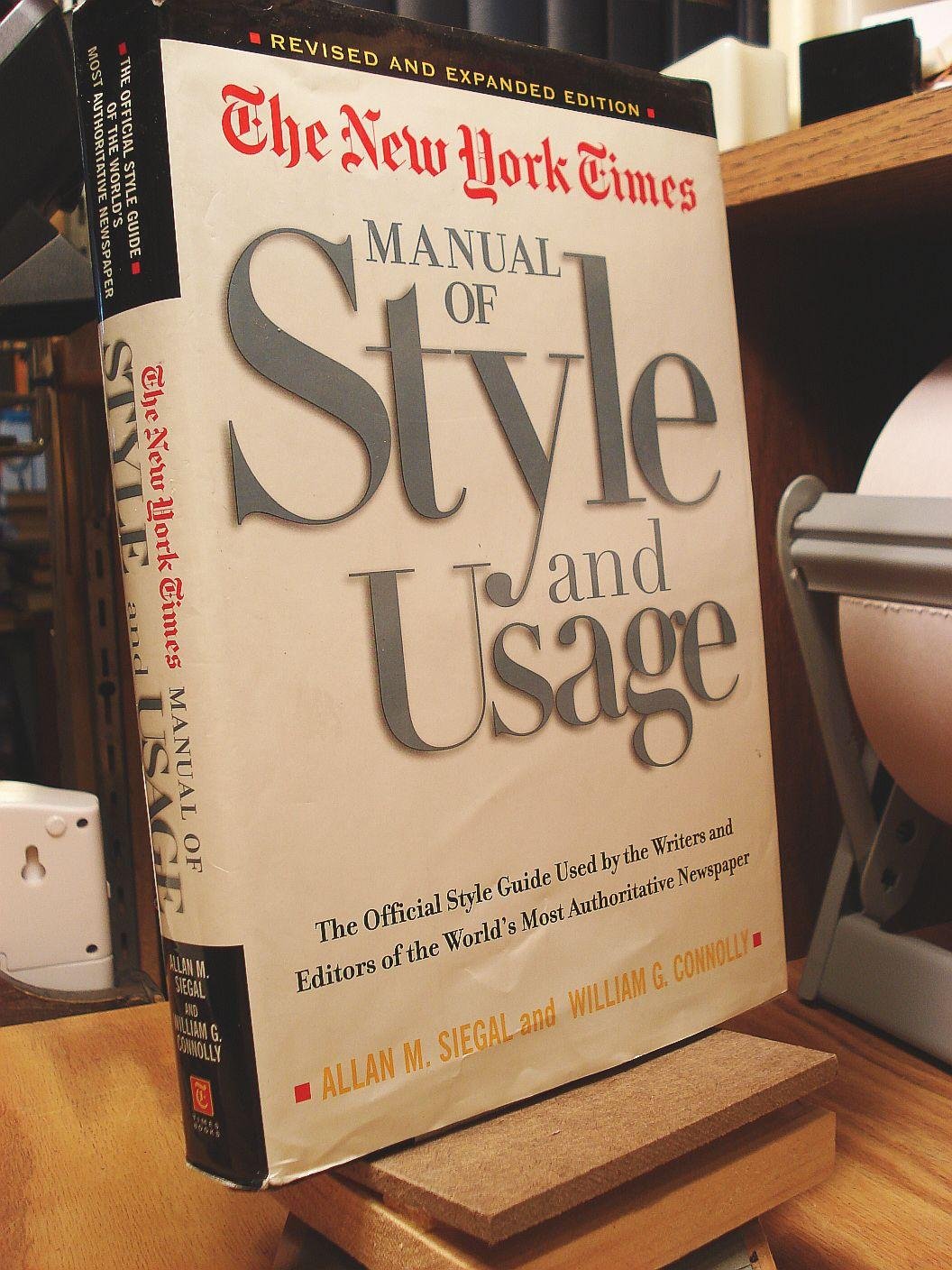
The New York Times Manual of Style and Usage : The Official Style Guide Used by the Writers and Editors of the World's Most Authoritative Newspaper
$14.68
by Allan M. Siegal



For anyone who writes--a short story or a business plan, a book report or a news report--knotty choices of spelling, grammar, punctuation and word meaning lurk in every line: Lay or lie? Who or whom? None is or none are? Is touch-tone a trademark? Is Day-Glo? It's enough to send you for a Martini. (Or is that a martini?) Now everyone can find answers in the handy alphabetical guide used by the thousand journalists of the world's most authoritative newspaper. The guidelines to correct hyphenation, punctuation, capitalization and foreign and English spelling are crisp and compact, created for instant reference in the rush of deadlines. Rewritten for the first time in twenty-three years and greatly expanded since the last edition, the manual tackles issues that will follow writers into the new century: How to respect the equality of the sexes without self-conscious devices such as "he or she" How to choose thoughtfully between terms like African-American and black; Hispanic and Latino; American Indian and Native American How to translate the vocabulary of e-mail and cyberspace for everyday readers, and how to cope with the eccentric capitalization and punctuation of Internet company names and Web site addresses The authors have more than seventy years of combined newsroom experience, most of it at The Times. They recognize that our language is changing, but they tailor their responses to the paper's impression of its readership: "educated and sophisticated . . . traditional but not tradition-bound." They counsel a fluid style, easygoing but not slangy, the unpretentious language of a letter to a literate friend. They invite readers of the manual to be precise while casting off the stodgy (among dozens of examples, writing before instead of the pompous prior to, and carry out instead of implement). The authors also offer a thumbnail guide to newsroom ethics and standards in their entries on anonymous sources, attribution, fairness and obscenity. And they seed the rules with wry humor. (On vogue words: "Wannabe is the faddish slang of adults who, well, want to be teenagers." And about the late: "Do not fall into this error: Only the late Senator Miel opposed the bill. He was almost certainly alive at the time.") For writers, editors, students, researchers and all who love language, The New York Times Manual of Style and Usage is an entertaining tool as well as an essential reference. "A foolish consistency," Emerson insisted, "is the hobgoblin of little minds." That may well be, but editors have enough reasons to reject your work; don't let sloppy inconsistencies be one of them. The New York Times Manual of Style & Usage was written for the paper's editors and writers, but it is a fine, up-to-date resource for anyone's use. Our language is ever-mutating, and a guide such as this will ensure that you understand the impact your words might have before they reach print. Should you use Native Americans or American Indians ? Debark or disembark ? Did you know that thermos is no longer a trademark, but that Popsicle and Dumpster are? Writing, when you get down to it, is nothing more than the careful choosing of words. This style book will ensure that you don't choose carat when you mean karat , jury-rigged when you want jerry-built , chow chow when chowchow is called for, or V-8 when you could have had a V8 . A naysayer may bridle against the strictures of such a rule book, but the authors believe "the rules should encourage thinking, not discourage it." Plus, "a rule," they say, "can shield against untidiness in detail that might make readers doubt large facts." We'd call the book "user-friendly," but that, we've learned, can be downright "reader-tiresome." --Jane Steinberg This is an updated version of the style guide used by the writers and editors of the New York Times. (The last edition came out in 1982.) Aimed primarily at newspaper writers, it is written in dictionary format and covers a very broad range of style and usage topics, including abbreviations, city names, capitalizations, compound forms, numbers, and updated language preferences. It also includes special style changes and exceptions for headline writers. Everyone who wants to write for a newspaper will want this book, as its approach is fairly universal. It will also answer many reference questions and is fun to browse. Recommended for public and academic libraries.ALisa J. Cihlar, Monroe P.L., WI Copyright 1999 Reed Business Information, Inc. ho writes--a short story or a business plan, a book report or a news report--knotty choices of spelling, grammar, punctuation and word meaning lurk in every line: Lay or lie? Who or whom? None is or none are? Is touch-tone a trademark? Is Day-Glo? It's enough to send you for a Martini. (Or is that a martini?) Now everyone can find answers in the handy alphabetical guide used by the thousand journalists of the world's most authoritative newspaper. The guidelines to c