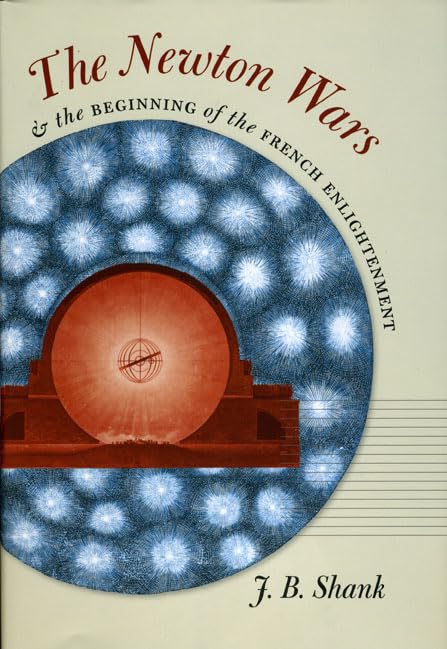



Nothing is considered more natural than the connection between Isaac Newton’s science and the modernity that came into being during the eighteenth-century Enlightenment. Terms like “Newtonianism” are routinely taken as synonyms for “Enlightenment” and “modern” thought, yet the particular conjunction of these terms has a history full of accidents and contingencies. Modern physics, for example, was not the determined result of the rational unfolding of Newton’s scientific work in the eighteenth century, nor was the Enlightenment the natural and inevitable consequence of Newton’s eighteenth-century reception. Each of these outcomes, in fact, was a contingent event produced by the particular historical developments of the early eighteenth century. A comprehensive study of public culture, The Newton Wars and the Beginning of the French Enlightenment digs below the surface of the commonplace narratives that link Newton with Enlightenment thought to examine the actual historical changes that brought them together in eighteenth-century time and space. Drawing on the full range of early modern scientific sources, from studied scientific treatises and academic papers to book reviews, commentaries, and private correspondence, J. B. Shank challenges the widely accepted claim that Isaac Newton’s solitary genius is the reason for his iconic status as the father of modern physics and the philosophe movement. "J. B. Shank’s project is ambitious: to debunk the myth of the French Enlightenment as the direct intellectual descendant of Isaac Newton. For Shank, there was nothing inevitable about the uses made in France of Newton’s work.....This is a good book, well researched and readable....In this light, the major virtue of Shank’s study is not that it offers an entirely new interpretation of the origins of the French Enlightenment, but that it provides a novel perspective on traditional accounts." -- Christopher Baxfield ― British Journal for the History of Science "It will be a long time before anyone seeks to replace the thoroughness of Shank's scholarship. He manages to allow the polemics around Newton's science to unfold until we begin to see that it was the polemic itself that generated enlightened thought. This is not what Newton's opponents had in mind, but as Shank brilliantly demonstrates, it is exactly what they got." -- Margaret C. Jacob ― American Historical Review "A complex tale documented from hundreds of sources, this definitive stury is well worth a central plaace in studies in intellectual history." ― Choice "This is a really important book because it helps us rethink the important early part of Voltaire's career. . . . What J B Shank does is to give a much more nuanced understanding of how Voltaire is trying to make his career in that early period. It's the most important new insight into Voltaire's intellectual evolution to come out for the last generation." -- Nicholas Cronk ― Five Books J. B. Shank is associate professor of history at the University of Minnesota.