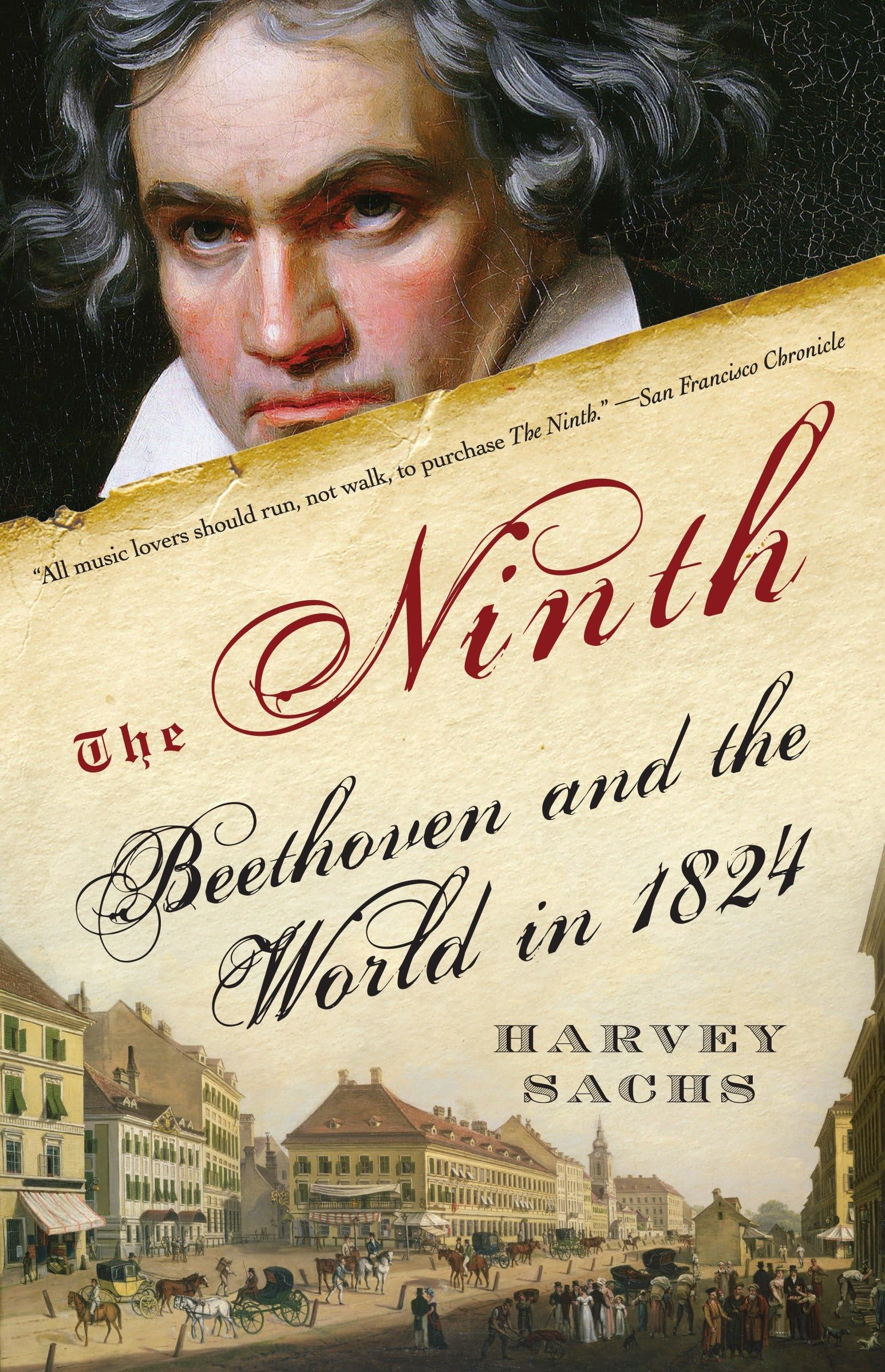



The premier of Beethoven’s Ninth Symphony in Vienna on May 7, 1824, was the most significant artistic event of the year—and the work remains one of the most precedent-shattering and influential compositions in the history of music. Described in vibrant detail by eminent musicologist Harvey Sachs, this symbol of freedom and joy was so unorthodox that it amazed and confused listeners at its unveiling—yet it became a standard for subsequent generations of creative artists, and its composer came to embody the Romantic cult of genius. In this unconventional, provocative book, Beethoven’s masterwork becomes a prism through which we may view the politics, aesthetics, and overall climate of the era. Part biography, part history, part memoir, The Ninth brilliantly explores the intricacies of Beethoven’s last symphony—how it brought forth the power of the individual while celebrating the collective spirit of humanity. “All music lovers should run, not walk, to purchase The Ninth .” —San Francisco Chronicle “An inspiring examination of one of music’s supreme masterpieces.” —Pittsburgh Tribune Review “Insightful . . . Reading this book, you feel for the composer, trying to bond with others through an astonishing symphony.” —The New York Times “Sachs’ enthusiasm is infectious, his knowledge impressive.” —USA Today “A revelatory ride through a creative time and four symphonic movements.” —The Dallas Morning News “Will send readers to their CD players.” —The Washington Post Harvey Sachs is a writer and music historian and the author or co-author of eight previous books, of which there have been more than fifty editions in fifteen languages. He has written for The New Yorker and many other publications, has been a Guggenheim Fellow and a Fellow of the New York Public Library’s Cullman Center for Scholars and Writers, and is currently on the faculty of the Curtis Institute of Music in Philadelphia. He lives in New York City. The latest news in Vienna” Reeking, rotting garbage, overflowing from bins: That is what I found when, in November 2004, I pushed open the main door of a massive but anonymous gray stone apartment building in Vienna’s third Bezirk (district) and made my way through a hallway to an internal courtyard. The rectangular four-story building’s façade bears a commemorative plaque put up by the Vienna Schubert Society on May 7, 1924—the hundredth anniversary of the premiere of Beethoven’s Ninth Symphony—as well as another, more recent plaque bedecked with banners dirtied by automobile exhaust, which proclaims that the symphony’s “Ode to Joy” theme has been the European anthem since 1972, when the Council of Ministers in Strasbourg officially adopted it as such. There is no museum in the building at Ungargasse 5, on the northwest corner of a busy intersection; in fact, by going through the entrance door I was trespassing on private property. In the composer’s day the address was Landstrasse 323, and the building was called the house Zur schönen Sklavin (By the Beautiful Slave Girl); Beethoven lived in it throughout the final months of the symphony’s creation and until shortly after its first performance. His apartment was situated on the top floor—the cheapest one, in pre-elevator days—but he usually received friends and acquaintances at a nearby, no longer extant coffeehouse, Zur goldenen Birne (By the Golden Pear), where he spent many an afternoon. As one contemporary writer put it, “If you have something important1 to tell a Viennese man, you can go ten times to his apartment without finding him in, but if you know which coffeehouse he frequents you’ll meet him there for sure.” Occasionally, however, people would visit Beethoven at home. Once, during the composition of the Ninth, he invited the poet Franz Grillparzer to the Landstrasse apartment to discuss an opera project; Grillparzer found Beethoven, who was ill at the time, The opera project never came to fruition, and we don’t know what happened to the butter and eggs. lying on a disordered bed2 in dirty night attire, a book in his hand. At the head of the bed there was a small door which, as I discovered later, communicated with the larder and which Beethoven was, in a way, guarding. For when subsequently a maid emerged from it with butter and eggs he could not restrain himself, though in the middle of a spirited conversation, from casting an appraising glance at the quantity of the food that was being carried away—and this gave me a painful picture of his disordered household. The composer Carl Maria von Weber visited Beethoven during the same period, and his son later recounted the father’s impressions of “the dreary,3 almost sordid room inhabited by the great Ludwig.” It was “in the greatest disorder: music, money, clothes, lay on the floor, linen in a heap on the unclean bed, the open grand piano was covered in thick dust, and broken coffee-cups lay on the table.” Beethoven tossed all the music off the sofa “and