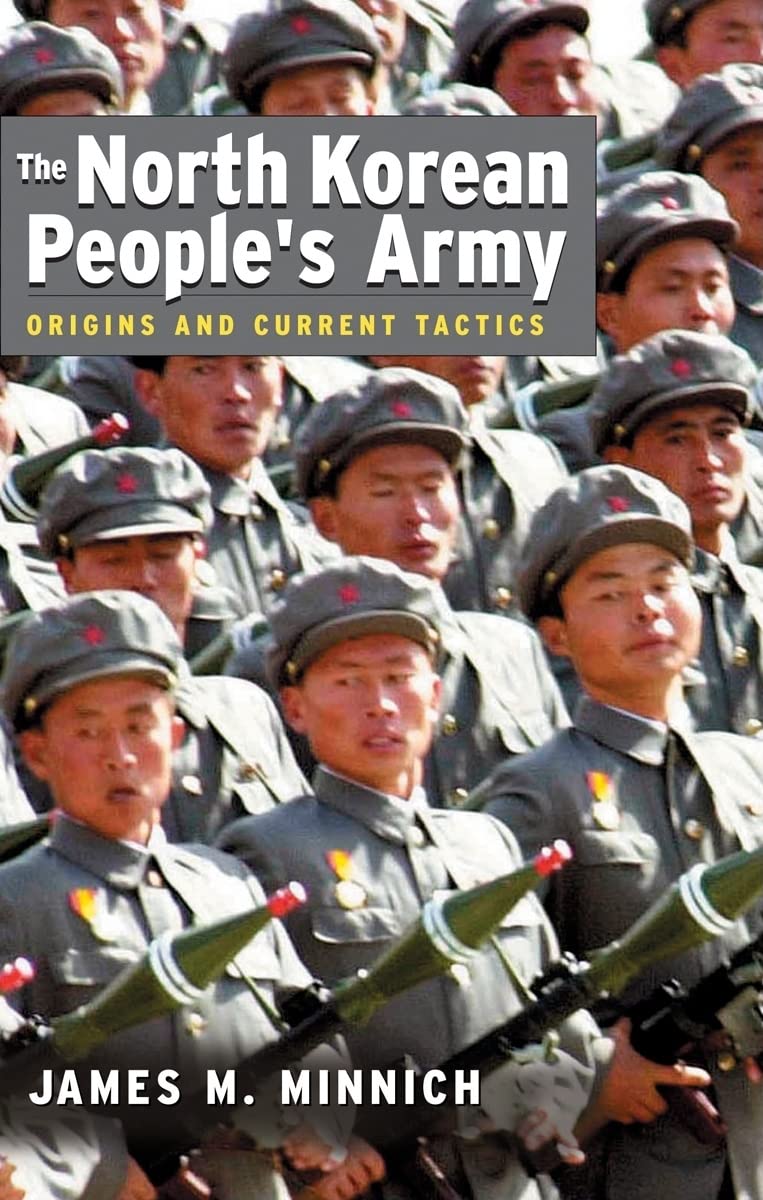



For more than fifty years, the combined armed forces of the United States and the Republic of Korea have faced down the North Korean People's Army (NKPA) along the world's most militarized stretch of land known as the demilitarized zone. Despite the prolonged standoff, much remains unknown about the world's third largest army. In this authoritative study, James M. Minnich blends academic knowledge with nearly twenty-five years of military experience to explain the NKPA's origins, military ideology, strategy, combat formations, and tactics to ensure a full understanding of this reclusive belligerent. At the outset, Minnich examines the first crucial years of the North Korean state and its army. Solidly grounded in primary sources and buttressed by the judicious use of secondary sources, his work traces the formative elements of the Korean partisans, Soviet Army, and Chinese communists to show how each group contributed to the NKPA's development and its ability to mount the first shooting campaign of the Cold War. This timely book then presents a vitally relevant examination of the NKPA's current military tactics, including its seven forms of offensive maneuver, two forms of defense, and tactical artillery groupings. Required reading for military planners and personnel who must remain prepared to rapidly deploy to Korea, this concise profile will also appeal to students of Korean history and those seeking a deeper understanding of the NKPA. "A captivating read, profoundly researched and well organized. ...indispensable for learning about North Korean military tactics and organizations." -- Alexandre Y. Mansourov, Associate Professor, Asia-Pacific Center for Security Studies "A serious, well-informed, and balanced study. James Minnich has done an exceptional job of reducing the mysteries about the NKPA." -- Ezra F. Vogel, Henry Ford II Professor of the Social Sciences, Fairbank Center for East Asian Research, Harvard University "This study belongs on the shelf of all serious students of Korean security." -- Jonathan D. Pollack, Professor of Asian and Pacific Studies, Naval War College James M. Minnich is a U.S. Army Foreign Area Officer serving as the J5 Policy Branch Chief with U.S. forces in Korea, where he has carried out various military assignments since 1982. An alumnus of the Republic of the Korea Army College and Sogang University's Center for Korean Studies in South Korea with master's degrees from Harvard University and the U.S. Army Command and General Staff College, he also is the author of The Denuclearization of North Korea . Since at least February 1948, when Kim Il Sung delivered his inaugural speech to the (North) Korean People s Army (NKPA), North Korea has officially recognized his former Anti-Japanese Guerrilla Army as the predecessor to the nation s modern armed forces. To this end, the North Korean state has attempted to create a single, uninterrupted history that traces Kim Il Sung from independent leader of the Anti-Japanese Guerrilla Army in 1932--later renamed the Korean People s Revolutionary Army--to supreme commander of the NKPA in 1948. Regardless of its degree of authenticity, North Korea officially endorses this historiography as the NKPA s true lineage, and despite many factual discrepancies that are evident in this contrived history (as will be revealed throughout this book), there is indeed a thread of truth to this idea. Certainly a great number of NKPA soldiers and leaders, including Kim Il Sung, did hail from a partisan background, including service with Chinese Communist guerrillas in Manchuria and the Soviet Red Army in the Soviet Far East. Thus, roots of North Korea s modern era, including origins of the NKPA, can be found in this partisan period between the early 1930s and the early 1940s. It was during this time that the country s future leaders were trained in the art of command, that its men became battle-hardened, and that these neighboring Communist states--China and North Korea--forged enduring associations and bonds. What follows is a reconstruction of North Korea s partisan period from the Manchurian Incident or Mukden Incident of 1931 until Korea s national liberation in 1945. This account clearly deconstructs the myth of the NKPA s heritage; namely, that its antecedent organization operated as an independent army under the leadership of Kim Il Sung from its inception in 1932 until national liberation in 1945. At the same time, it explains the effect that this period later had upon the NKPA, particularly as it pertained to the selection of its senior leaders, who for the most part were all Kapsan Partisans (Soviet exiles), or Kapsanists--including Kim Il Sung.