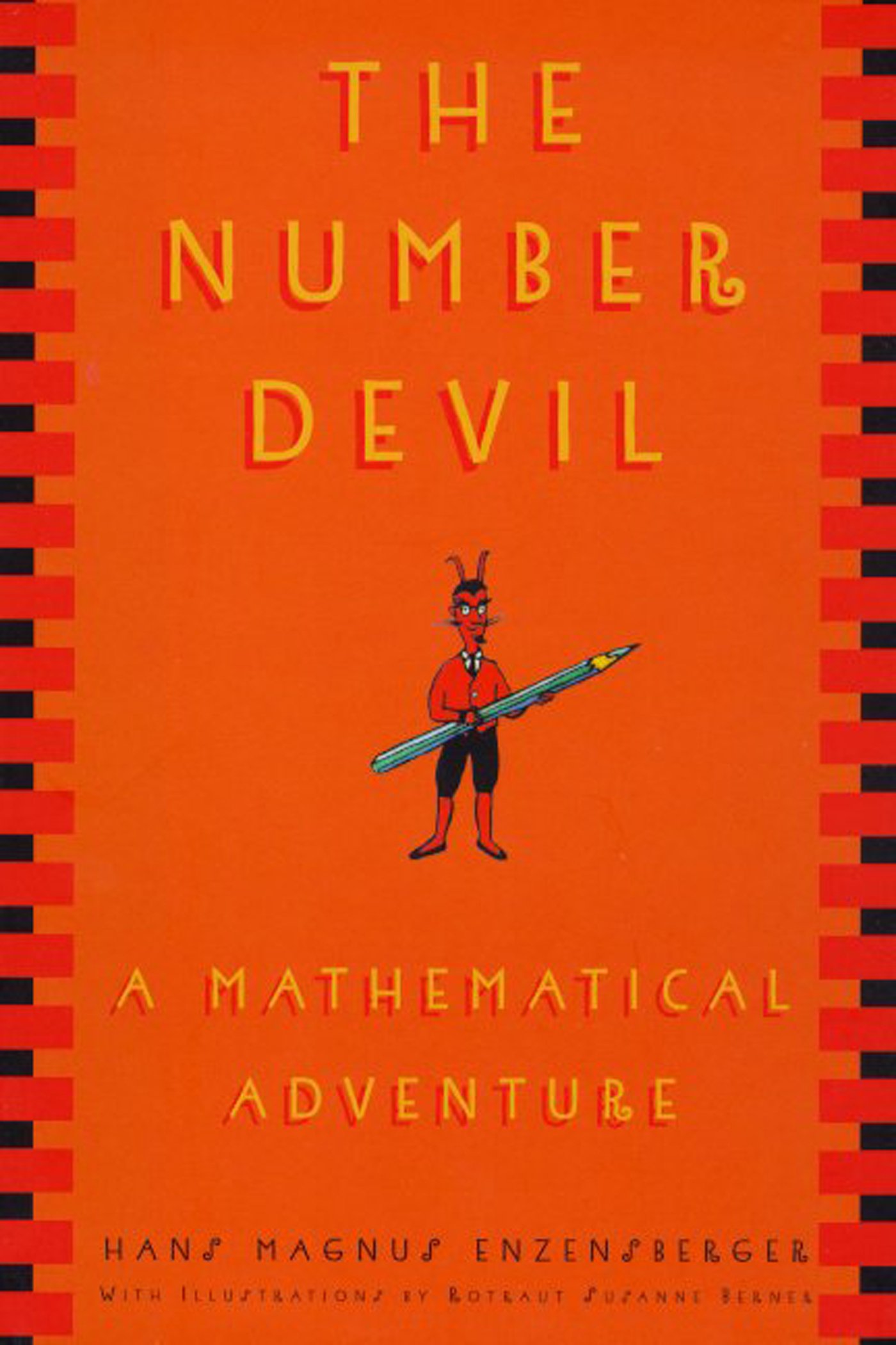



The international best-seller that makes mathematics a thrilling exploration. In twelve dreams, Robert, a boy who hates math, meets a Number Devil, who leads him to discover the amazing world of numbers: infinite numbers, prime numbers, Fibonacci numbers, numbers that magically appear in triangles, and numbers that expand without . As we dream with him, we are taken further and further into mathematical theory, where ideas eventually take flight, until everyone-from those who fumble over fractions to those who solve complex equations in their heads-winds up marveling at what numbers can do. Hans Magnus Enzensberger is a true polymath, the kind of superb intellectual who loves thinking and marshals all of his charm and wit to share his passions with the world. In The Number Devil, he brings together the surreal logic of Alice in Wonderland and the existential geometry of Flatland with the kind of math everyone would love, if only they had a number devil to teach it to them. Young Robert's dreams have taken a decided turn for the weird. Instead of falling down holes and such, he's visiting a bizarre magical land of number tricks with the number devil as his host. Starting at one and adding zero and all the rest of the numbers, Robert and the number devil use giant furry calculators, piles of coconuts, and endlessly scrolling paper to introduce basic concepts of numeracy, from interesting number sequences to exponents to matrices. Author Hans Magnus Enzensberger's dry humor and sense of wonder will keep you and your kids entranced while you learn (shhh!) mathematical principles. Who could resist the little red guy who calls prime numbers "prima donnas," irrational numbers "unreasonable," and roots "rutabagas"? Not that the number devil is without his devilish qualities. He loses his temper when Robert looks for the easy way out of a number puzzle or dismisses math as boring and useless. "What do you expect?" he asks. "I'm the number devil, not Santa Claus." (Ages 10 to adult) --Therese Littleton Grade 6 Up-This book consists of a dozen unusual dreams of Robert, a 12 year old who thinks math is "a waste of time." The number devil who visits him each night changes that with magical demonstrations of mathematical concepts that intrigue the boy. Starting simply with the concept of infinity, the devil introduces prime numbers, square roots, Fibonacci numbers, and more, inventively using coconuts, multiplying rabbits, and other oddities as examples. He demonstrates concepts in imaginative ways that actually make sense, focusing on general principles, with an emphasis on the pleasing consistency of mathematics. Robert becomes interested and is named a "number apprentice" in the final chapter. Building new concepts from those previously learned makes the progression to more complicated areas easier and satisfying. The devil uses made-up terms (e.g., square roots are called "rutabagas") and the author warns that students should learn the correct words. A helpful index identifies these terms, and also reveals the identities of various mathematicians referred to by other names (Johan van de Lune is the "Man in the Moon"). Colorful, cartoon illustrations appear throughout, along with useful tables and diagrams. The dream world recalls Alice's Adventures in Wonderland and Norton Juster's The Phantom Tollbooth (Knopf, 1961), but the attempts at humor and silliness here never match the wit and charm of those classics. Although it is not a fully realized fantasy, The Number Devil may intrigue and teach readers willing to try an unusual introduction to math principles. Steven Engelfried, West Linn Public Library, OR Copyright 1998 Reed Business Information, Inc. "Rare and glorious." (Michael Pakenham, Baltimore Sun) "Adults who know a little about math will find this book as enlightening as younger readers will." (Martin Gardner, Los Angeles Times) Hans Magnus Enzensberger is the author of many highly lauded books, including Civil Wars: From L.A. to Bosnia . He lives in Munich. Rotraut Susanne Berner is an illustrator who lives in Heidelberg. Michael Henry Heim is a prize-winning translator who teaches at UCLA. In time Robert grew accustomed to dreaming of the number devil. He even came to look forward to it. True, he could have done without his know-it-all attitude and his temper tantrums--you could never tell when he'd blow up and yell at you--but it was better, so much better, than being swallowed by a slimy fish or sliding down and down into a black hole. Besides, Robert had made up his mind to show the number devil that he was no fool. You have to put people like him in their place, Robert thought as he got ready for bed one night. The big ideas he has about himself--and all because of a zero. He wasn't much more than a zero when you got down to it. All you had to do was wake up and he was gone. But to put him in his place Robert had to dream of him, and to dream of him he had to fall asleep. And Robert su