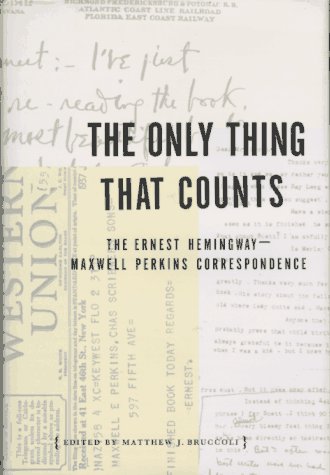
The ONLY THING THAT COUNTS: The Ernest Hemingway/Maxwell Perkins Correspondence
$29.90
by Matthew J. Bruccoli



In 1924 F. Scott Fitzgerald told his editor Maxwell Perkins about a young American expatriate in Paris, an unknown writer with a "brilliant future." When Perkins wrote to Ernest Hemingway several months later, he commenced a correspondence spanning more than two decades and charting the career of the most influential American author of this century. The letters collected here are the record of a remarkable professional alliance - an enduring friendship between editor and author - and of Hemingway's development as a writer. Determined to be a great novelist, Hemingway reported frequently on the pitfalls and triumphs of the writing process. While his fiction is characterized by precision and control, his letters reveal Hemingway at his most ebullient. Whether self-satisfied, bitter, or intoxicated, he wrote impassioned letters about everything that was on his mind, from literature and money to bull-fighting, fishing, and friendship. From Paris in the Twenties through the Depression, the Spanish Civil War, and World War II, the correspondence between these men provides inside commentary on an era marked by influential developments in both literature and politics. And finally, for anyone interested in books, editing, and authorship, Perkins and Hemingway's exchange on the subjects of advances, advertising, critics, jacket illustrations, and movie deals show how much has changed in book publishing and how much has stayed the same. Was it his personal desire to be in print like the men whose books he edited that made Maxwell Perkins preserve his correspondence, or a clear appreciation that his pen pals were the century's greatest writers? First there was Dear Scott, Dear Max: The Fitzgerald-Perkins Correspondence , which captured the exchange between Perkins, an editor at Scribner's, and F. Scott Fitzgerald, who introduced Perkins to Papa. Now, with The Only Thing That Counts we have a collection of Perkins's letters to Ernest Hemingway and Hemingway's often poignant replies. The letters offer a fuller view into the relationship between a writer and editor and capture the two men in a way nothing else could. Will today's great editors and authors care enough to back up their e-mail and thus preserve the next century's literary record? Hemingway was an indefatigable letter writer and, as editor Bruccoli (English, Univ. of South Carolina) states in his introduction, "wrote more words in letters than he wrote for publication, and letter writing became part of the mechanism of his literary career." This collection of correspondence between legendary Scribner's editor Perkins and his star author offers their personal insight into the writing and editing of Hemingway's works. Although Hemingway is now almost as famous for being a son of a bitch as he is for being a writer, he comes across here as a loyal and trusting friend?at least to Perkins. But most important, these letters reveal him to be an artist first and foremost. The shooting, fishing, and drunken bravado that mark the Papa Hemingway persona are present but inconsequential here; what shines through is his total and unfaltering dedication to writing and how, for him, producing great literature was the only thing that counted. That insight makes this a valuable addition to Hemingway scholarship and an aficionado's delight.?Michael Rogers, "Library Journal" Copyright 1996 Reed Business Information, Inc. Underneath the usual authorial complaints about royalties and editorial requests for finished manuscripts, Hemingway's dedication to his craft, and Perkins's to Hemingway, come through in this carefully abridged selection. Elsewhere Hemingway wrote, ``Plenty of times people who write the best write the worst letters.'' But he only occasionally exemplifies this rule himself. His correspondence with august editor Maxwell Perkins, spanning the businesslike and the personal, has the benefit of focusing on Hemingway's literary career, which sprawled through the Selected Letters (1981). Here we get to look over their shoulders during Hemingway's early time with Scribner's, in which he often has to defend (and sometimes amend) his use of strong language, starting with The Sun Also Rises, and to battle against cuts in magazine serializations (``Half the writing I do is elimination''). In this rich, sometimes swamping flow of letters, we see Hemingway's guard going gradually, but never totally, down and Perkins moving from literary associate to confidant (thanks to a fishing trip to Key West). Amid the quotidian debates about advertising and royalty advances, Perkins also has to insert himself into the Fitzgerald-Hemingway rivalry (Hemingway's side is candid but brutal) and diplomatically participate in literary feuds with Gertrude Stein and others, and critical skirmishes, notably involving Max Eastman, whom Hemingway wrestled to the floor in Perkins's office. Given Hemingway's fundamental unreliability about himself, Fitzgerald maven Bruccoli (Some Sort of Epic Gra