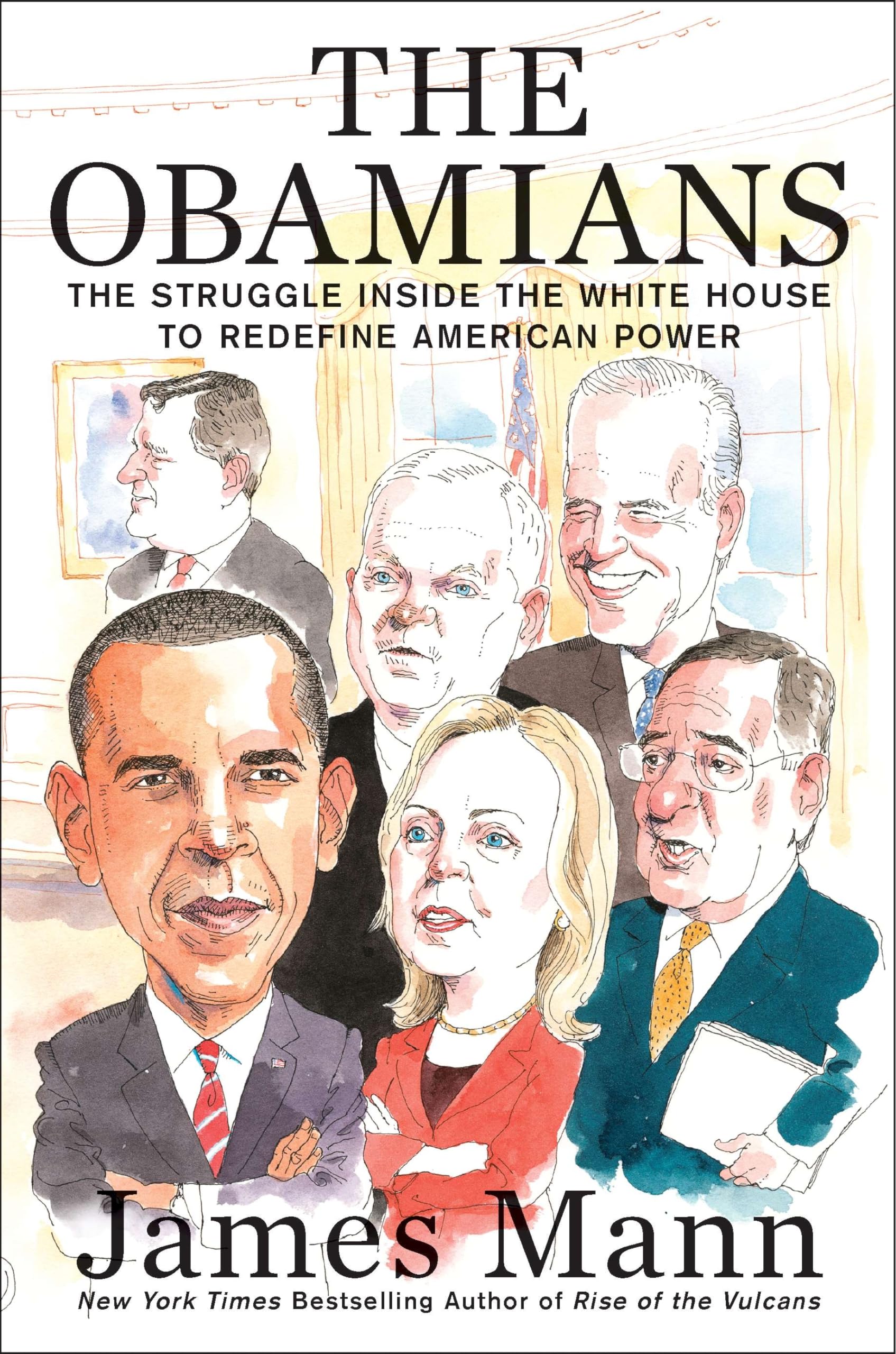
The Obamians: The Struggle Inside the White House to Redefine American Power
$17.99
by James Mann



The definitive analysis of the events, ideas, personalities, and conflicts that have defined Obama’s foreign policy When Barack Obama took office, he brought with him a new group of foreign policy advisers intent on carving out a new global role for America in the wake of the Bush administration’s war in Iraq. Now the acclaimed author of Rise of the Vulcans offers a definitive, even-handed account of the messier realities they’ve faced in implementing their policies. In The Obamians , acclaimed author James Mann tells the compelling story of the administration’s struggle to enact a coherent and effective set of policies in a time of global turmoil. At the heart of this struggle are the generational conflicts between the Democratic establishment—including Robert Gates, Hillary Clinton, and Joseph Biden—and Obama and his inner circle of largely unknown, remarkably youthful advisers, who came of age after the Cold War had ended. Written by a proven master at elucidating political underpinnings even to the politicians themselves, The Obamians is a pivotal reckoning of this historic president and his inner circle, and of how their policies may or may not continue to shape America and the world. Mann is an experienced and judicious observer of both presidential policy making and the bipartisan foreign-policy establishment, and, as in the case of his earlier book, many of his initial judgments are likely to pass the test of time. —Michael Lind James Mann, a former Washington reporter, columnist, and foreign correspondent for the Los Angeles Times , is author in residence at the Johns Hopkins School of Advanced International Studies. He is the author of many books on global affairs and U.S. foreign policy. The ultimate Obamian, of course, was Obama himself. Aides such as McDonough and Rhodes reflected the president’s own views. Obama was as new to foreign policy as they were, and as little influenced by previous Democratic administrations. Over the years, far too much has been made of how Obama’s race and upbringing supposedly affected his thinking about the world. Political opponents, diplomats and journalists have sometimes speculated about the impact on Obama of his father’s roots in Kenya or of his childhood years in Indonesia. Some have theorized that Obama had somehow been imbued with an “anticolonial” perspective and was hostile, or at least unsympathetic, to British and European traditions. There is little if any evidence to support this theory, and it represents an extremely selective interpretation of Obama’s youth. His postprimary education included a private college-prep school in Hawaii, private colleges in Los Angeles (Occidental College) and New York City (Columbia), and law school at Harvard. Obama’s secondary and higher education, in other words, was not radically different from that of, say, John F. Kennedy (prep school and Harvard), Franklin Roosevelt (prep school, Harvard and Columbia Law School), Richard Nixon (Whittier College and Duke Law School), Gerald Ford (University of Michigan and Yale Law School), George H. W. Bush (prep school and Yale), Bill Clinton (Georgetown and Yale Law School) or George W. Bush (prep school, Yale and Harvard Business School). If Obama’s worldview was influenced by his upbringing—and even this is an open question—then surely those long years of elite American schooling must have counted for far more than the father he barely knew or his four years in elementary school overseas. Instead, Obama’s views of the world and of America’s role in it were shaped to a far greater extent by his age and by the times in which he came to national prominence. Obama was the first president since Vietnam whose personal life and career were utterly unaffected by that war. Every president since Gerald Ford had tried, in one fashion or another, to declare an end to the Vietnam War or to put to rest its continuing impact. Ford had ended the American presence in Vietnam. Ronald Reagan and George H. W. Bush had both proclaimed the end of the “Vietnam syndrome,” their term for the fear of military intervention and casualties. Bill Clinton had normalized diplomatic relations with Vietnam. The war had nevertheless retained its potency in American political life. When Clinton ran for the presidency in 1992, he had to explain why he hadn’t served in the military during Vietnam. When George W. Bush ran in 2000, his campaign was obliged to justify an assignment in the Texas Air National Guard that kept him out of Vietnam. In the 2004 presidential campaign, after the Democrats nominated a Vietnam veteran, the Republicans managed to raise questions about John Kerry’s service on a “swift boat” in that war. In the election of 2008, however, Obama, who was only thirteen years old when the last American troops came home from Vietnam, defeated a Republican candidate who was a Vietnam War hero and former prisoner of war. Vietnam had finally vanished from American presidential politics. Obama was