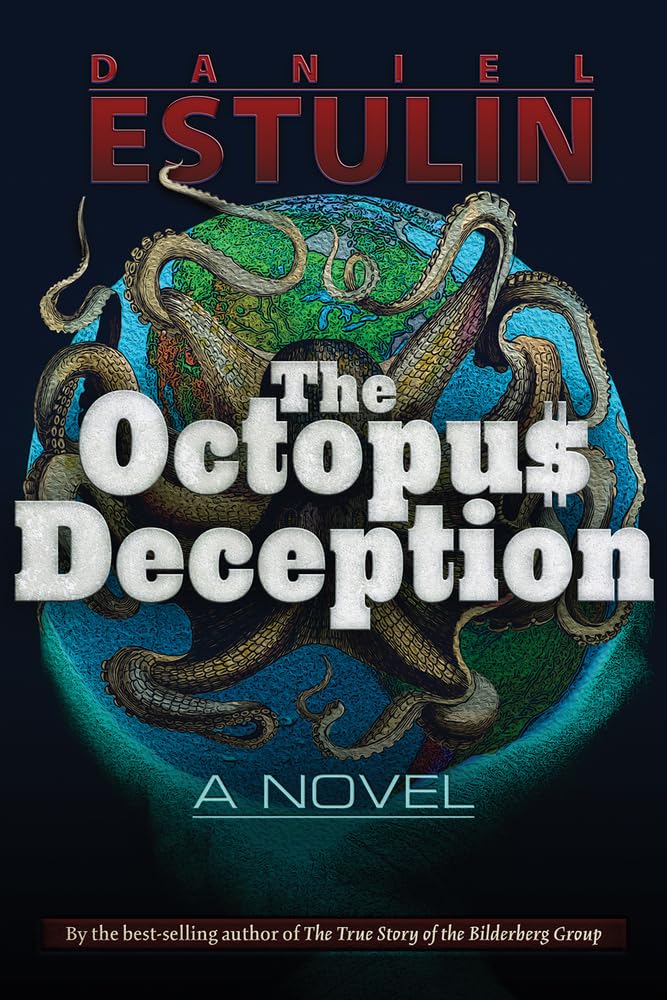



In this timely political thriller, CIA special agent Curtis Fitzgerald, scholar Simone Casoloro, and historian Michael Asbury, must race against the clock to find trillions of dollars worth of stolen funds to prevent global economic collapse. Since the end of the Second World War, an elite organization called The Octopus has controlled the funds hidden away in six bank accounts. As the crux of the global economy, the loss of the money threatens to send the world into pure chaos unless it’s retrieved. Fitzgerald, Casoloro, and Asbury find themselves down the rabbit hole of government conspiracies and secret societies in the hunt for the missing riches. Love, betrayal, murder, and deceit play prominently in this novel following in the wake of the ongoing financial crisis. Daniel Estulin is an award-winning investigative journalist and the author of Shadow Masters and The True Story of the Bilderberg Group . The Octopus Deception By Daniel Estulin Trine Day LLC Copyright © 2013 Daniel Estulin All rights reserved. ISBN: 978-1-937584-23-8 CHAPTER 1 Simone Casolaro entered the lecture hall with great élan. Ninety-five pairs of eyes watched her attentively. Ms. Casolaro's Renaissance Literature class at Cornell University in Ithaca, New York, was the most popular academic option on campus, and this was day one of Winter term. She stomped snow from her galoshes and kicked them off, revealing a pair of Roman-style sandals. Then she removed her full-length wool coat, showing off a fine Egyptian cotton dress with a low bosom and high hemline. Appreciative male murmurs rippled through the room as she eyed her troops for a few pregnant moments. Then, abruptly, she began. "You will buy Dante's Divine Comedy today and start reading it at once. Read every word. Don't skip the "boring bits." There are no boring bits in Dante. Turn off the television, put your computer to sleep, take the iPod out of your ear. No twittering, texting, tooting, hooting or whatever new App you're addicted to. Dante is to be smelled, savored, tasted, chewed, and digested, like a juicy Italian sausage." The hall erupted in laughter. Simone was an exceptional performer, with a unique flamboyant style. She felt a passion for her subject and had a knack for the provocative. More important, however, she animated her students' imaginations, a gift they would carry, and many of them treasure, for the rest of their lives. "A hundred years ago," she began, "Flaubert in a letter to his mistress made the following observation: 'What a scholar one might be if one knew well enough some half a dozen books.'" She swept the room with her gaze. "Dante's Divine Comedy is one of those worthy to be included in any short list. Dante's allegory, however, is highly complex, and we shall examine other levels of meaning, such as the historical, moral, literal, and the anagogical. The development of the art of description throughout the centuries should be treated in terms of vision, of that prodigious eye of individual genius." She paused for effect, rising to the balls of her feet. "What we call genius is an evanescent quality, gradually yielding a complex spectrum for all to see. In reading and thinking and dreaming, you should notice and absorb the details. Let's leave generalizations, well-worn clichés, popular trends and social commentary at the door." She strode to the blackboard, quickly drawing an outline of Dante's face. "Any real work of art is the creation of a new psychic world. A great writer is always a great enchanter, and Dante is a supreme example." A skinny girl in the front row raised her hand. "Professor Casolaro, I was told in my last year's class that we can learn a lot about people and their culture from reading historical novels. By reading Dante, will we learn about Renaissance Italy?" Simone looked at the girl and smiled. She made an expansive movement with her hand. "Can we truly rely on Jane Austen's picture of England during the Industrial Revolution when all she really knew was a clergyman's parlor? Those who seek facts about provincial Russia won't find them in Gogol, who spent most of his life abroad. The truth is that great works of art are, in a way, fairy tales and this trimester we will focus on one of the supreme fairy tales of all time." The stage door on her right was pulled slightly ajar and a man's head emerged. "I am sorry to disturb you, Professor Casolaro, but could I have a word, please?" She looked at the clock. "I can see you in half an hour." The man gave her a heavy look. "I'm afraid it can't wait." Simone felt a chill. "All right, give me two minutes." He nodded his head and closed the door. She turned back to the auditorium. "Although the two great events which made the fifteenth century a turning-point in human history – the invention of printing and the discovery of the New World – were still two centuries in the future, Dante's era was unique, essentially a period of great men; of free thought