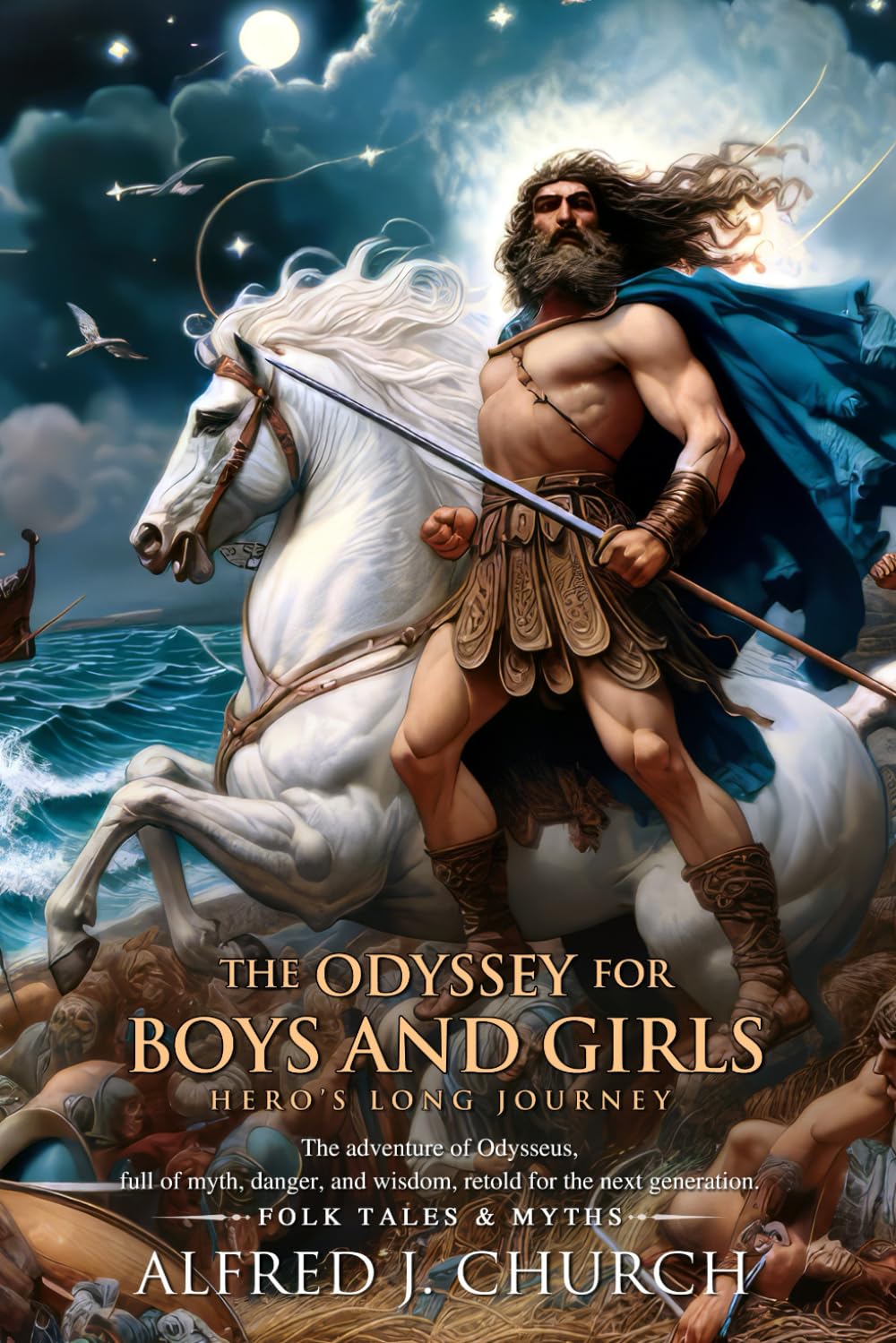



"The Odyssey for Boys and Girls" by Alfred John Church is a masterfully crafted adaptation of Homer’s epic *The Odyssey*, simplified for young readers without sacrificing the majesty, depth, or timeless appeal of the original. Church retells the incredible journey of Odysseus, the cunning Greek hero, as he struggles to return home after the Trojan War—an odyssey filled with enchantments, monsters, trials of character, and divine interventions. The story begins with Odysseus having been away from his home, Ithaca, for nearly twenty years—ten years fighting at Troy and ten more wandering the seas. His wife, Penelope, remains faithful, fending off suitors who seek her hand and throne, while their son, Telemachus, longs for his father’s return. Meanwhile, Odysseus, held captive on the island of Ogygia by the nymph Calypso, yearns to return to his homeland and loved ones. With the help of the goddess Athena and the intervention of Zeus, Odysseus is finally allowed to leave Calypso’s island. From there, his journey is recounted in a series of adventures that define him as not only a brave warrior, but a clever and resilient hero. Each episode presents moral challenges, clever solutions, and the unyielding drive to reach home. Among the most memorable adventures is his encounter with the **Cyclops Polyphemus**, a one-eyed giant who devours several of Odysseus’s men. Using his wits, Odysseus blinds the monster and escapes—a bold act that earns the wrath of Poseidon, Polyphemus’s father. This curse becomes one of the central obstacles on his journey. Other perilous trials follow: the land of the **Laestrygonians**, where giants destroy his fleet; the enchantress **Circe**, who turns his men into swine but is eventually persuaded to help him; and the chilling descent into the **Underworld**, where Odysseus speaks with the dead and learns critical truths about his destiny. In each tale, Church captures the suspense and wonder of Homer’s poetry in language that resonates with young minds. Odysseus also must navigate past the **Sirens**, whose enchanting songs lure sailors to their doom; between the monstrous **Scylla** and the deadly whirlpool **Charybdis**; and through the island of the **Sun God**, where his crew’s disobedience leads to their doom. Time and again, Odysseus’s leadership, courage, and devotion to his home are tested. After years of enduring these hardships alone, Odysseus is finally cast ashore on the island of the **Phaeacians**, where he recounts his tale. The Phaeacians, moved by his story, provide him passage home. Upon arriving in Ithaca, Odysseus finds his palace overrun with suitors. In disguise and with Athena’s help, he devises a plan. With his son Telemachus by his side, he reveals his identity and reclaims his home in a dramatic and just conclusion. Church’s version of *The Odyssey* retains the rich moral and thematic elements of the original—loyalty, perseverance, identity, justice, and the tension between human will and divine power—while using straightforward prose suited to children and young readers. The characters are vivid, the action fast-paced, and the journey itself inspiring. Odysseus is presented not merely as a man of strength, but of intellect, emotion, and enduring love for his homeland and family. In this accessible retelling, young readers are introduced to one of the greatest literary works of all time. "The Odyssey for Boys and Girls" preserves the integrity of Homer’s masterpiece while offering an entry point into the world of Greek mythology, heroic storytelling, and ancient values. Alfred J. Church’s work is not only a summary of a journey—it is a bridge between centuries, guiding the imagination of young readers across the same seas Odysseus once sailed.