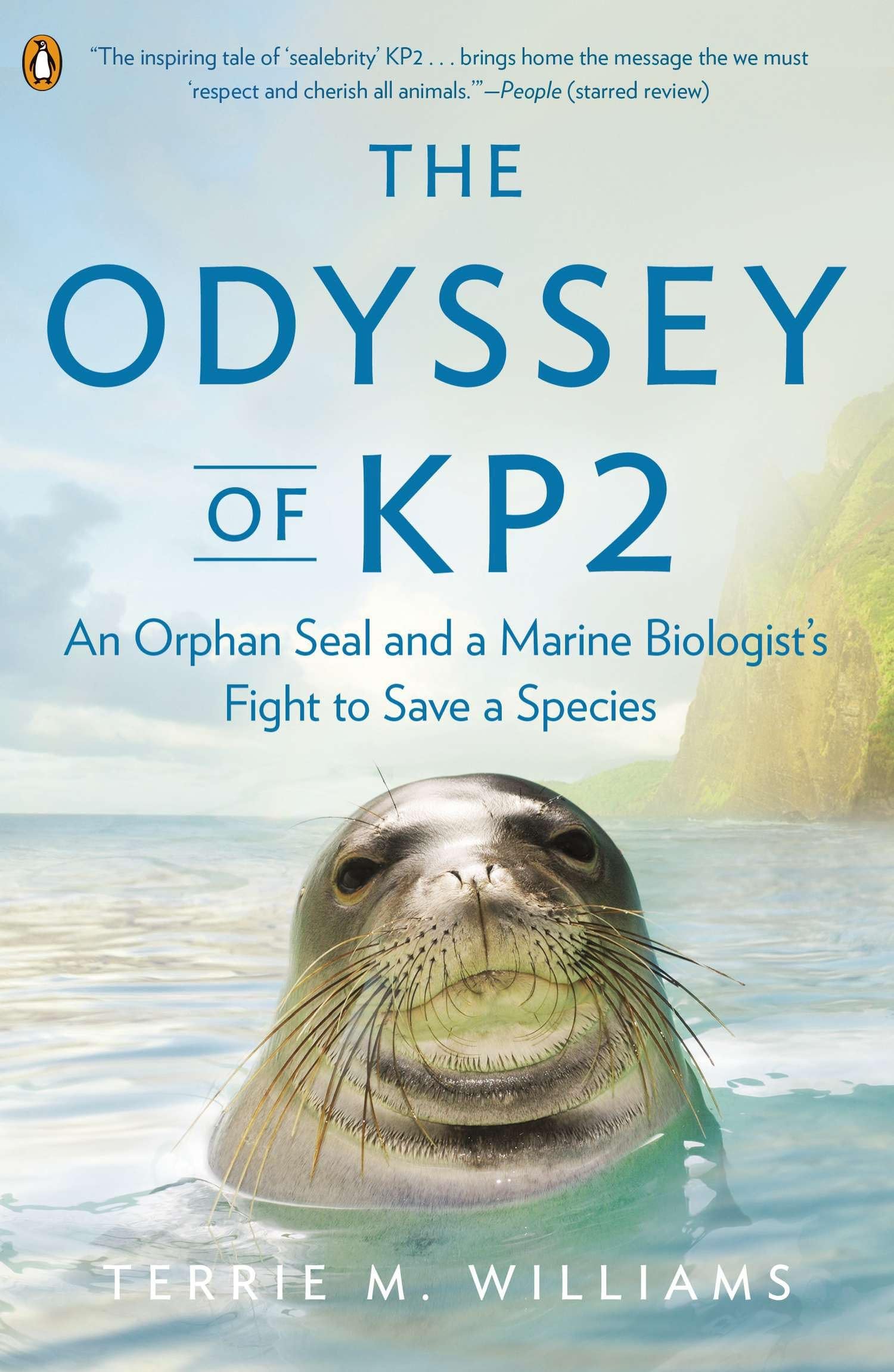
The Odyssey of KP2: An Orphan Seal and a Marine Biologist’s Fight to Save a Species
$13.00
by Terrie M. Williams



An inside look at a renowned marine biologist’s quest to save an abandoned, endangered seal pup Only eleven hundred Hawaiian monk seals survive in the wild. Without intervention, they face certain extinction within fifty years. When a two-day-old Hawaiian monk seal pup, later named Kauai Pup 2, or KP2, is attacked and abandoned by his mother on a beach, he is rushed off on a journey that will take him across the ocean to the California marine lab of eminent wildlife biologist Dr. Terrie M. Williams. As Williams works with the boisterous KP2 to save his species, she forms a lasting bond with him that illustrates the importance of the survival of all earth’s creatures and the health of the world’s oceans. Terrie M. Williams is the director of the Marine Mammal Physiology Project at the University of California, Santa Cruz, and a cocreator of the Center for Ocean Health. She was named one of the Fifty Most Important Women in Science by Discover magazine. She lives in Soquel, California. 1. Birth My earliest aspiration, at five years old, was to grow up to be a dog. This seemed the noblest of professions, and I determined that it was only a matter of time and desire before I grew the requisite four legs and tail. My religious parents, however, had equally unlikely expectations and prayed that I’d become a Roman Catholic nun. Sister Everista and Sister Agnes never knew their true influence on the girl known best for scraped-up knees and a love of the outdoors. Instead of civilizing the animal out of me, the stern-faced, black-habited sisters inadvertently taught me how to communicate with the “lowly creatures” of the Bible. I found that I could perceive the nearly invisible body and eye movements comprising animal language, and predict an animal’s next move as if I were inside its mind. It wasn’t communication in a Dr. Dolittle sense; rather, I was able to “read” the local dogs, cats, foxes, squirrels, and rabbits as others might read a newspaper. At every opportunity I’d escape the disinfected halls of the parochial schools and plunge into the wild chaos of the surrounding oak forests of the East Coast. The freedom to poke around creeks like an otter in search of frogs or to slip through thorny blackberry bushes with the liquid movement of a fox was exhilarating. My animal senses grew with time, much to the consternation of the nuns and the rest of the girls in my class. I was known somewhat disparagingly as “that girl who likes animals.” Trips to the confessional enforced by Sister Agnes with a twisting two-fingered clamp on my ear were, more often than not, to confess to the sin of having released some rescued frog, baby bird, or field mouse that had wriggled free of my pocket and crawled between the church pews. I considered the litany of Hail Marys recited on scabbed knees due penance for the creature’s salvation. Over the years this fascination with the furred and finned evolved into a lifetime of globe-trotting in the man’s world of wildlife research. I knew that my success had less to do with raw intelligence and more with an innate ability to relate to animals. If I couldn’t be an animal, then at least I could learn to appreciate the intimate details of their daily lives by studying them. The wilderness became my cathedral. Skittish cheetahs, playful dolphins, mitten-pawed sea otters, and stoic Antarctic seals were my congregation. Dominican discipline taught me focus; Mother Superior’s demands for self-sacrifice honed an inborn skill for animal empathy. Yet in all my wildlife encounters encompassing a lifetime of adventures, there was one major disappointment. No wild animal had ever read me in return. A Pembroke Welsh corgi named Austin, the canine member of my tiny Hawaiian ‘ohana (family), had come the closest. But when it came to the inhabitants of the woods and the oceans, animal communication had been a lonely, one-way affair. Nuns and scientific textbooks espoused that such was the nature of animals, since nonhuman creatures possessed neither souls nor intellect. Here I must say that both were mistaken. For, unexpectedly, after half a century of being the mind reader, one of them suddenly read me. He was not the fastest, biggest, or purportedly smartest of animals; rather he was an immature, nearly blind sea mammal that had been cast out by his own species. By all rights he should have died on an isolated beach on Kauai. Like me, he began life attempting to cross physical and societal boundaries that separated humans from animals, oblivious to the impossibility. He was a boisterous surprise in a scientific career that was in danger of maturing into comfortable cynicism. KP2 came into the world on May 1, 2008, in the usual way of seals—slippery, wet, and sliding unceremoniously from between his mother’s back flippers onto a nursing beach. With a shake of a head covered in thick black lanugo, the dark fetal fur jammies of his species, he opened his eyes to tropical tranquillity while res