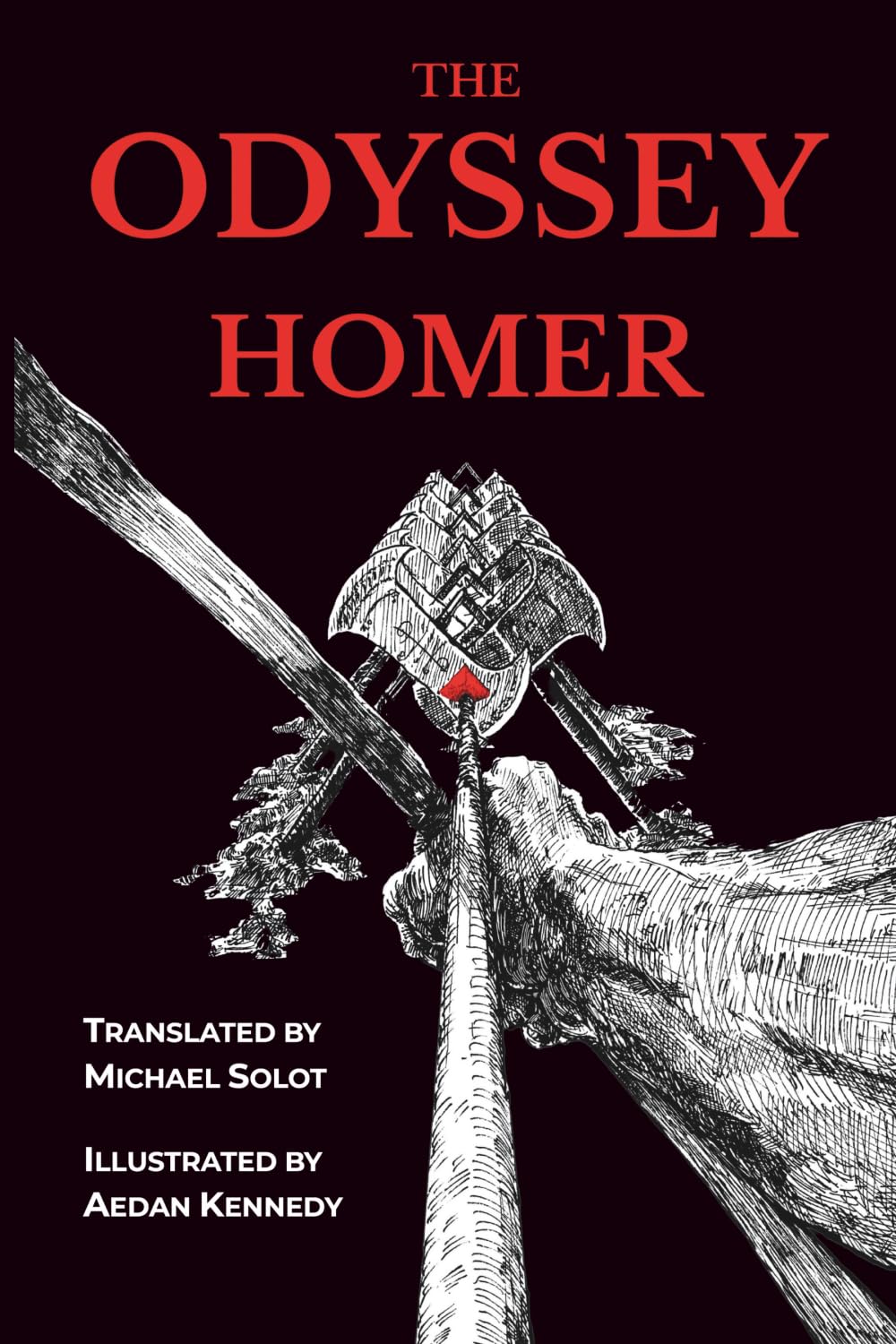



This is not your grandfather’s Odyssey . “Solot’s translation . . . breathes and bleeds. I have read many versions of the Odyssey , but when I read the Solot version I felt as if I were reading it for the first time.” — Brian Yapko, award-winning poet Homer, when he came to tell the story of the peace that followed the war in Troy, chose to focus on Odysseus—hardly the most glamorous hero in his Iliad , but the wiliest, a man who does whatever it takes to win, survive, and get what he wants. Homer chose well. Thanks both to the character of Odysseus, a fully modeled if not always admirable man, and to the instinctively cinematic storytelling of his creator, the Odyssey is not only one of the two foundational works of European literature, it remains one of the most entertaining of all time. This masterpiece of adventure, longing, and return is now reborn in a fresh translation by Michael Solot—fresh, because for him the Odyssey isn’t a subject of academic study, a precious relic to be handled by experts who know just what they’re looking for as they turn it this way and that. In Solot’s hands the epic is revealed as the robust, living work of art that it is. Homer’s poetry is often thought to be hard; it isn’t. The Odyssey is easy, and if you don’t already know what you’re looking for it’s full of surprises, and often very funny. The Odyssey ’s ease, its surprises, and its humor are all brought to light in Solot’s translation. Solot looks first to the story . So, to make it as easy to enjoy in English as it is in Greek he rejected the restrictive line-for-line approach often found in academic translations, a constraint that helps the student trying to construe his text, but does nothing for the reader trying to follow the tale. Likewise, Solot steered clear of both blank verse and any attempt to imitate Homer’s metrics directly, the two most common ways of versifying Homer in English. Instead he has developed a supple five-beat line, as consistently scannable as Homer’s own hexameter, but with a length and a cadence far better suited to the task of recreating the distinctive flow of Homer’s poetry. Solot’s verse—dactylic here, anapestic there—everywhere seeks to embody the endlessly varying and propulsive rhythms of the original. Aedan Kennedy brings the Odyssey to life as never before with more than eighty pen-and-ink illustrations drawn especially for this edition. Other illustrated versions offer only a small number of drawings set off against the text on separate pages; here each of Kennedy’s illustrations is placed precisely within the text to depict a particular moment in the story, a unique achievement in the history of Homeric translation. In place of a commentary this edition offers an introduction summarizing the following: what we know about Homer; the heroic ethos of his poetry, and its importance in the decision Odysseus makes to return home; the basic themes of the Odyssey ; the plotlines and the structure of the poem; the differences between the Odyssey and the Iliad ; their unity of authorship; and the affinities between Homeric and cinematic storytelling. There is also a survey of some of the many varieties of humor to be found in the Odyssey , with explanatory examples of each. Also included: “Reading the Rhythm,” a guide for those unfamiliar with metrical verse; a pronouncing glossary; and three maps by Bailey Bellavance covering the geography of the Homeric world. "In the crowded field of Homeric translation, where the pendulum has long swung between literal fidelity and poetic freedom, Michael Solot's Odyssey emerges as something rare: a linguistically rich, metrical recreation that feels both ancient and alive. Solot's verse moves with the pulse of the sea he describes—waves of rhythm breaking, retreating, returning—conveying not merely the meaning of Homer's Greek but its energy, its oral vitality, its relentless forward motion." — James Sale, author of the epic poem "The English Cantos" "Solot's work focuses on the human aspects of the characters, giving his Odyssey an emotional heft that is missing from other versions. This affords the piece an almost cinematic quality—an aspect greatly enhanced by Aedan Kennedy's splendid illustrations, which go far beyond the usual stiff representation of an overexposed scene here and there. Rather, they reinforce the words and give them heart. The marriage of art and language in this translation is a joy for the reader to experience." — Brian Yapko, award-winning poet "Odysseus' journey is one we all recognize, and Michael Solot helps us feel that from the start. His introduction offers a clear path into Homer's world, even highlighting the epic's unexpected humor, so readers coming to the story for the first time can fully enjoy it." — Michael Pietrack, bestselling author of "Legacy" and "Boone"