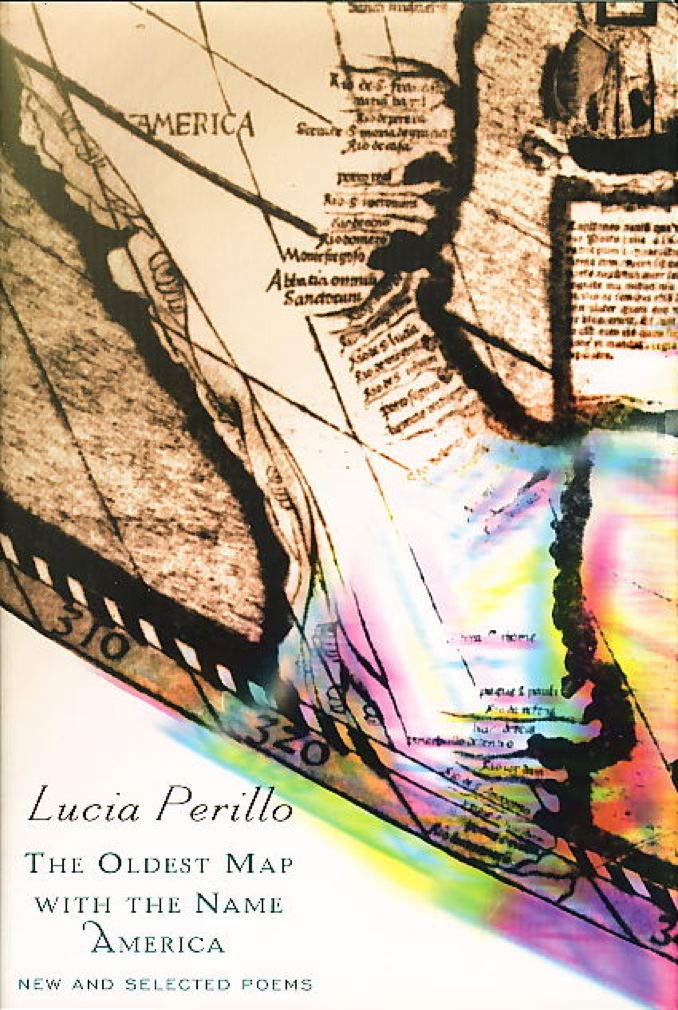



Lucia Perillo's poetry embodies a sensibility at once personal and national. Many of her poems are candid and affecting--some document how she negotiates life with multiple sclerosis; others concern her working-class Catholic childhood in a small Hudson River town. But in general, and even in these personal works, her poetry picks up the fragments of American culture--Bart Simpson, crimes of violence, Girl Scouting, teen rebellion, redneck survivalists--and assembles them into a highly readable and illuminating cultural commentary. One poem, "Foley," blends the subjects of movie sound effects and phone sex to make the point that in electronic America things are seldom as they seem--or sound. In "For I Have Taught the Japanese," an ESL instructor confesses, "I was such/an idiot I even tried to apologize more than once/for Nagasaki." In a third, Perillo thumbs through a survivalist magazine to see what it has to offer to her newborn nephew: "They're hawking a T-shirt: I entered the world/fat, mad, and bald, and I plan on leaving that way." The texture of Lucia Perillo's writing is conversational, poignant, often mordantly funny. The structure of her work is architectural in its grandeur, dramatic in its impact. Taken together, the poems in The Oldest Map with the Name America present the reader with an important new way of looking at the world--a vision that in its coherence provides us with a deep and original understanding of what we're all about, as individuals and as a culture. "Someday / you could even write a poem," Lucia Perillo tells her newborn nephew in "The Sportsmen's Guide," then ruefully adds, the tradition of which pretty much demands the reader be told off the bat what a muckheap the world is. But then comes the swerve where the poet flipflops or digresses to come up with something that the muckheap will surprise you with. This is, in a sense, the distillation of both Perillo's poetic voice--funny, knowing, tough--and her mission: to show the world in all its beauty and terror and strangeness. Is there a better title, anywhere, than "Thinking About Illness After Reading About Tennessee Fainting Goats"? ("Stopped in their tracks / they go down like drunks.... / How cruel, gripes a friend. But maybe they show / us what the body's darker fortunes mean-- / we break, we rise. We do what we're here for.") For Perillo, transcendence is an ambiguous business. "The Body Rising," for instance, moves from airborne disasters and funeral-home smoke to the miracle of teenage punks handed up from the mosh pit "weightless and waterlogged, bullied and buoyed." But for every body rising, there is another that wants to fall. Perillo's women hitchhike and rock climb; they earn their Girl Scout merit badges in "Dangerous Life." In "Pomegranate" her ambivalent Persephone must choose between, on the one hand, "the underground gods and their motorbikes" and, on the other, "daylight, sure / but also living with her mother." It's the tension between these that makes Perillo's dangerous poetry sing; she's like the narrator of "Kilned," who sculpts with molten lava "to see what this catastrophe is saying." The world may indeed be a muckheap, but these poems never fail to surprise. --Mary Park "Born on the same day the Big Bopper perished--one of her poems tells us--Lucia Perillo is a poet of culture, high and low. I love the way she allows it all to flood into her work, how she welcomes Bart Simpson and Edward Hopper, Harrison Ford and Heraclitus, Pliny and Edith Piaf. These poems are lively, various, beautiful--some collected, most new, and all aimed precisely at the reader." --Billy Collins "I first encountered Lucia Perillo's work about ten years ago and found it breathtaking and bold in its range of reference and feeling. It is now better than ever, it seems, full of energy yet with an eye for the holy and serene." --Lorrie Moore Lucia Perillo's poetry embodies a sensibility at once personal and national. Many of her poems are candid and affecting--some document how she negotiates life with multiple sclerosis; others concern her working-class Catholic childhood in a small Hudson River town. But in general, and even in these personal works, her poetry picks up the fragments of American culture--Bart Simpson, crimes of violence, Girl Scouting, teen rebellion, redneck survivalists--and assembles them into a highly r "Born on the same day the Big Bopper perished--one of her poems tells us--Lucia Perillo is a poet of culture, high and low. I love the way she allows it all to flood into her work, how she welcomes Bart Simpson and Edward Hopper, Harrison Ford and Heraclitus, Pliny and Edith Piaf. These poems are lively, various, beautiful--some collected, most new, and all aimed precisely at the reader." --Billy Collins Lu