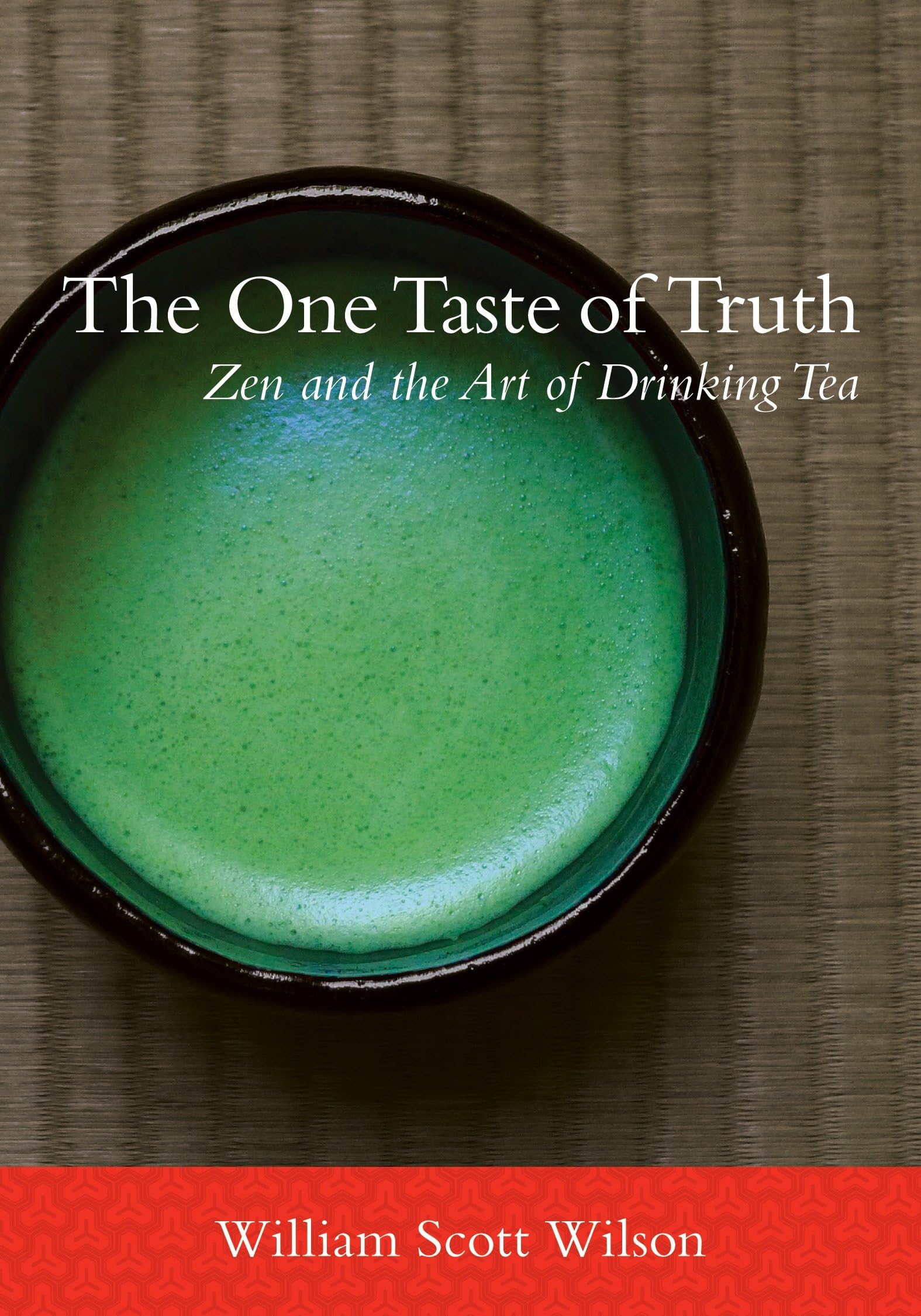



This heartfelt ode to the meditative practice of drinking tea examines the origins of traditional tea culture in the East, revealing how a good cuppa can elevate both the mind and spirit Traditionally in China and Japan, drinking a cup of tea was an opportunity for contemplation, meditation, and an elevation of mind and spirit. Here, renowned translator William Scott Wilson distills what is singular and precious about this traditional tea culture, and he explores the fascinating connection between Zen and tea drinking. He unpacks the most common phrases from Zen and Chinese philosophy—usually found in Asia printed on hanging scrolls in tea rooms, restaurant alcoves, family rooms, and martial arts dojos—that have traditionally served as points of contemplation to encourage the appropriate atmosphere for drinking tea or silent meditation. Part history, part philosophy, part inspirational guide, The One Taste of Truth will connect you to the distinctive pleasure of sipping tea and allowing it to transport your mind and thoughts. This beautifully written book will appeal to tea lovers and anyone interested in tea culture, Chinese philosophy, and Zen. William Scott Wilson is the foremost translator into English of traditional Japanese texts on samurai culture. He received BA degrees from Dartmouth College and the Monterey Institute of Foreign Studies, and an MA in Japanese literary studies from the University of Washington. His best-selling books include The Book of Five Rings , The Unfettered Mind , and The Lone Samurai , a biography of Miyamoto Musashi. chapter 1 Fundamentals 〇1En, or enso This is the circle signifying the freedom, impartiality, and equality of the Buddha, in which nothing is lacking. It is the symbol of absolute or true reality, and therefore of enlightenment. The enso is a popular subject in Zen painting, and perhaps, more than in the calligraphic art itself, is said to demonstrate the painter’s state of mind. It is usually executed with a single brushstroke, with the end of the brushstroke often trailing to meet the beginning. In this way, the enso indicates that the world is at once both perfect and imperfect (absolute and relative), or perfectly imperfect: it is the slightly misshapen tea bowl from which we drink tea, said to be the flavor of Zen. There is an interesting anecdote concerning an enso in the Piyenlu, the twelfth-century collection of Zen koans: Nan-ch’uan, Kuei Tsung, and Ma Ku were traveling together to offer ceremonial salutations to the National Teacher Chung.1 When they reached the halfway point, Nan-ch’uan drew an enso on the ground and said, “If you can say [a word of Zen], we’ll keep going.” Kuei Tsung sat down in the middle of the enso. . . . Nan-ch’uan said, “If that’s it, we aren’t going any farther.” Kuei Tsung said, “Where is this man’s mind going?” [是什麻心行]. Piyenlu, case 69 Like Kuei Tsung, we may wonder what’s going on here, but it would seem that the man of Zen is neither totally within the enso nor outside of it. Some commentators have speculated that the enso has its origin in the full moon, often a Buddhist symbol of enlightenment. But however one wishes to interpret the enso, it is considered to be an absolute test of the balance and spontaneity of the painter’s mind (or Mind), and the best or most interesting are often displayed not only in tea rooms and Zen temples, but in martial arts dojos as well. Indeed, the great swordsman and painter Miyamoto Musashi said in essence that the stroke of the sword and the stroke of the brush are the same: that with each stroke, the mind of the practitioner could be observed with certainty. This is reflected in the Chinese dictum 心正即筆正 When the mind is correct, the brush will be also. The same can be said for the ladling of the water, the movement of the whisk, and the taste of the tea. Although the enso almost always appears by itself, it is sometimes accompanied by other Chinese characters, as in: ○是れ食ふて茶飲め Eat this, and have a cup of tea. 無2Mu “Emptiness” This is no doubt the best-known Chinese character in Zen literature and calligraphy. Variously translated as “Emptiness,” “the Void,” “Nonexistence,” or “the Origin of All Things,” it is etymologically related to the character for “dance,” the archaic form depicting a man or woman adorned ornamentally going through dance-like movements. Could this indicate the empty, receptive mental state reached by dancing shamans or shaman-esses? Or could it simply represent, as the folk etymology holds, a forest burned to nothingness? In the third or fourth century, Lao Tzu, the old man who is said to have established Taoism as a philosophy, had this to say: Thirty spokes make the nave of a wheel, Yet it is the nonbeing [at the center of the wheel] that is the wheel’s utility. It is the kneaded clay that fashions a pot, Yet it is the nonexistence [inside the pot] that is the pot’s utility. It is the chiseling out of window