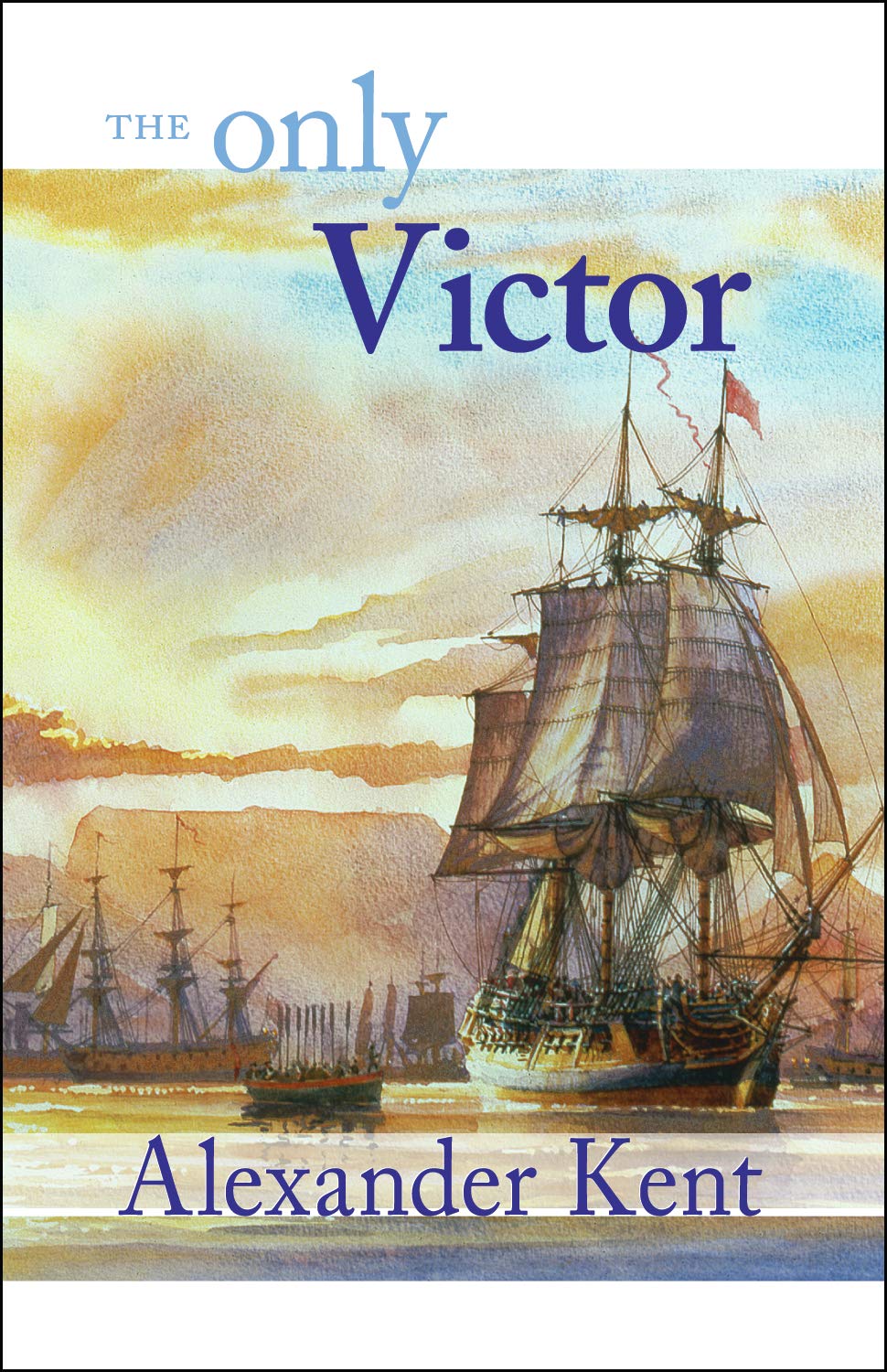



February 1806: Vice-Admiral Sir Richard Bolitho carries the news of Trafalgar to southern Africa, where he is to aid British ground forces in any way he can to retake Cape Town from the Dutch. Impatient to be home, Bolitho decides yet again that the boldest measures are best, and proves to the army that brave men do not die in vain. "Kent's descriptions of ships under sail . . . crackle with realism." -- Library Journal Alexander Kent, pen name of Douglas Edward Reeman, joined the British Navy at 16, serving on destroyers and small craft during World War II, and eventually rising to the rank of lieutenant. He has taught navigation to yachtsmen and has served as a script adviser for television and films. His books have been translated into nearly two dozen languages. The Only Victor By Alexander Kent McBooks Press, Inc. Copyright © 1990 Highseas Authors Ltd. All rights reserved. ISBN: 978-0-935526-74-5 CHAPTER 1 "in the Name of duty" Captain Daniel Poland of His Britannic Majesty's frigate Truculent stretched his arms and stifled a yawn, while he waited for his eyes to accustom themselves to the darkness. As he gripped the quarterdeck rail and the dim figures around him took on identity and status, he was able to accept the pride he felt for this command, and the fashion in which he had moulded his company into a team, one that would react to his wishes and orders with little room for improvement. He had been in command for two years, but would not be fully "posted" for a further six months. Then, and only then, would he feel safe from disaster. A fall from grace, an unfortunate mistake or misunderstanding of some senior officer's despatches — any of these could hurl him down the ladder of promotion; or worse. But once a post-captain with matching epaulettes on his shoulders, little could shift him. He gave a brief smile. Only death or some terrible wound could do that. The enemy's iron was no respecter of the hopes or ambitions of its victims. He moved to the small table by the companion way and raised its tarpaulin hood so that he could examine the log by the light of a small shaded lamp. Nobody on the quarterdeck spoke or disturbed him; every man was well aware of his presence and, after two years, his habits. As he ran his eyes along the neatly written comments of the most recent officers-of-the-watch he felt his ship lift and plunge beneath him, spray whipping across the open deck like cold hail. In an hour all would be different. Again he felt the same twinge of pride, cautious pride, for Captain Poland trusted nobody and nothing which might bring displeasure from his superiors, and which in turn might damage his prospects. But if the wind held they would sight the coast of Africa, the Cape of Good Hope, perhaps at first light. Nineteen days. It was probably the fastest passage ever made by a King's ship from Portsmouth. Poland thought of the England they had seen fall into a rain squall as Truculent had thrust her way down-Channel for open waters. Cold. Wet. Shortages and press gangs. His gaze fastened on the date. The first of February,1806. Perhaps that was the answer. England was still reeling from the news of Trafalgar, which had exploded less than four months ago. It seemed people were stunned more by the death of Nelson, the nation's hero, than the crushing victory over the French and Spanish fleets. Even aboard his own ship, Poland had sensed the change, the damage to morale amongst his officers and seamen. Truculent had not even been in the same ocean at the time of the great battle, and to his knowledge none of the people had ever laid eyes on the little admiral. It irritated him, just as he damned the luck which had taken his ship so far from a fight out of which only glory and reward could result. It was typical of Poland that he had not considered the awesome lists of dead and wounded after that memorable day off Cape Trafalgar. He peered up at the pale shape of the bulging mizzen topsail. Beyond it there was only darkness. The ship had rid herself of her heavy canvas and changed every sail to the pale, light-weather rig. She would make a fine sight when the sunlight found her again. He pictured her rapid passage south, with the mountains of Morocco misty blue in the far distance, then south-east across the Equator with the only landfall the tiny island of St Helena, a mere speck on the chart. It was no wonder that young officers prayed for the chance to gain command of a frigate, where once free of the fleet's apron strings and the interference of one admiral or another, they were their own masters. He knew that to his company a captain was seen as some kind of god. In many cases it was true. He could punish or reward any soul aboard with impunity. Poland considered himself a just and fair captain, but was sensible enough to know that he was feared rather than liked. Each day he had made certain that his men were not lacking in work. No admiral would find fau