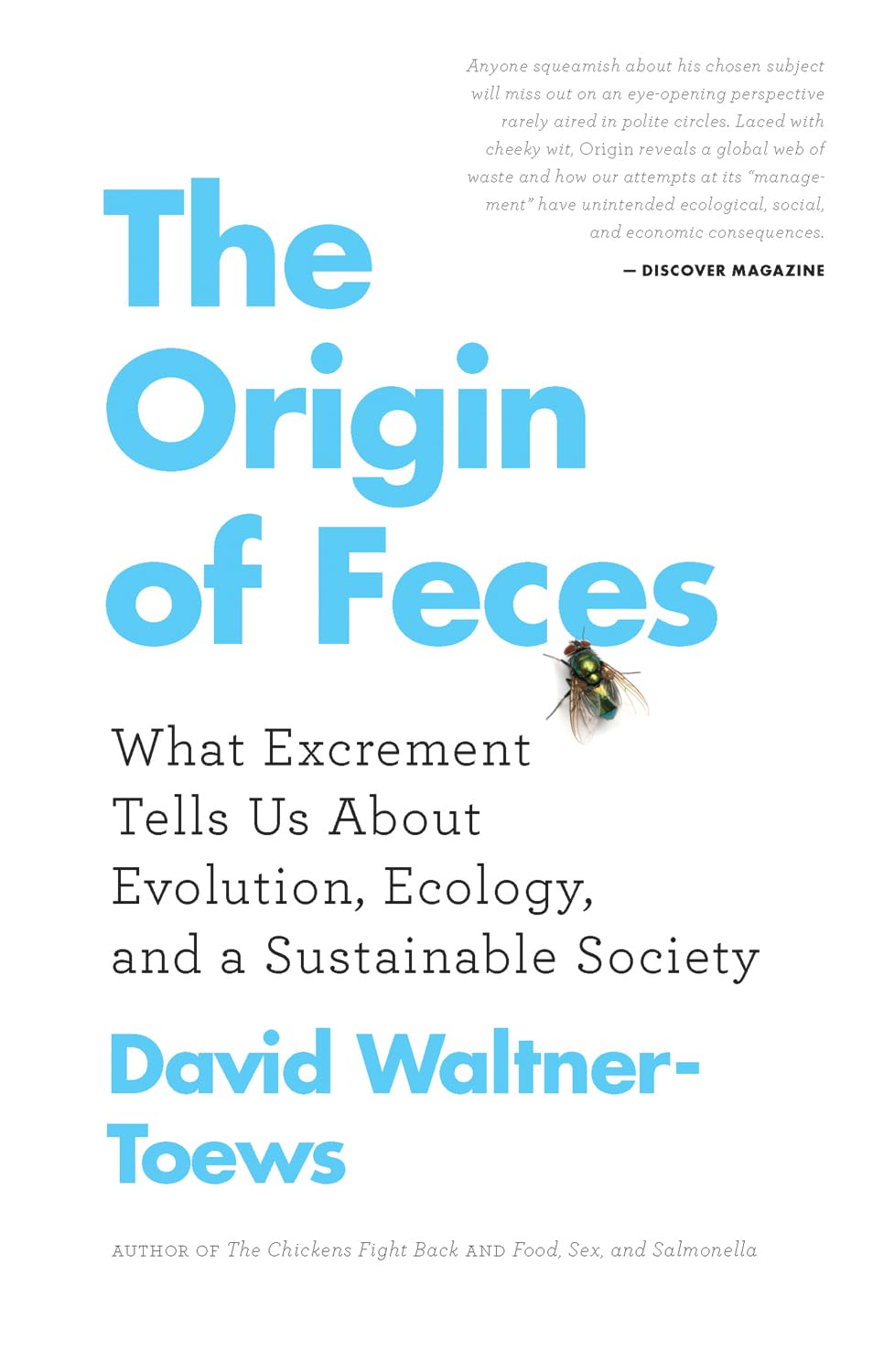
The Origin of Feces: What Excrement Tells Us About Evolution, Ecology, and a Sustainable Society
$16.95
by David Waltner-Toews



The Origin of Feces takes an important subject out of locker-rooms, potty-training manuals, and bio-solids management boardrooms into the fresh air of everyone’s lives. With insight and wit, David Waltner-Toews explores what has been too often ignored and makes a compelling argument for a deeper understanding of human and animal waste. Approaching the subject from a variety of perspectives — evolutionary, ecological, and cultural — The Origin of Feces shows us how integral excrement is to biodiversity, agriculture, public health, food production and distribution, and global ecosystems. From the primordial ooze to dung beetles, from bug frass, cat scats, and flush toilets to global trade, pandemics, and energy, this is the awesome, troubled, unexpurgated story of feces. “David Waltner-Toews has written a fascinating little book on the subject, full of small- and large-scale insights, esoteric yet riveting assessments of globalization, and wisecracks that are no doubt unavoidable given the subject matter…It’s a book worth reading.” — New York Journal of Books “At the heart (or gut) of The Origin of Feces is the idea that whether we like it or not, excrement is not only connected to every aspect of our lives but is also a crucial ingredient of life itself…Those sorts of ideas, along with a load of surprising facts and a good dose of levity (your inner five-year-old will think the poop jokes are hilarious), make for an enjoyably absorbing and profound read.” — Canadian Geographic “Uses humour and science to discuss its evolutionary, ecological and cultural perspectives. He shines a light on a subject many people would rather not think about, thank you very much.” — The Record “David Waltner-Toews picks up the thread with his impassioned treatise on the long, strange, even transcendent afterlife of poop in The Origin of Feces, a book whose cover is guaranteed to make you few friends at the coffee shop.” —Slate.com “Waltner-Toews takes as humorous approach to the scatological subject as you can; one chapter is titled ‘The Other Dark Matter.’ But at the heart of the book is a rather weighty message: ‘Unless we change how we think about’ waste, he writes, ‘we are doomed to forever live in it.’” — The Washington Post “In many modern societies, poop is perceived as a problem— potentially dangerous waste that has no place in our lives… in the cleverly-named The Origin of Feces , Canadian veterinarian and epidemiologist Waltner-Toews does the dirty work of dispelling that perception.” — National Geographic “It may be a poor topic for polite company, but we can learn a tremendous amount from both human and animal waste.… Until you read this, you really won’t know sh*t.” — Publishers Weekly , starred “Whether it's a gag gift, a toilet-side alternative to Sudoku or just some light, easily digestible po(o)p-sci fare, The Origin of Feces is sure to be a fun and pungent read.” — Bookish.com David Waltner-Toews is a veterinarian and epidemiologist. He is the author of The Chickens Fight Back: Pandemic Panics and Deadly Diseases That Jump from Animals to People (Greystone Books, 2007) and Food, Sex and Salmonella: Why Our Food Is Making Us Sick (Greystone Books, 2008). The Origin of Feces What Excrement Tells Us About Evolution, Ecology, and A Sustainable Society By David Waltner-Toews ECW PRESS Copyright © 2013 David Waltner-Toews All rights reserved. ISBN: 978-1-77041-116-6 CHAPTER 1 WHAT FROM THE TONGUE FALLS Fictional character Tante Tina Wiebe, in a dramatic monologue recounting family stories about Christmas, says that, whatever else has changed about Mennonite culture, the men still walk as if they are "bringing in the cows," but then laments that "... maybe too much sometimes what was once on the boots clinging now from the tongue falls ..." Before one can tell a story, one must have words. With words come culture, and with culture come taboos and conflicts, things we don't talk about, and don't talk about not talking about, even if we are sitting in a pile of it. If we cannot name "what from the tongue falls," how can we possibly, seriously, address all the other dimensions of excrement? How can we unleash the incredible power of excrement if we don't know shit? Shit is what sociologists and scientists call a wicked problem. The social planners who introduced the idea of wicked problems in the 1970s differentiated them from what were considered to be the "tame" problems addressed by conventional science. Wicked problems, they asserted, are poorly bounded and contradictory. They are difficult to solve because information is incomplete, or the requirements of those who want the problem solved keep changing. They can be defined from a variety of apparently incompatible perspectives, so that there is neither a definitive problem formulation nor an optimal solution. Worst of all, the solutions to some aspects of the problem may create or reveal other problems. Many public health and