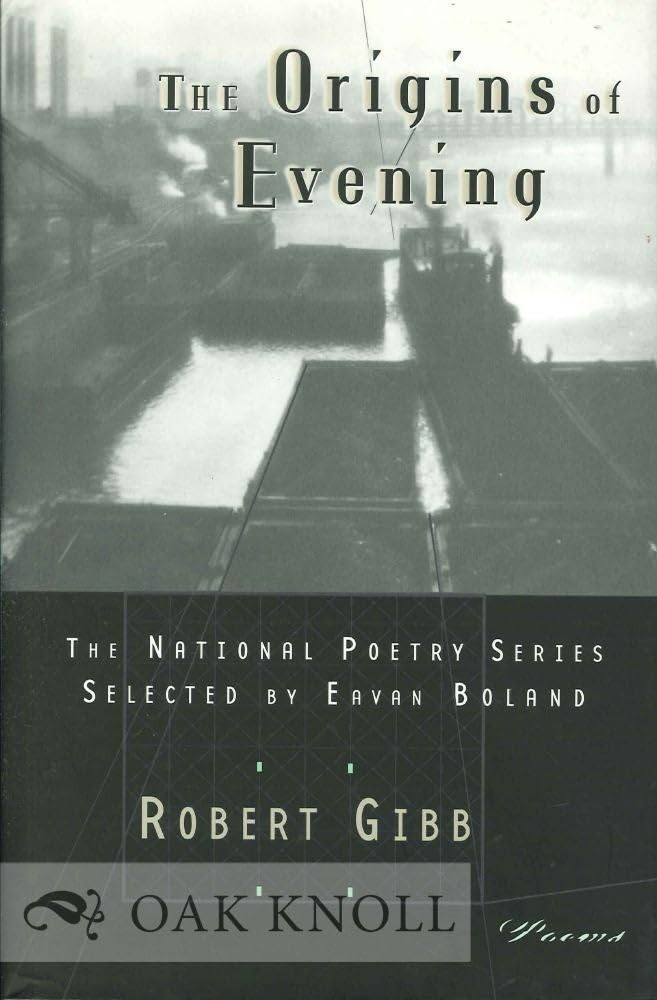



Winner of the 1997 National Poetry Series, judged and selected by Eavan Boland. Of the collection, Eavan Boland wrote: "The deft language and lyric intent of these poems serve one purpose: slowly and exactly they expose the dark, silvery images of a lost world. Here is Pittsburgh at twilight, in the old dusk of the steel mills. Here is a drug store, the Monongahela river, the trolleys and the carbarns. And here is memory at its most scalding, intense, and rigorous. This world is never regretted, never mourned for. There is no elegy here because not a single detail in this remarkable landscape has ceased to exist. It is all there, all alive, all available to language. This is a rare and forceful book of poems." One of the troubles of being a poet in contemporary America, it seems, is the rise of a pervading solemnity; afraid of revealing a fatal weakness by saying too much, or seeming to sing, our poets assure us of their worth by their unceasing seriousness. Gibb's fifth book of poems, the 1997 National Poetry Series-winning Origins of Evening, is unrelentingly downcast: the words night and gray and dark recur like bells striking the hour. Gibb has made a compelling craft out of the deep sadness of the spiritless and dangerous manual labors done in and around the Pittsburgh of his childhood, though the influence of James Wright on his diction and manner is heavy and at times imprisoning. Death, illness, and accident follow each other in mournful procession; even as Gibb describes early sexual feelings in "The Shape of the Goddess in Homestead Park" or "The Adorations," the effect is oddly involuted, as if in apology for the unexpected warmth of the subject. There is a musically gifted, exuberant poet within Gibb, if he were only permitted to sing. For larger collections of contemporary literature.?Graham Christian, Andover-Harvard Theological Lib., Cambridge Copyright 1998 Reed Business Information, Inc. This Pittsburgh-based poets latest volume, selected by Eavan Boland for 1997's National Poetry Series, wears its working- class credentials on its sleeve. Gibbs neo-proletarian poemsarranged on the page in the semblance of formsmoan and whimper about the lost world of mill workers and the unique glow that defines the industrial Pittsburgh and nearby Homestead. The past weighs so heavily on the poet that he cant enjoy the weather (Lines in a Slow Thaw) without thinking of the great lockout of 1892. The only greater burden is the memory of his fathers madness (Fathers and Sons), and his cremation (Fire Poem), which he inevitably links to the mill fires. Entering the Oven and First Daytwo of the strongest poems in the volumeboth record in fiery verse the poets own time on the graveyard shift at the plant, and the dizzying heat of working inside the great ovens. Elsewhere Gibbs subjects exist in solemn relation to his sounds: his celebrations of music are themselves tone-deaf; and his defense of drunkenness (Letter to a Friends Wife) couldnt be more sober. Memories intrude on the present in Gibbs somber verse, as drab and gray as the cityscape that haunts him. -- Copyright ©1998, Kirkus Associates, LP. All rights reserved. In this collection of poems about Pittsburgh, said reviewer Dennis Loy Johnson, the author delivers "a surgically precise yet dream-like evocation of the city and its surroundings." Calling the poems "impressive in their careful craftsmanship," Johnson said, "There is much to clap about in this touching and evocative book. -- Pittsburgh Tribune-Review, 13 December 1998 The deft language and lyric intent of these poems serve one purpose: slowly and exactly they expose the dark, silvery images of a lost world. Here is Pittsburgh at twilight, in the old dusk of the steel mills. Here is a drug store, the Monongahela river, the trolleys and the carbarns. And here is memory at its most scalding, intense, and rigorous. This world is never regretted, never mourned for. There is no elegy here because not a single detail in this remarkable landscape has ceased to exist. It is all there, all alive, all available to language. This is a rare and forceful book of poems. -- Eavan Boland Robert Gibb lives in Pittsburgh, Pennsylvania. His previous volumes include The Winter House, Fugue for a Late Snow, and Momentary Days, which won the Camden Poetry Award. His poetry has been published in Esquire, Poetry, Kenyon Review, Southern Review, and other magazines.