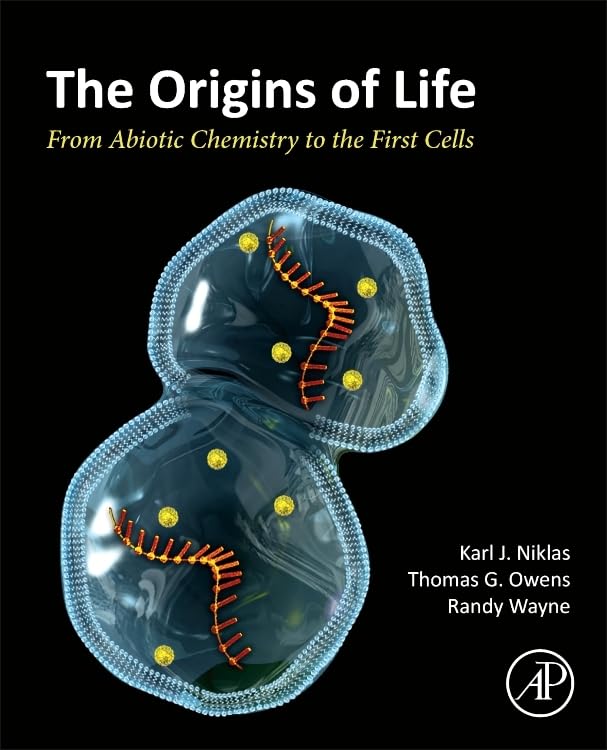



The Origins of Life: From Abiotic Chemistry to the First Cells is an essential textbook that tackles one of the greatest mysteries in science, how inanimate matter evolved into the first living things. The book takes an interdisciplinary approach, delving into the basic principles of the earth’s chemistry, the formation of pre-cellular entities, and the acquisition of chemical complexity. It explains the creation of chromosomes, metabolic pathways, and the features of the earliest prokaryotes. Users will find a detailed exposition of the World RNA Hypothesis in an accessible and easy-to-read style which is comprehensible for both science and non-science majors. This textbook is a critical resource for upper-level undergraduate students in Cellular Biology, specifically those studying or researching evolution, cellular chemistry, and pre-biotic chemistry, as well as non-science majors in courses on the philosophy of science or related topics. It is also useful for professionals in biochemistry, evolutionary biology, and astrobiology who wish to understand the origins of life and first cells. Science communicators could use this interdisciplinary textbook for teaching and dissemination to broader audiences as well. Functions as a readable and instructive book on the evolution of life - Offers a deep dive into the first principles of the physical sciences - Explores, in detail, the emergence of life from inanimate matter - Presents the RNA World Hypothesis in considerable depth An approachable textbook that tackles one of the greatest mysteries in science, the emergence of the first living things from inanimate matter, for both STEM and non-science majors The Origins of Life: From Abiotic Chemistry to the First Cells is an essential and intriguing textbook that tackles one of the greatest mysteries in science, how inanimate matter evolved into the first living things, using the first principles of the physical sciences. It takes an interdisciplinary approach to delve into the basic principles of the earth’s chemistry, the formation of pre-cellular entities and the acquisition of chemical complexity. It explains the creation of chromosomes, metabolic pathways, and the features of the earliest prokaryotes. It offers a detailed exposition of the World RNA Hypothesis in an accessible and easy-to-read style which is comprehensible for both science and non-science majors with varying degrees of pre-existing expertise. The first four chapters introduces the first principles of the physical sciences and how they directly relate to biology. The application of these principles to understand how life evolved begins in the subsequent chapters which introduce the RNA World Hypothesis and discuss how RNA molecules can participate in a self-replication process. The most important concepts of activation energy, organic molecular catalysis, and the evolution of ribozymes (ribonucleic acids capable of catalyzing chemical reactions) are introduced. The final parts of the book expand on the problems as well as the positive aspects of RNA World Hypothesis to explain how DNA became the repository of the hereditary code, the evolution of a core metabolism and how the genetic code became concatenated into chromosomes and conveyed during binary fission. They bring the narrative to a closure by considering seven critical evolutionary innovations (“themes”) diversified in different lineages (“variations”), e.g., photosynthesis, multicellularity, eukaryogenesis, mitosis/meiosis, and symbiosis. This textbook is a critical resource for upper-level undergraduate students in Cellular Biology, specifically those studying or researching evolution, cellular chemistry, and pre-biotic chemistry, as well as non-science majors in courses on the philosophy of science or related topics. It is also useful for professionals in biochemistry, evolutionary biology, and astrobiology who wish to understand the origins of life and first cells. Science communicators could use this interdisciplinary textbook for teaching and dissemination to broader audiences as well. Karl Niklas is an emeritus professor at Cornell University. He is the author of five books, and has taught classes ranging from Introductory Biology, Introductory Botany, Evolution, and Biomechanics. His research has focused on the application of engineering principles and physics to understand biology and evolution. Tom Owens is an emeritus professor at Cornell University. Over the course of his career, he taught classes that spanned the range from Introductory Biology through the physiology, biochemistry, and biophysics of plant processes. His research encompassed the physiology and molecular biophysics of photosynthesis Randy O. Wayne is a plant cell biologist at Cornell University notable for his work on plant development. In particular, along with his colleague Peter K. Hepler, Wayne established the powerful role of calcium in regulating plant growth; accordingly, their 1985 article, Ca