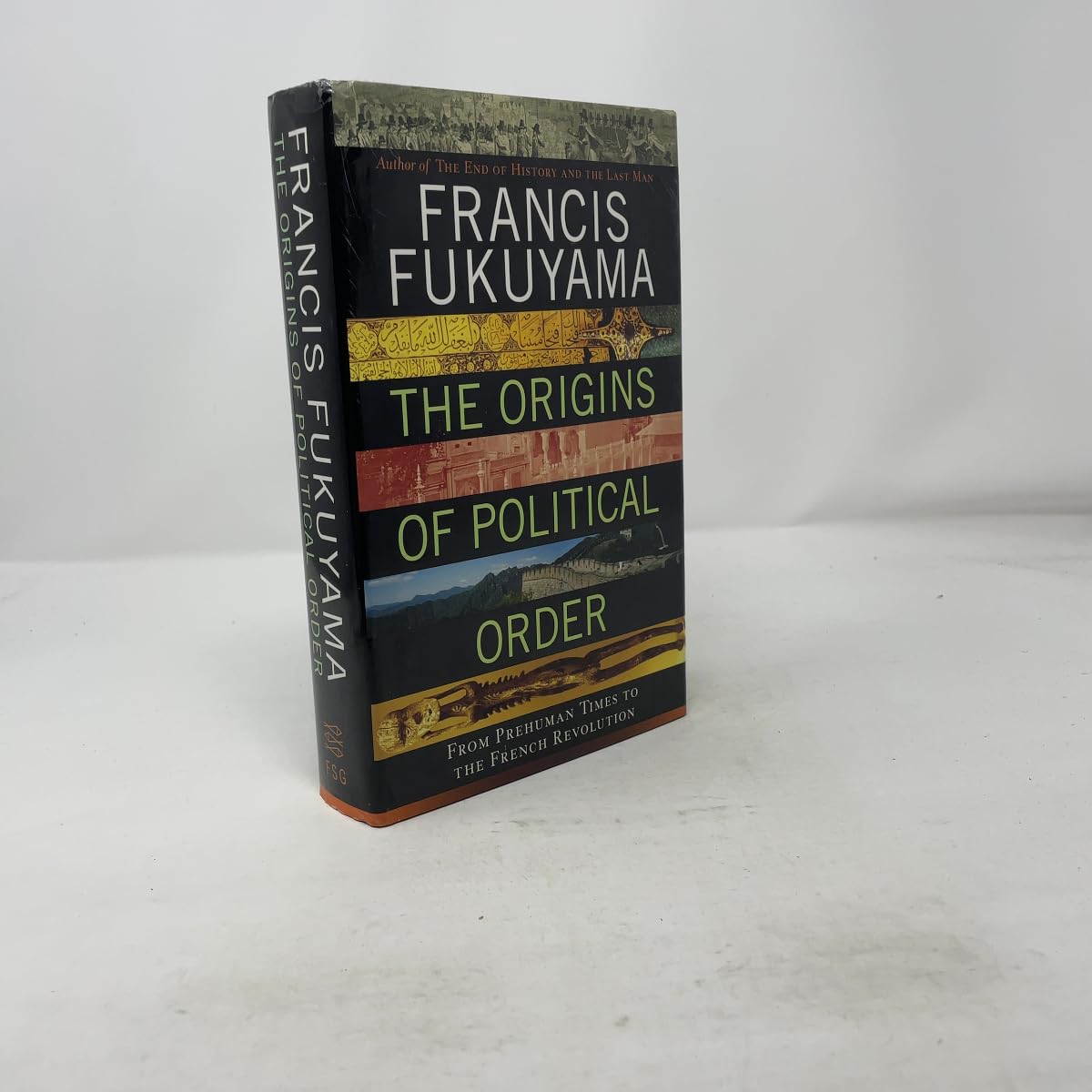
The Origins of Political Order: From Prehuman Times to the French Revolution
$31.39
by Francis Fukuyama



Virtually all human societies were once organized tribally, yet over time most developed new political institutions which included a central state that could keep the peace and uniform laws that applied to all citizens. Some went on to create governments that were accountable to their constituents. We take these institutions for granted, but they are absent or are unable to perform in many of today’s developing countries—with often disastrous consequences for the rest of the world. Francis Fukuyama, author of the bestselling The End of History and the Last Man and one of our most important political thinkers, provides a sweeping account of how today’s basic political institutions developed. The first of a major two-volume work, The Origins of Political Order begins with politics among our primate ancestors and follows the story through the emergence of tribal societies, the growth of the first modern state in China, the beginning of the rule of law in India and the Middle East, and the development of political accountability in Europe up until the eve of the French Revolution. Drawing on a vast body of knowledge—history, evolutionary biology, archaeology, and economics—Fukuyama has produced a brilliant, provocative work that offers fresh insights on the origins of democratic societies and raises essential questions about the nature of politics and its discontents. Political theorist Fukuyama presents nothing less than a unified theory of state formation, a comparative study of how tribally organized societies in various parts of the world and various moments in history have transformed into societies with political systems and institutions and, in some cases, political accountability. Drawing upon a diverse range of sources—sociobiology and anthropology as well as macroeconomics and legal history—and paying particular attention to political development in Asia, Fukuyama describes a somewhat evolutionary mechanism wherein political systems develop in response to certain societal conditions and become institutionalized because of, among other things, their ability to adapt. Very much a continuation of his former teacher Samuel Huntington’s interest in political decay, this wide-ranging and frequently provocative work also carries the mantel of the great nineteenth-century sociologists, who addressed many of the same questions. Though Fukuyama hints at his theory’s relevance to present-day political challenges, readers seeking commentary on anything more recent than the French Revolution will need to be patient; this is volume 1 of 2. --Brendan Driscoll “Ambitious and highly readable.” ― The New Yorker “Political theorist Francis Fukuyama's new book is a major accomplishment, likely to find its place among the works of seminal thinkers like Jean-Jacques Rousseau and John Locke, and modern moral philosophers and economists such as John Rawls and Amartya Sen . . .It is a perspective and a voice that can supply a thinker's tonic for our current political maladies.” ― Earl Pike, The Cleveland Plain Dealer “An intellectual triumph--bold in scope, sound in judgment, and rich in provocations; in short, a classic.” ― Ian Morris, Slate “A sweeping survey that tries to explain why human beings act as they do in the political sphere. Magisterial in its learning and admirably immodest in its ambition.” ― David Gress, The Wall Street Journal “In many respects, Fukuyama is an ideal guide for this enormous undertaking. He combines a deep expertise in political institutions with an impressive familiarity of world history, philosophy and social theory. An engaging writer, his prose crackles with sharp observations and illuminating comparisons, and the book marshals a breathtaking array of stimulating facts and provocative generalizations. Who knew, for instance, that the tsetse fly retarded the spread of Islam into sub-Saharan Africa? Simply as a compendium of fascinating minutiae and social science theory, the book offers a treasure trove to the casual student of political history. More important, Fukuyama's book can help us appreciate why so many countries fail to combine the strong institutions, rule of law and accountability that are the hallmark of peaceful and prosperous nations.” ― Eric Oliver, San Francisco Chronicle “Fukuyama's intellectual instincts hard-wire him into the most geopolitically strategic--not to mention dangerous--corners of the world….[He] is arguably the world's bestselling contemporary political scientist... His new book, The Origins of Political Order , which hits bookstores this week, seeks to understand how human beings transcended tribal affiliations and organized themselves into political societies... His books have taken on not only politics and philosophy, but also biotechnology and that tinderbox of an idea: human nature. ‘He's incredibly intellectually honest,' says Walter Russell Mead, a historian of American foreign policy. ‘He goes where his head takes him. His first duty is to th