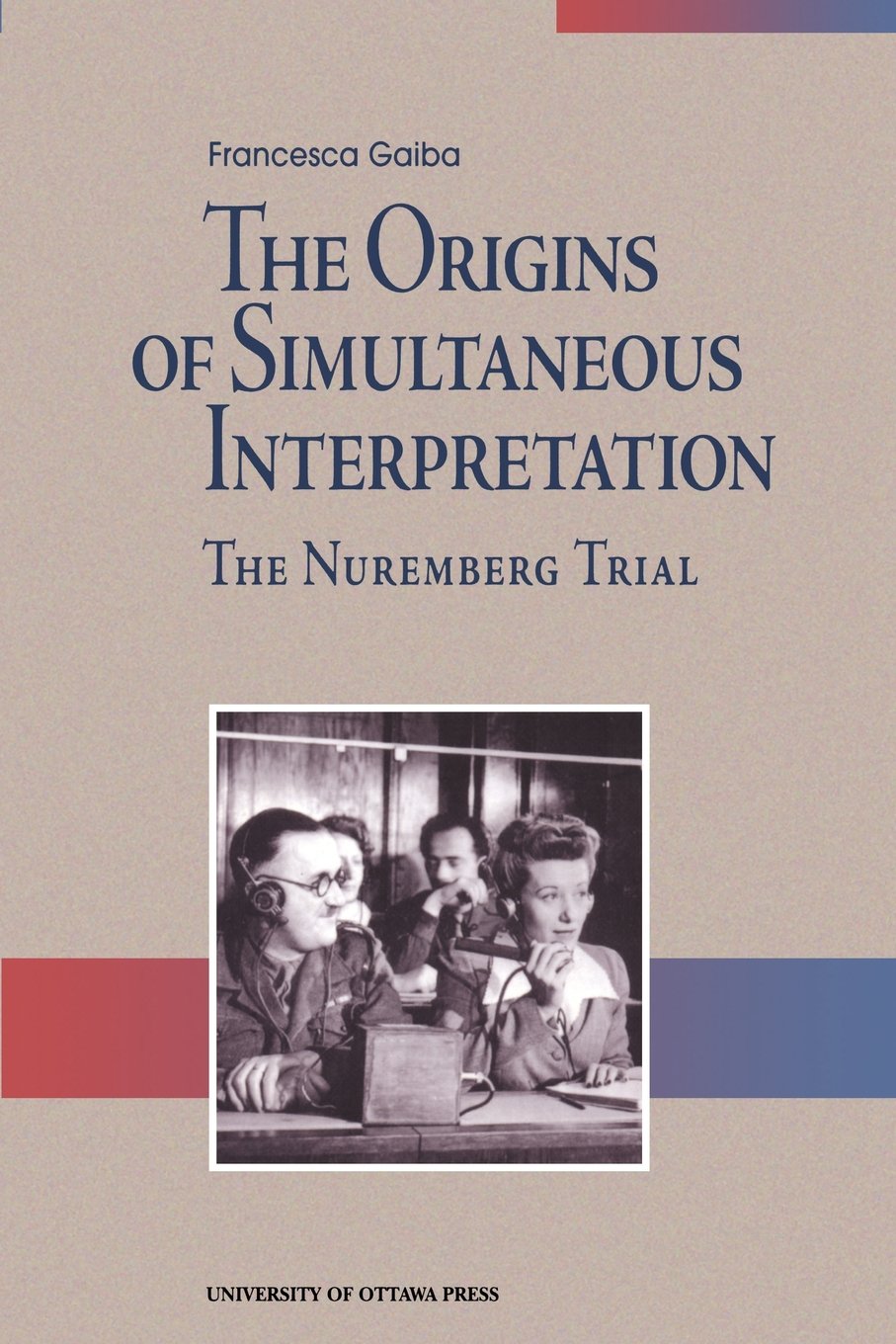



This book offers the first complete analysis of the emergence of simultaneous interpretation at the Nuremburg Trail and the individuals who made the process possible. Francesca Gaiba offers new insight into this monumental event based on extensive archival research and interviews with interpreters, who worked at the trial. This work provides an overview of the specific linguistic needs of the trial and examines the recruiting of interpreters and the technical support available to them. Published in English. Francesca Gaiba trained as a conference interpreter at the University of Bologna, where she specialized in English, German, French and Italian. In 1997 she received the A. Schiavi Foundation Award for her research on the Nuremberg Trial. FRANCESCA GAIBA trained as a conference interpreter at the University of Bologna, where she specialized in English, French and ltalian. In 1997 she received the A. Schiavi Foundation Award for her research on the Nuremberg Trial. From Introduction: The research for this book began as the answer to a simple question: "What is the origin of the profession of simultaneous interpretation?" Surprisingly, very little is known about the origins of the art and profession of simultaneous interpretation, which is now commonly used and even taken for granted at international conferences and gatherings. This book focuses on one particular and specific aspect of the birth of the interpreting profession: the invention of simultaneous interpretation. Who, I wonder in this book, had the idea that it was possible to connect microphones and earphones in such a way that a speech could be translated instantaneously and extempore in a different language? Who thought it was possible for an interpreter to hear and speak at the same time? And how did the translation affect the trial? This book answers these and other questions, and offers a complete overview of the birth of simultaneous interpretation by presenting a description of its workings at the 1945-1946 War Crimes Trial (Nuremberg, Germany). The Nuremberg Trial was the first official international gathering in which simultaneous interpretation was used. Astonishing as it may seem, the miracle of simultaneous interpretation did not receive any attention from historians. Thousands of volumes have been written about the trial, about its legal, political, historical aspects-but if we were to add all the parts dealing with the interpreting system, they would amount to about a dozen pages. In these books, interpreters receive as much attention as court stenographers, police officers or press correspondents. And yet, one thing should become clear by reading this book: the Nuremberg Trial would not have been possible without simultaneous interpretation. [...] From Chapter 3: The Defendants and Interpretation. The situation created by interpretation at the Nuremberg Trial was new and unfamiliar to the court members. It created possibilities that no one thought could be exploited for one's own advantage, until Hermann Gring took the stand. During his cross-examination, Gring adopted strategies to gain time and think about his answers, and to make prosecutors lose their temper. Gring was quick in exploiting one of the major weaknesses of the interpreting system, the double translation, that is, when a German original document had been translated into English for the use of the prosecution and was then retranslated into German for the defendants in the courtroom. Gring complained that the interpretation was biased to his disadvantage: "That quotation has not been translated by the interpreter as it is written down here in the original. The interpreter who is translating your words into German is using many strong expressions which are not contained in this document." Gring also played on the fact that he knew both English and German, while the American Prosecutor Jackson was not familiar with German at all. More than once Gring pointed out inaccuracies in the English translation of German documents. For example, during the episode that became famous as the "translation mistake," Jackson had to withdraw an important document from the evidence, which, according to him, should have proved the German intention to free the Rhineland early in 1935. The original document read "Freimachung des Rheins," which means "clearing of the Rhine" but had been translated as "liberation of the Rhine" in the English translation of the document. This notwithstanding, the document was not mistranslated, but Jackson, or someone on his staff, mistook the term "Rhine" for "Rhineland," a blatant mistake that did not escape the clever eye of Gring. When Jackson triumphantly presented the document as a proof of the German intention to free the Rhineland, Gring mercilessly lectured Jackson on why he was wrong and showed off his translation skills. [...]