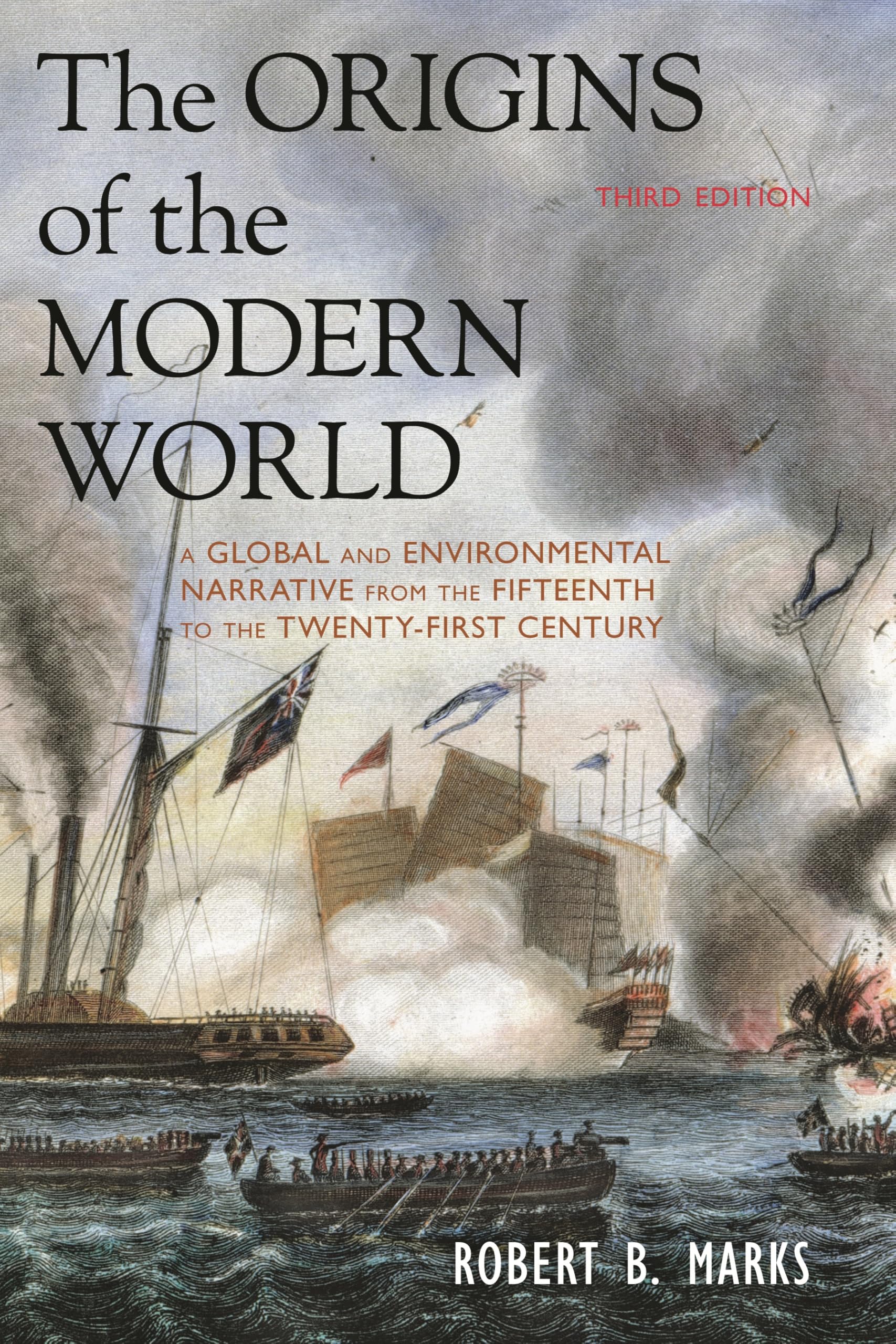
The Origins of the Modern World: A Global and Environmental Narrative from the Fifteenth to the Twenty-First Century (World Social Change)
$87.72
by Robert B. Marks



This clearly written and engrossing book presents a global narrative of the origins of the modern world from 1400 to the present. Unlike most studies, which assume that the “rise of the West” is the story of the coming of the modern world, this history, drawing upon new scholarship on Asia, Africa, and the New World and upon the maturing field of environmental history, constructs a story in which those parts of the world play major roles, including their impacts on the environment. Robert B. Marks defines the modern world as one marked by industry, the nation state, interstate warfare, a large and growing gap between the wealthiest and poorest parts of the world, increasing inequality within the wealthiest industrialized countries, and an escape from the environmental constraints of the “biological old regime.” He explains its origins by emphasizing contingencies (such as the conquest of the New World); the broad comparability of the most advanced regions in China, India, and Europe; the reasons why England was able to escape from common ecological constraints facing all of those regions by the eighteenth century; a conjuncture of human and natural forces that solidified a gap between the industrialized and non-industrialized parts of the world; and the mounting environmental crisis that defines the modern world. Now in a new edition that brings the saga of the modern world to the present in an environmental context, the book considers how and why the United States emerged as a world power in the twentieth century and became the sole superpower by the twenty-first century, and why the changed relationship of humans to the environmental likely will be the hallmark of the modern era―the “Anthopocene.” Once again arguing that the U.S. rise to global hegemon was contingent, not inevitable, Marks also points to the resurgence of Asia and the vastly changed relationship of humans to the environment that may in the long run overshadow any political and economic milestones of the past hundred years. “Marks offers a new broad sweep of this period that significantly is not Eurocentric in approach. His book reflects the more recent advanced scholarship that considers the influence of Asia and departs from the traditional interpretation of the ‘Rise of the West’ or the ‘European Miracle’ as the foundation of the modern world. This book is extremely informative; the author delves into ecological issues that include critical contemporary questions, such as global warming, and occasionally population growths and declines, as in the horrific period appropriately labeled the ‘Black Death’ in the mid-14th century, an epidemic that affected three continents. Numerous maps of the world support the book's global theme, and Marks writes that for well over 1,000 years, the Indian Ocean ‘arguably was the single most important crossroad of trade and generator of merchant wealth in the world.’ The book's main topics are the expansion of the Russian, Chinese, and Ottoman Empires; the conquest of the Americas; the spread of Islam; the Industrial Revolution; and the rise of the US. This serious and important work, written in a historically conventional manner, is thoughtful, relevant to the present times, and well written. Summing Up: Highly recommended. All levels/libraries.” ― Choice Reviews “Marks is eminently well-qualified to bring Asia to the front of the story about the origins of the modern world. . . . Inspired mostly through the work of André Gunder Frank and Ken Pomeranz, Marks writes a world history survey that is very useful for locating the place of China and India in the construction of the modern world.” ―Adrian Carton, Education About Asia “The Origins of the Modern World aims at the undergraduate student . . . but any teacher who has struggled with the question, 'When did American Civilization begin?' will see other applications. Inexpensive enough to consider as a supplemental reading requirement in a traditional Atlantic History class or even for an American History survey, this well designed textbook will orient students toward broader awareness, both historically and within their own world.” ―Joe Petrulionis, U.S. Intellectual History “This is a splendid book that . . . brings together the very latest scholarship to provide a highly readable and erudite account of world history over the last half a millennium. . . . I thus thoroughly recommend this book.” ―James Beattie, University of Waikato, New Zealand Journal of Asian Studies “A very useful tool for world history courses, undergraduate and graduate, as well as offering new concepts for scholars still locked in rigid territorial or national studies. . . . The composition in this concise book is clear and topics are interestingly presented, while the source references make it useful for classroom research projects. . . . A helpful account of the principles and organization of trade in world history, written from a global perspective.” ―Mary Watrous-S