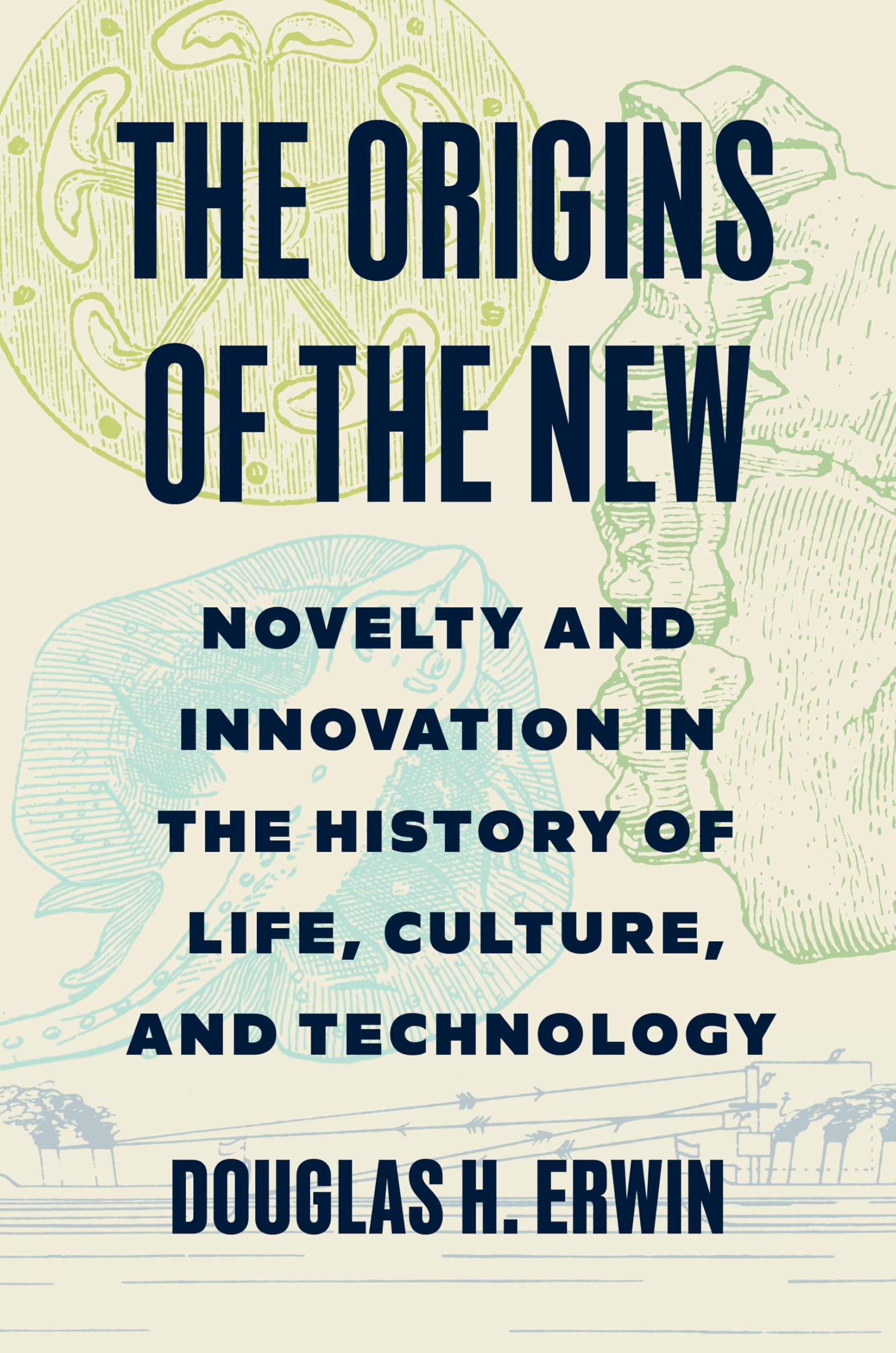
The Origins of the New: Novelty and Innovation in the History of Life, Culture, and Technology
$45.00
by Douglas H. Erwin



A visionary look at how novel attributes arise and become transformative innovations in nature, culture, and technology The Origins of the New presents a revolutionary approach to evolutionary success in all realms of life. In this groundbreaking book, Douglas Erwin takes readers on a dazzling excursion across science and history to explore how evolution generates new and enduring features in biology, culture, and technology. Erwin begins by tracing how thinkers from Darwin’s time to the present day have sought to discover the driving mechanisms of evolutionary novelty. He then lays out compelling empirical evidence for separating novelty from innovation, showing how novelty involves the emergence of unique characteristics while innovation has to do with the success of those characteristics across time. Erwin develops a unifying conceptual framework for these powerful dynamics, demonstrating how they have shaped everything from the evolution of avian feathers and flight to the creation of human language and the breathtaking advances in digital computing we’re witnessing today. A landmark work that redefines our understanding of the changes happening all around us, The Origins of the New reveals how the forces of novelty and innovation are the same across nature and culture, continually producing new forms and refashioning the world as we know it. Published in association with the Smithsonian National Museum of Natural History, Washington, DC "I skipped not a page, and found myself absorbed by the whole concept of novelty and innovation. . . . The book is exceedingly well written; one often stands in awe of Erwin's adroit use of language." ---David Gascoigne, Travels with Birds “ The Origins of the New is a remarkable achievement. Erwin masterfully shows that novelty and innovation are distinct but deeply intertwined, creating a link between biology, culture, and technology. He explains how breakthroughs, from grasses to computers, transform the world only when the right conditions allow them to flourish. An essential book for anyone who wants to understand how the world changes.” —Michael J. Mauboussin, Morgan Stanley Investment Management, author of The Success Equation “Douglas Erwin’s The Origins of the New is a tour-de-force history of life through the lens of novelty and innovation. Sweeping and profound, it goes to the heart of what evolution is and how evolution really works, in both biology and culture.” —Kyle Harper, author of Plagues Upon the Earth: Disease and the Course of Human History “This book is a profound meditation on the evolution of novelty. Douglas Erwin shows how recent progress in paleontology, the evolution of development, and complexity science are challenging legacy perspectives and moving us toward new conceptions and new formalisms for the origin of adaptive spaces and dimensions.” —David Krakauer, President and William H. Miller Professor of Complex Systems, Santa Fe Institute “Erwin displays an unparalleled command of the literature—from paleontology to gene regulatory networks, from ecological modeling to economic history—but wears his learning lightly while guiding the reader along the tangled road of biology’s struggle to account for patterns of origination and understand the processes behind them in the history of life.” —Alan C. Love, University of Minnesota “Douglas Erwin makes a persuasive case for how we should rethink the roles of novelty and innovation in much that is unique to Earth and humanity—how life has evolved and the arc of cultural and technological transformations. This book is a testament to the power of interdisciplinary scholarship between economics, biology, and anthropology.” —Rachel Wood, University of Edinburgh Douglas H. Erwin is a leading paleobiologist whose books include Extinction: How Life on Earth Nearly Ended 250 Million Years Ago (Princeton) and (with James W. Valentine) The Cambrian Explosion: The Construction of Animal Biodiversity . He is an external faculty member at the Santa Fe Institute and was for many years a senior scientist and curator at the Smithsonian National Museum of Natural History.