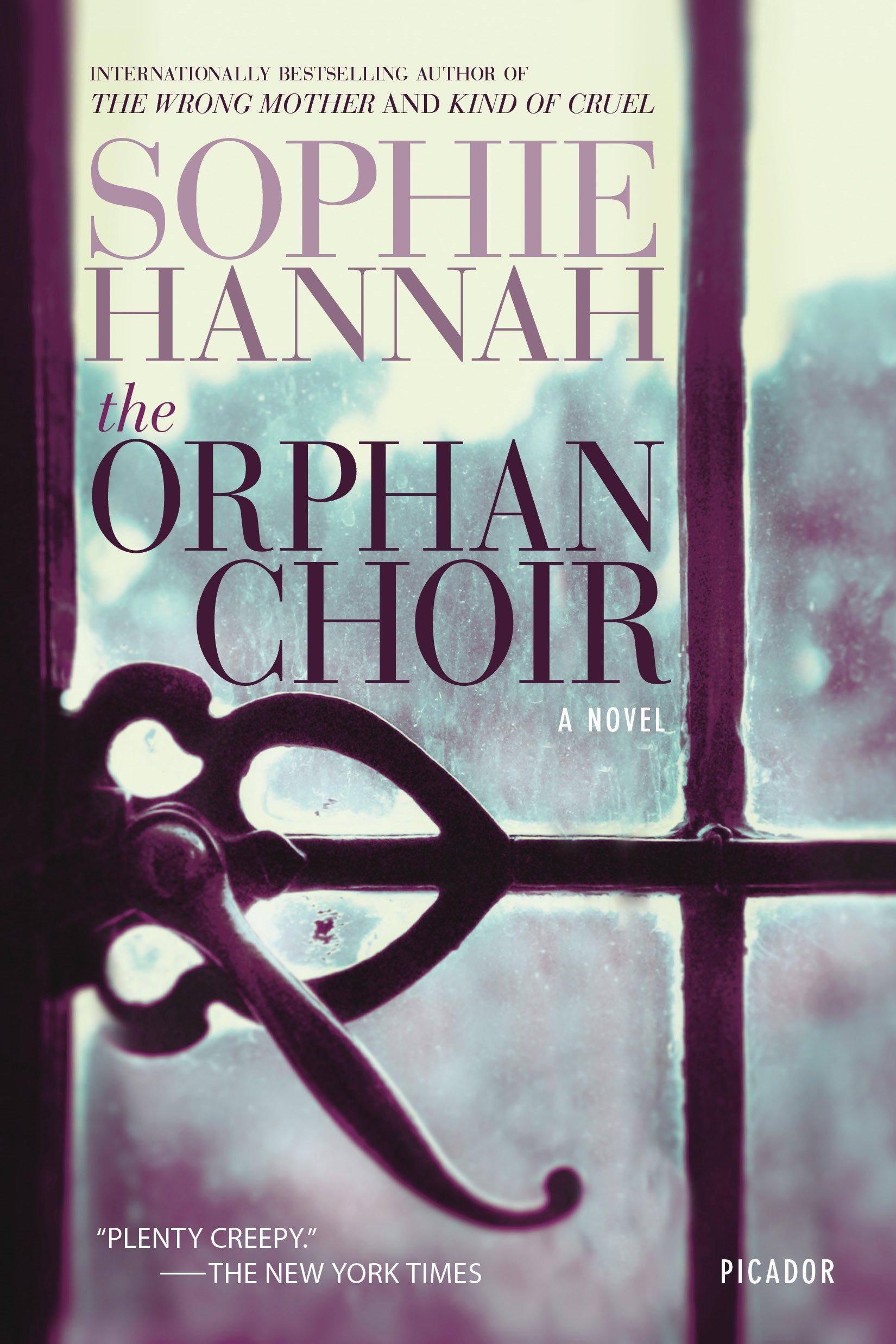



In The Orphan Choir , Sophie Hannah brings us along on a darkly suspenseful investigation of obsession, loss, and the malevolent forces that threaten to break apart a loving family. A mother with an empty nest is being haunted by a ghostly children's choir. Are they giving her an important message that only she can hear, or are their motives more sinister? Louise Beeston is being haunted. Louise has no reason left to stay in the city. She can't see her son, Joseph, who is away at boarding school, where he performs in a prestigious boys' choir. Her troublesome neighbor has begun blasting choral music at all hours of the night―and to make matters worse, she's the only one who can hear it. Hoping to find some peace, Louise convinces her husband, Stuart, to buy them a country house in an idyllic, sun-dappled gated community called Swallowfield. But it seems that the haunting melodies of the choir have followed her there. Could it be that her city neighbor has trailed her to Swallowfield, just to play an elaborate, malicious prank? Is there really a ghostly chorus playing outside her door? And why won't they stop? Growing desperate, she begins to worry about her mental health. Against the pleas and growing disquiet of her husband, Louise starts to suspect that this sinister choir is not only real but a warning. But of what? And how can it be, when no one else can hear it? “Devilishly elegant.” ― The New York Times Book Review “Expertly paced and brilliantly conceived.” ― New York Journal of Books “A creepy, tension-filled surprise.” ― Independent on Sunday (London) “You have to hand it to a writer who can make a children's choir spooky . . . Hannah builds uneasiness with so many odd touches: an out-of-place gesture, an exasperated husband, increasingly aberrant behavior by the main character.” ― The News & Observer “This stand-alone novel, a break from Hannah's series of psychological police procedurals featuring Charlie Zailer and Simon Waterhouse, is a riveting story in which suspense snowballs to a climax that is all the more dire for its everyday contemporary English setting. Absolutely haunting, in every sense of the word.” ― Booklist “Chilling. A must read.” ― Daily Express (London) “Horrifically good.” ― The Independent (London) “This bestselling thriller writer knows how to pile on the tension, and her ending is chillingly, memorably disturbing.” ― The Sunday Times (London) “An old-fashioned horror story, given a modern spin by the likeable narrator. It has a creepy cinematic feel and races along to its frightening ending.” ― Sunday Mirror (London) “Sophie Hannah is a prodigious talent. I can't wait to see what she does next.” ― Laura Lippman, author of What the Dead Know “Hannah [writes] persuasively and with style and wit about modern women who buckle under the stress of motherhood.” ― The New York Times Book Review “Gripping . . . It's like watching a nightmare come alive.” ― Tana French on The Truth Teller's Lie SOPHIE HANNAH is an internationally bestselling author of psychological thrillers, poetry, and short fiction. Her work has been published in twenty-four countries, and her novel, Kind of Cruel , was shortlisted for the National Book Awards Crime Novel of the Year in 2012. Her poetry has been shortlisted for the T. S. Eliot Award, and is taught in schools throughout the United Kingdom. She lives with her husband and children in Cambridge. 1. It’s quarter to midnight. I’m standing in the rain outside my next-door neighbor’s house, gripping his rusted railings with cold, wet hands, staring down through them at the misshapen and perilously narrow stone steps leading to his converted basement, from which noise is blaring. It’s my least favorite song in the world: Queen’s “Don’t Stop Me Now.” There’s a reddish-orange light seeping out into the darkness from the basement’s bay window that looks as unappealing as the too-loud music sounds. Both make me think of hell: my idea of it. There are no other lights on anywhere in my neighbor’s four-story home. My lower ground floor next door is dark and silent. We mainly use it as guest accommodation, and as we don’t often have guests, it is usually empty. It comprises two bedrooms, a playroom-cum-Xbox room for Joseph, and a large bathroom. All of number 19’s internal cellar walls have been knocked down to make a single vast area: either a chill-out den or an entertaining space, depending on whether you’re talking to my neighbor or his girlfriend. I think the label “entertaining space” worries him because of its public-spirited implications. The word “entertain” suggests that one might give a toss about people other than oneself. My next-door neighbor doesn’t. Freddie Mercury’s reflections about supersonic women are making me glad that I’ve never met one: they sound like a bit of a handful—not very easygoing. I’ve never had ambitions in the direction of supersonicness, whatever it might be. What I want is far more achieva