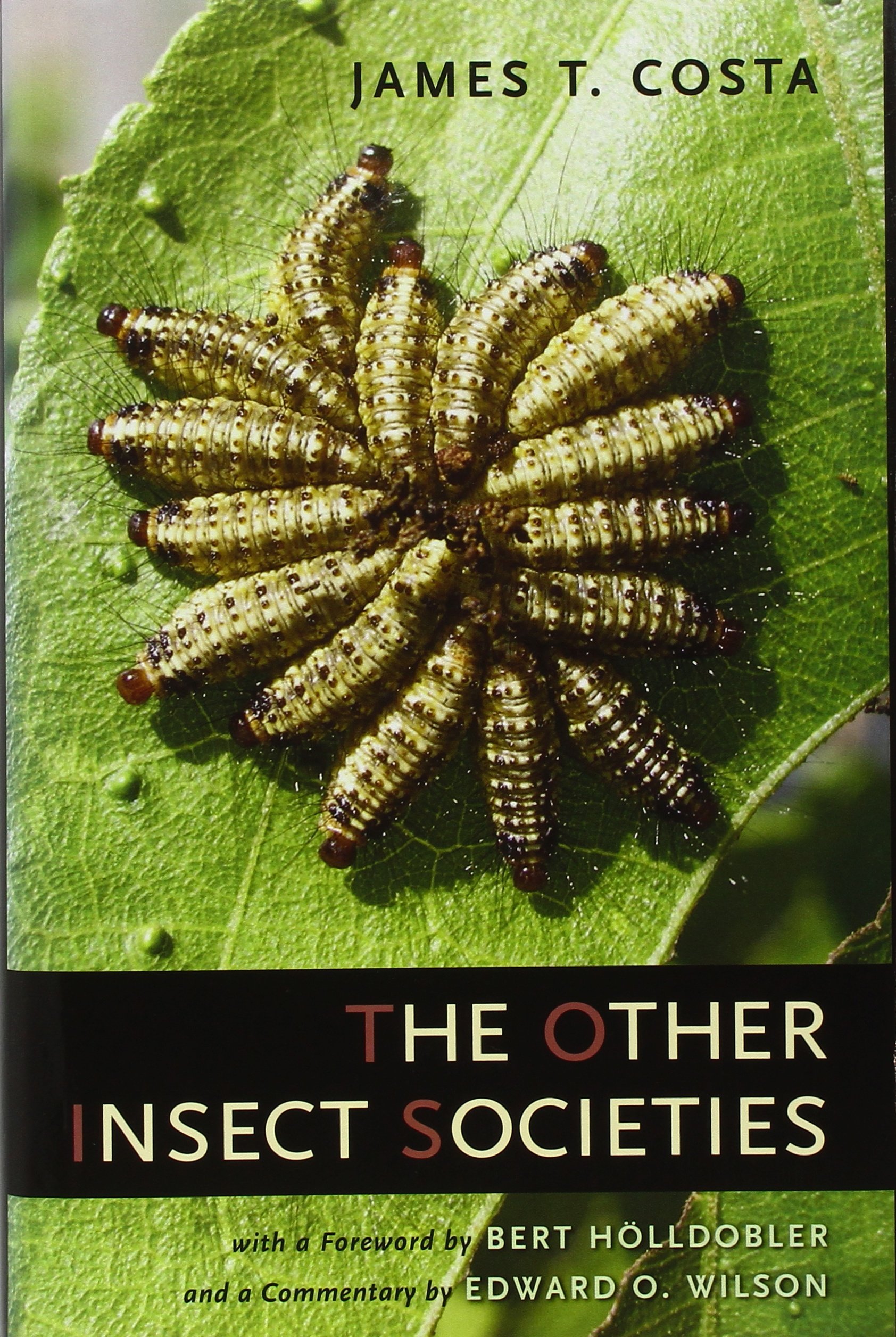



Asked to name an insect society, most of us--whether casual or professional students of nature--quickly point to one of the so-called eusocial marvels: the ant colony, the beehive, the termite mound, the wasp nest. Each is awe-inspiring in its division of labor--collective defense, foraging, and nestbuilding. Yet E. O. Wilson cautioned back in 1971 that sociality should be defined more broadly, "in order to prevent the arbitrary exclusion of many interesting phenomena." Thirty-five years later, James T. Costa gives those interesting phenomena their due. He argues that, in trying to solve the puzzle of how highly eusocial behaviors evolved in a few insect orders, evolutionary biologists have neglected the more diverse social arrangements in the remaining twenty-eight orders--insect societies that don't fit the eusocial schema. Costa synthesizes here for the first time the scattered literature about social phenomena across the arthropod phylum: beetles and bugs, caterpillars and cockroaches, mantids and membracids, sawflies and spiders. This wide-ranging tour takes a rich narrative approach that interweaves theory and data analysis with the behavior and ecology of these remarkable groups. This comprehensive treatment is likely to inspire a new generation of naturalists to take a closer look. “This book provides comprehensive, astoundingly thorough coverage of the 'minor' social insect groups, which have been neglected since Fabre brought the study of insect behavior to life over 100 years ago. The chapters make accessible for the first time a huge trove of obscure yet endlessly fascinating natural history, which should entertain as well as inspire future researchers to study its six-legged bestiary. I was especially pleased to see the historical treatments of issues and research topics, which put the fields and topics in perspective. The Other Insect Societies is a tremendously impressive piece of scholarship.” ― Bernard Crespi, Professor of Evolutionary Biology, Simon Fraser University “This marvelously researched and comprehensive work fills a major gap in the literature on insect social behavior...Jim Costa has done this only as a seasoned entomologist could accomplish it, with a full account of each major taxonomic group in turn, including the contextual information needed to understand the significance of the social behavior its constituent species display...[He] routinely travels from taxonomy to anatomy, from physiology to ecology, and into broad issues of natural history to create in this book an overall mosaic of what the 'other' insect societies are and what they have achieved across hundreds of millions of years of evolution.” ― from Edward O. Wilson's Commentary on The Other Insect Societies “Perhaps we need fresh data from previously neglected kinds of insect societies. This is the approach James Costa offers in The Other Insect Societies . Costa launches the entomological equivalent of subaltern studies, focusing deliberately on species that have failed to make it to Wilson's elite grade of 'eusociality.' Readers will find in the book a fascinating wealth of information about the obscure social lives of earwigs, grasshoppers, crickets, mantids, cockroaches, aphids, treehoppers, bugs, thrips, beetles, caterpillars, sawflies, and even some non-insect anthropods. Costa's book will inevitably be compared with The Evolution of Social Behavior in Insects and Arachnids , edited by Jae C. Choe and Bernard Crespi...I am rather optimistic that, paralleling the effects of the subaltern studies of Indian historians, a focus on other insect societies will provide valuable fresh perspectives useful even for understanding present-day eusocial species...A few hours with Costa's book will bring any beginner up to date with a century's worth of scattered literature on almost everything that is known about any of the many obscure groups of insects discussed.” ― Raghavendra Gadagkar , Science “E.O. Wilson calls the honeybees, the army and leaf-cutter ants, and the mound-building termites the superstars of insect social behavior. In this demanding but interesting book, Costa explores the other arthropod orders for social behavior. A few of his chapter titles suggest the range of areas and activities he explores: 'Earwig Mothers,' 'Hopper Herds and Cricket Families,' 'Samurai Aphids' and 'Communes and Family Fortresses.' A good present for the serious scientist.” ― Gerry Rising , Buffalo News “For much of its history, the study of insect sociality has been dominated by the study of ants, bees and wasps...The other social arthropods have been largely ignored or relegated to fringe status. James T. Costa seeks to correct this oversight with his book The Other Insect Societies . He succeeds in showcasing the true diversity of social behaviour among insects, spiders and crustaceans, and provides support for a set of alternative hypotheses about social evolution that should stimulate research and fuel scie