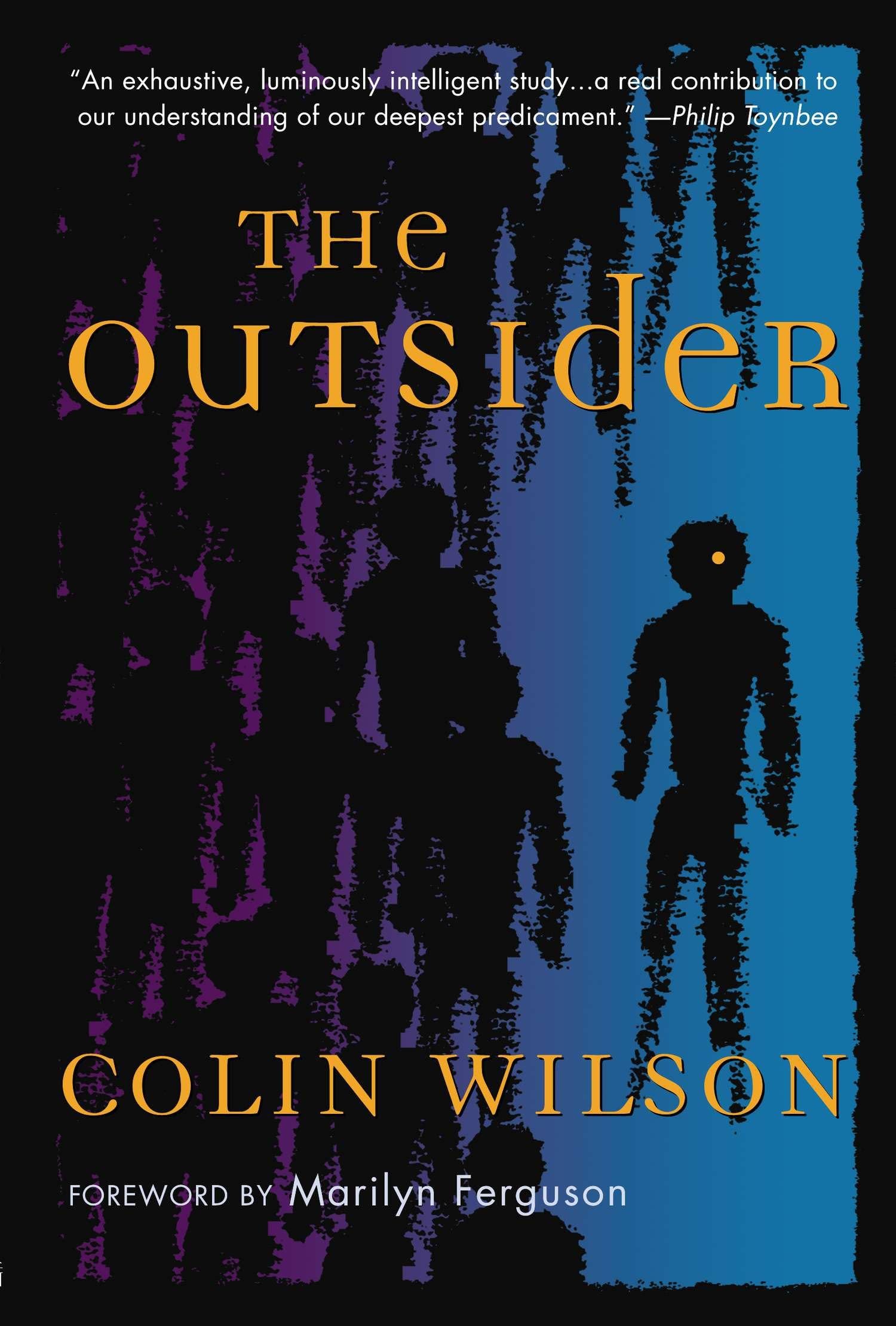



The seminal work on alienation, creativity, and the modern mind-set. "An exhaustive, luminously intelligent study...a real contribution to our understanding of our deepest predicament."—Philip Toynbee. "An exhaustive, luminously intelligent study...a real contribution to our understanding of our deepest predicament." — Philip Toynbee "The newest prodigy on the English literary scene, Mr. Wilson came out of nowhere from the outside. He walked into literature...as a man walks into his own house ... filled with assimilated erudition ... Where young Wilson got his knowledge baffled the critics. That he had there could be no mistake." — The New York Times Born to a working class English household in 1931, Colin Wilson went from being the "bad boy" of the British literary scene to becoming a wide-ranging historian, novelist, critic, and philosopher. In addition to his classic study of rebellion, The Outsider , Wilson distinguished himself as one of the most prolific and grounded historians of occult and esoteric movements. A rebel until the end, Wilson later in life wrote stirring intellectual defenses of optimism, challenging the dark vogue of figures such as Bertolt Brecht and Samuel Beckett. He died in Cornwall, England, in late 2013. 1 The Country of the Blind At first sight, the Outsider is a social problem. He is the hole-in-corner man. In the air, on top of a tram, a girl is sitting. Her dress, lifted a little, blows out. But a block in the traffic separates us. The tramcar glides away, fading like a nightmare. Moving in both directions, the street is full of dresses which sway, offering themselves airily, the skirts lifting; dresses that lift and yet do not lift. In the tall and narrow shop mirror I see myself approaching, rather pale and heavy-eyed. It is not a woman I want-it is all women, and I seek for them in those around me, one by one. . . . This passage, from Henri Barbusse's novel L'Enfer, pinpoints certain aspects of the Outsider. His hero walks down a Paris street, and the desires that stir in him separate him sharply from other people. And the need he feels for a woman is not entirely animal either, for he goes on: Defeated, I followed my impulse casually. I followed a woman who had been watching me from her corner. Then we walked side by side. We said a few words; she took me home with her. . . . Then I went through the banal scene. It passed like a sudden hurtling-down. Again, I am on the pavement, and I am not at peace as I had hoped. An immense confusion bewilders me. It is as if I could not see things as they were. I see too deep and too much. Throughout the book, this hero remains unnamed. He is the anonymous Man Outside. He comes to Paris from the country; he finds a position in a bank; he takes a room in a "family hotel." Left alone in his room, he meditates: He has "no genius, no mission to fulfill, no remarkable feelings to bestow. I have nothing and I deserve nothing. Yet in spite of it, I desire some sort of recompense." Religion . . . he doesn't care for it. "As to philosophic discussions, they seem to me altogether meaningless. Nothing can be tested, nothing verified. Truth-what do they mean by it?" His thoughts range vaguely from a past love affair and its physical pleasures, to death: "Death, that is the most important of all ideas." Then back to his living problems: "I must make money." He notices a light high up on his wall; it is coming from the next room. He stands on the bed and looks through the spy-hole: I look, I see. . . . The next room offers itself to me in its nakedness. The action of the novel begins. Daily, he stands on the bed and stares at the life that comes and goes in the next room. For the space of a month he watches it, standing apart and, symbolically, above. His first vicarious adventure is to watch a woman who has taken the room for the night; he excites himself to hysteria watching her undress. These pages of the book have the kind of deliberate sensationalism that its descendants in post-war France were so consistently to be accused of (so that Guido Ruggiero could write: "Existentialism treats life in the manner of a thriller"). But the point is to come. The next day he tries to recreate the scene in imagination, but it evades him, just as his attempt to recreate the sexual pleasures with his mistress had evaded him: I let myself be drawn into inventing details to recapture the intensity of the experience. "She put herself into the most inviting positions." No, no, that is not true. These words are all dead. They leave untouched, powerless to affect it, the intensity of what was. At the end of L'Enfer, its nameless hero is introduced to a novelist who is entertaining the company with an account of a novel he is writing. A coincidence . . . it is about a man who pierces a hole in his wall and spies on all that happens in the next room. The writer recounts all of the book he has written; his listeners admire it: Bravo! Tremendous