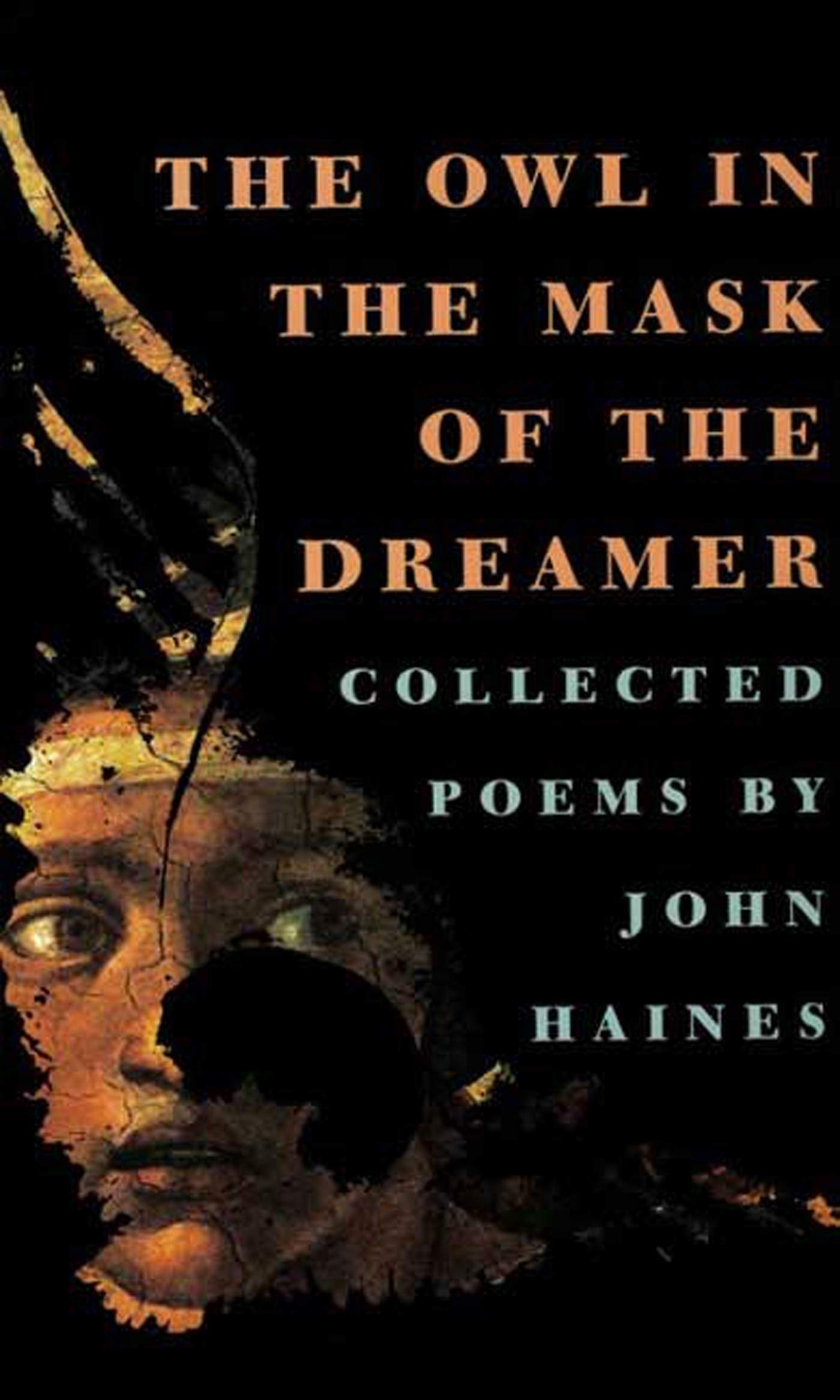



A collection of poems taken from the author's eight previous books looks at humans' relationship with each other and with the natural world In "South Wind," describing a dream of horses, John Haines writes: "The thunder of their passage / broke down the walls of my dream. / I awoke in the ruined kingdom / of frost with a warm wind / blowing my hair, and hard about me / and in the distance / the heavy hoofs still pounding ..." Notice how, even in this brief excerpt, Haines marries opposites together in an unsettling way: the heavy inaction of sleep is infused with thunderous commotion, the horses represent both threat and beauty, waking does not chase away the dream, and the positive imagery of a warm wind becomes a "ruined kingdom / of frost." It's not for nothing that the New York Times Book Review called Haines's writing "splendidly odd." The passage is representative in terms of content as well as style. Haines, a longtime resident of Alaska, frequently writes about the environment and the elements. This collection uncovers 30 years of good work, from 1966 to 1996. “A writer of rare vision and poetic eloquence.” ― Robert Michael Pyle, New York Times Book Review “Haines has always written with a beautiful ear. His early work distinguished itself by combining lucid images from the natural world with a dreamy inwardness. An imagination of solitude inhabited a solitary landscape; if the sensibility relished an ascetic purity, the body presented itself in the mouth's pleasure of vowel and in the eye's exactness. The later work ... retains these qualities-- sense and imagination-- while it adds more of the world and more of Haines' rigorous intelligence. He writes with a hard instrument on a hard surface, making no disposable verses.” ― Donald Hall, The Nation “His poems require concentration, rereading, and knowledge beyond what they impart, but the extra effort is richly, religiously rewarded.” ― Ray Olson, Booklist “If one views Haines' poetic development as a journey from the specific geography of the Alaskan wilderness to the uncharted places of the spirit, then that journey is now complete.” ― Dana Gioia Praise for John Haines "A writer of rare vision and poetic eloquence." --Robert Michael Pyle, New York Times Book Review "Haines has always written with a beautiful ear. His early work distinguished itself by combining lucid images from the natural world with a dreamy inwardness. An imagination of solitude inhabited a solitary landscape; if the sensibility relished an ascetic purity, the body presented itself in the mouth's pleasure of vowel and in the eye's exactness. The later work ... retains these qualities-- sense and imagination-- while it adds more of the world and more of Haines' rigorous intelligence. He writes with a hard instrument on a hard surface, making no disposable verses." --Donald Hall, The Nation "His poems require concentration, rereading, and knowledge beyond what they impart, but the extra effort is richly, religiously rewarded." --Ray Olson, Booklist "If one views Haines' poetic development as a journey from the specific geography of the Alaskan wilderness to the uncharted places of the spirit, then that journey is now complete." --Dana Gioia Born in Norfolk, Virginia in 1924, John Haines studied at the National Art School, the American University, and the Hans Hoffmann School of Fine Art. He homesteaded in Alaska for over twenty years. He is the author of several major collections of poetry; a collection of reviews, essays, interviews, and autobiography, Living Off the Country (University of Michigan Press, 1981); and a memoir, The Stars, the Snow, the Fire (Graywolf Press, 1989). He has received numerous awards, including two Guggenheim Fellowships, a National Endowment for the Arts Fellowship, the Alaska Governor's Award for Excellence in the Arts, and most recently a Western State Arts Federation Lifetime Achievement Award and a Lenore Marshall/ The Nation poetry prize for New Poems 1980-1988 (Story Line Press, 1990). He is currently a freelance writer and teacher and still spends part of each year in Alaska. Praise for John Haines "A writer of rare vision and poetic eloquence." --Robert Michael Pyle, New York Times Book Review "Haines has always written with a beautiful ear. His early work distinguished itself by combining lucid images from the natural world with a dreamy inwardness. An imagination of solitude inhabited a solitary landscape; if the sensibility relished an ascetic purity, the body presented itself in the mouth's pleasure of vowel and in the eye's exactness. The later work ... retains these qualities-- sense and imagination-- while it adds more of the world and more of Haines' rigorous intelligence. He writes with a hard instrument on a hard surface, making no disposable verses." --Donald Hall, The Nation "His poems require concentration, rereading, and knowledge beyond what they impart, but the extra effort is richly, religiousl