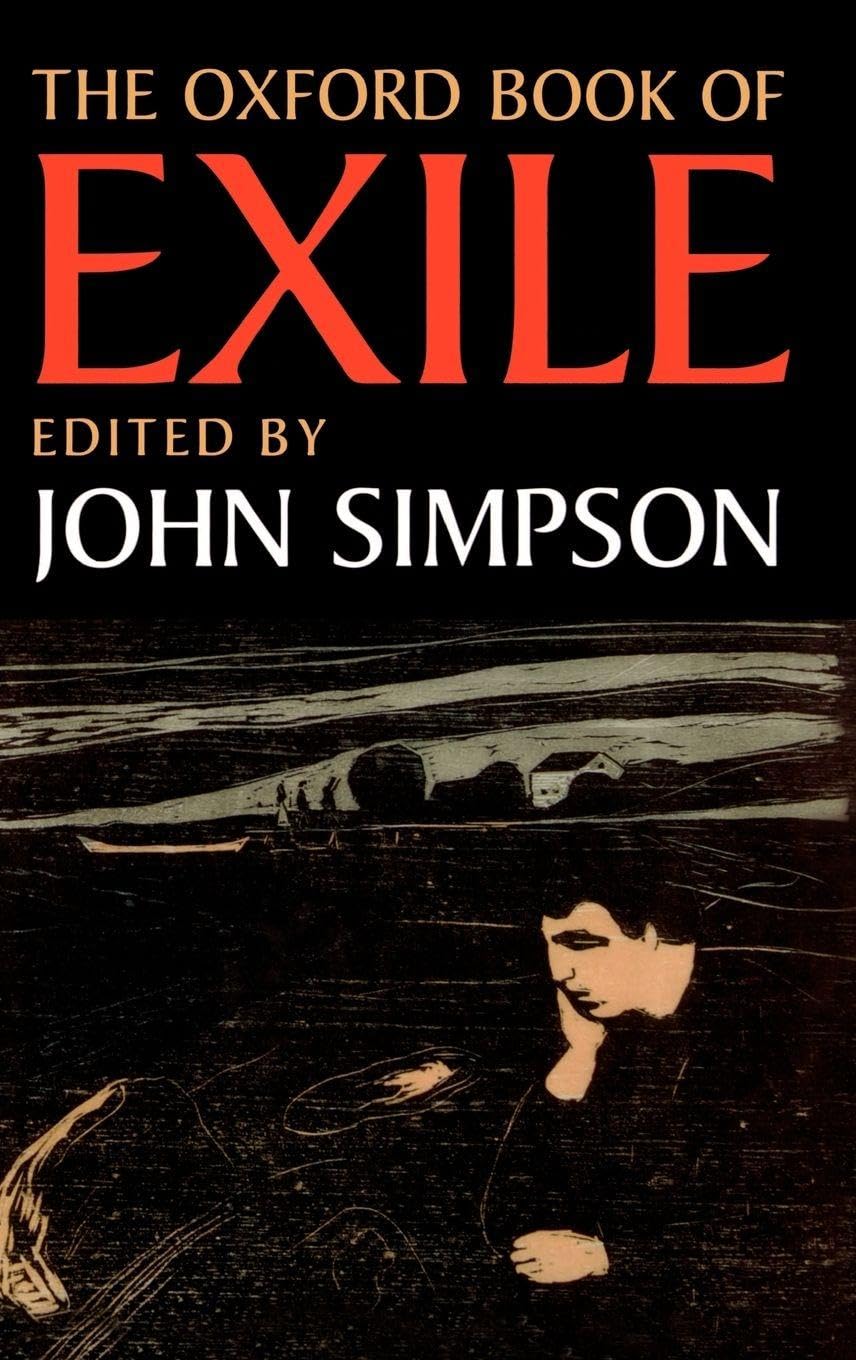



From the moment Adam and Eve were expelled from Paradise, exile has been a part of the human experience. The circumstances in which individuals or entire peoples are compelled to leave their homeland are as various as they are numerous, and how people react to exile also varies widely. Think of the wit of Alexander Herzen, or the quiet despair of Oscar Wilde, sitting outside the Cafe' de Flore in the Boulevard St. Germain in the hope that someone will pay for his coffee, or the comfortable life of Sir Richard and Lady Burton in their garconnerie in Trieste, or the angst of Albert Camus, or the wanderings of Jack Kerouac. Now, in The Oxford Book of Exile , John Simpson has brought together examples of exile from all over the world, and from all periods of history. Here is an intense record of the experience of exile, with writers from Ovid to Solzhenitsyn describing their emotions, their struggle, and their despair. For those who have chosen a life in exile, Simpson shows how the response is more mixed: ambivalence about the country they have left and the country they have chosen suffuses the writing of these intellectuals. We read of literary expatriates, such as Henry James, Gertrude Stein, Ernest Hemingway, Henry Miller, and James Joyce. There is also the happy life of exiles in utterly foreign places, such as Robert Louis Stevenson in Samoa or Paul Gauguin in Tahiti. And those persecuted for their faith--such as the Pilgrims at Plymouth or the Ayatollah Khomeini in France--rub shoulders with those fleeing from war, or from debt, or even from the weather. Castaways and spies, premiers and princes describe their departure, their reception, and sometimes their return, in an anthology that is by turns inspiring, moving, and deeply thought-provoking. With sources ranging from police records, newspaper articles, interviews, letters, and memoirs, as well as verse and fiction, and settings as remote as Iran and Russia, China and Palestine, The Oxford Book of Exile provides fascinating insight into an experience that touches so many, and captures the imagination of us all. Other recent anthologies have engaged in defining the essential condition of exile. However, Simpson, an editor for the BBC, pushes this notion's boundaries to include excerpts from poems and letters, novels, memoirs, and plays, all of which deal with variations on the theme. To confirm his theory that in one way or another some form of exile is familiar to one and all, Simpson sets the stage by way of an introduction to each of the book's sections. If it all began with Adam and Eve, Simpson quickly moves past that, providing examples of historical and contemporary figures who were expelled, banished, or suffered victimization due to the inconstancy of politics. Of course, so-called self-exiles make appearances--Gertrude Stein speaks of her preference for Paris, and Jack Kerouac appears in On the Road . Taken together, Simpson's selections offer a stimulating perspective and a good read. Alice Joyce "Drawing on letters, memoirs, biographies, poems, and fiction, this book explores various types of exile--political and spiritual, voluntary and forced--via the words and stories of those cut off from home."-- Washington Post "Mr. Simpson has steered a course through these tricky waters with great skill and judgement, inclining always towards diversity. This is an extremely interesting book, continuously interesting, not just pleasant to dip into....A brilliantly organized book and it is absorbing to read. One cannot ask for more."--Barry Unsworth, Sunday Telegraph "Taken together, Simpson's selections offer a stimulating perspective and a good read."-- Booklist From Robinson Crusoe to Nelson Mandela--personal writings on life in exile From the moment Adam and Eve were expelled from Paradise, exile has been a part of the human experience. The circumstances in which individuals or entire peoples are compelled to leave their homeland are as various as they are numerous, and in this book John Simpson has brought together examples of exile from all over the world, and from all periods of history. The emphasis is on personal experience, with writers from Ovid to Solzhenitsyn describing their exile, their emotions, their struggles and their despair. For those who have chosen a life in exile, the response is more mixed: ambivalence about the country they have left and the country they have chosen suffuses the writings of intellectuals seeking freedom of speech, as of ex-pats living in India or Australia. Those persecuted for their faith or their politics rub shoulders with those fleeing from war, or from debt, or even from the weather. Castaways and spies, premiers and princes describe their departure, their reception and sometimes their return, in an anthology that is by turns inspiring, moving, and deeply thought-provoking. John Simpson is the BBC Foreign Affairs Editor.