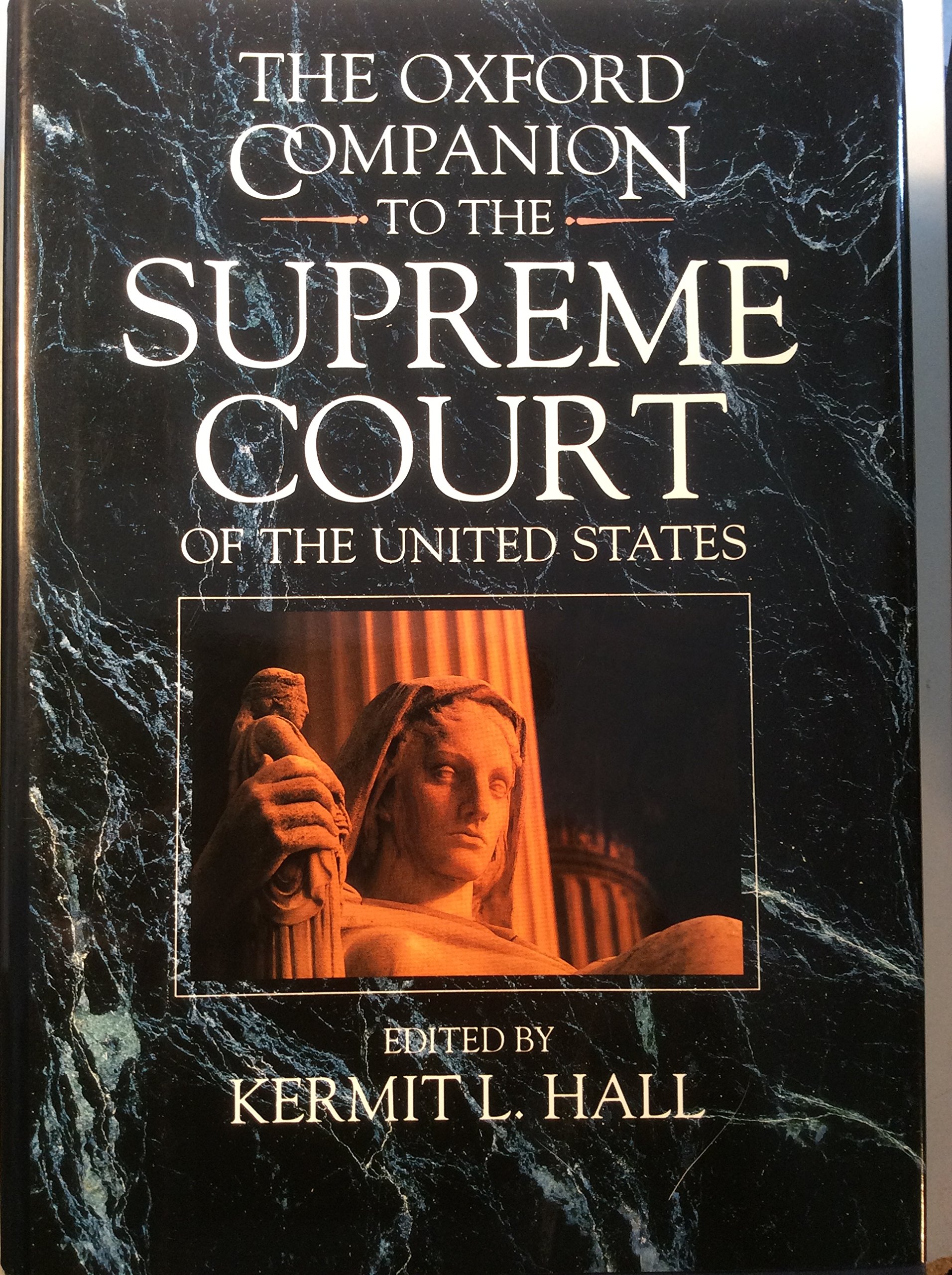



In Democracy in America , De Tocqueville observed that there is hardly a political question in the United States which does not sooner or later turn into a judicial one. Two hundred years of American history have certainly born out the truth of this remark. Whether a controversy is political, economic, or social, whether it focuses on child labor, slavery, prayer in public schools, war powers, busing, abortion, business monopolies, or capital punishment, eventually the battle is taken to court. And the ultimate venue for these vital struggles is the Supreme Court. Indeed, the Supreme Court is a prism through which the entire life of our nation is magnified and illuminated, and through which we have defined ourselves as a people. Now, in The Oxford Companion to the Supreme Court of the United States , readers have a rich source of information about one of the central institutions of American life. Everything one would want to know about the Supreme Court is here, in more than a thousand alphabetically arranged entries. There are biographies of every justice who ever sat on the Supreme Court (with pictures of each) as well as entries on rejected nominees and prominent judges (such as Learned Hand), on presidents who had an important impact on--or conflict with--the Court (including Thomas Jefferson, Abraham Lincoln, and Franklin Delano Roosevelt), and on other influential figures (from Alexander Hamilton to Cass Gilbert, the architect of the Supreme Court Building). More than four hundred entries examine every major case that the court has decided, from Marbury v. Madison (which established the Court's power to declare federal laws unconstitutional) and Scott v. Sandford (the Dred Scott Case) to Brown v. Board of Education and Roe v. Wade . In addition, there are extended essays on the major issues that have confronted the Court (from slavery to national security, capital punishment to religion, from affirmative action to the Vietnam War), entries on judicial matters and legal terms (ranging from judicial review and separation of powers to amicus brief and habeas corpus), articles on all Amendments to the Constitution, and an extensive, four-part history of the Court. And as in all Oxford Companions, the contributors combine scholarship with engaging insight, giving us a sense of the personality and the inner workings of the Court. They examine everything from the wanderings of the Supreme Court (the first session was held on the second floor of the Royal Exchange Building in New York City, and the Court at times has met in a Congressional committee room, a tavern, a rented house, and finally, in 1935, its own building), to the Jackson-Black Feud and the clouded resignation of Abe Fortas, to the Supreme Court's press room and the paintings and sculptures adorning the Supreme Court building. The decisions of the Supreme Court have touched--and will continue to influence--every corner of American society. A comprehensive, authoritative guide to the Supreme Court, this volume is an essential reference source for everyone interested in the workings of this vital institution and in the multitude of issues it has confronted over the course of its history. Grade 10 Up-- An extremely thorough treatment of the subject, composed of brief defining entries and lengthy essays by almost 300 contributors, including lawyers, judges, scholars, and journalists, who were charged with the responsibility of making their presentations accessible to a general readership. Entries, arranged alphabetically, cover the internal operations and history of the Court; biographical information on all of the justices plus other relevant historical figures; definitions of basic legal and constitutional terminology; and the process of selecting, nominating, and confirming justices. More than 400 entries examine the Court's most significant decisions. All are signed; those of any length are followed by selective bibliographies of further reading. Every effort has been made to provide adequate cross referencing within the text and at the end of entries. Cases (with proper citation), persons, places, and institutions are indexed. This work will be of value not only to students of the Court and constitutional law, but also to those needing information (interpretive and/or historical) about the major socioeconomic issues of our day. Illustrations, primarily portraits and photographs of the justices, are of good quality and appropriately placed. This is a landmark publication, representing the highest standard of American scholarship. It is strongly recommended for reference collections serving high school students. - Tess McKellen, Packer Collegiate Institute, Brooklyn Copyright 1993 Reed Business Information, Inc. This obviously impressive and highly needed collection of over 1000 entries on the Supreme Court is sure to become the standard in the field. Succeeding in their appointed task "to humanize the high court," the editors have