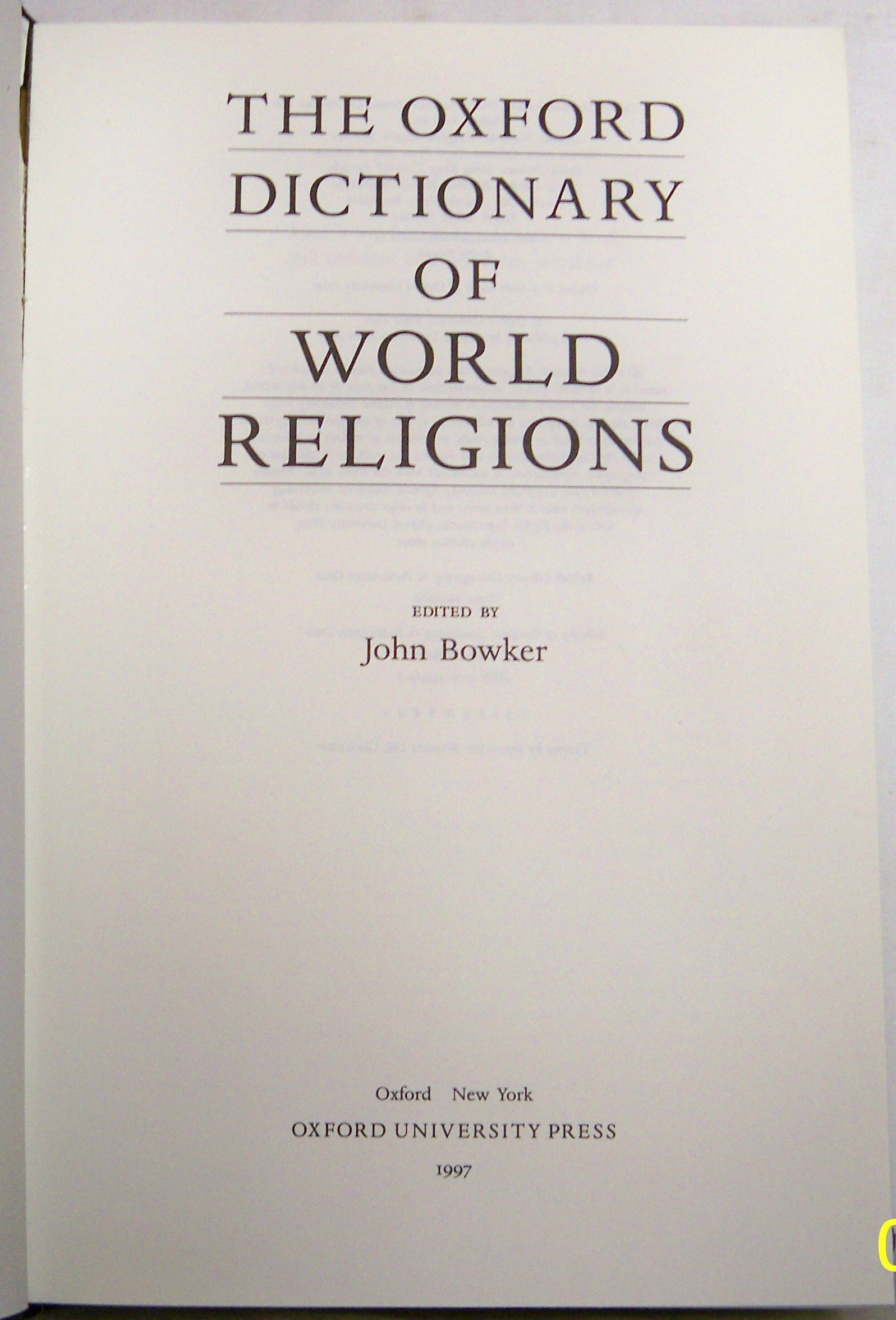



IThe Oxford Dictionary of World Religions is an exceptionally wide-ranging A-Z reference guide to the history, beliefs, dogmas, practices, individuals, customs, and artifacts of the worlds religions past and present. As well as detailed information on individual religious traditions, there are fascinating general entries on common topics such as prayer, ethics, asceticism, confession, cosmology, art and architecture, and music. Bowker (divinity, Gresham Coll., London) has produced two very different books, though both are focused on world religion. The Oxford Dictionary, whose entries often lack information on etymology and pronunciation, is actually a one-volume desktop encyclopedia for ready reference. Combining brevity of exposition with a massive number of entries in an attempt to be dictionary-like, the work suffers from trying to be comprehensive in breadth of coverage instead of depth. The psychology of religion is discussed in a half-page, for instance, and the Church Fathers get only two sentences. In addition, the entries are uneven in quality; one has the feeling that the 80 contributors are each writing according to his or her own personal interests and styles. Despite these idiosyncracies, the work is a solid reference source for people who want to know only the barest of facts about any religious topic. In World Religions, on the other hand, one has the feeling that Bowker, now the author, is finally freed to range over what he wants to say and how he wants to say it. This book is a bold attempt to meld religious information with expressive art and to use the art as a tool for pedagogy. Each religion is represented by a few brilliantly illustrated icons, paintings, or sculptures, which the author painstakingly annotates to illuminate their theologies and deepen one's insight. Whether he is using Michelangelo's Final Judgment to explain Christian eschatology or a handscroll of Chou Ch'en to explain Taoist concepts of immortality, the emphasis upon the visual makes these religions vibrant and intriguing. There are surprising discrepancies between the two works. World Religions has generous discussions of the ancient Egyptian, Greek, Roman, Norse, and Celtic religions, topics not even included in the Oxford Dictionary. There are also variations of names. Ultimately, World Religions is the more commendable publication, though both books are recommended for most libraries.?Glenn Masuchika, Chaminade Univ. Lib., Honolulu Copyright 1997 Reed Business Information, Inc. Learning about the world's many spiritual traditions can be a challenge. This title, designed "to provide initial bearings," is an excellent place to start. With an introductory essay on the meaning of religion by editor Bowker, a professor of religion, and more than 8,200 alphabetical entries on a wide range of subjects, it offers an overview of concepts from world religions as well as movements, sects, and cults. There are no illustrations, but Bowker recently completed World Religions (DK, 1997), a profusely illustrated volume that is a good companion to this work. The entries include broad topics such as prayer and cosmology; specific religions; historical events such as the Reformation and the Crusades; sacred texts; individuals; doctrines; sacred sites; customs; and ethics. Asterisks designate cross-references to terms with their own entries. See and see also references refer users to related material. Many entries have bibliographic citations to books on the subject for further research. Terms in language with non-Roman alphabets are transliterated. There is a special index of Chinese headwords with a Wade-Giles/Pinyin conversion table. A topic index directs readers to entry headings on broad subject areas so that someone interested in dietary laws and customs could look under Food and find entries for Buddhist, Hindu, Jewish, Muslim, Shinto, Sikh, Taoist, and Zen regimens. A comparable source is The HarperCollins Dictionary of Religion [RBB Ap 15 96], which has 3,200 articles. This is far fewer than the Oxford work, but HarperCollins devotes significant space to comprehensive feature articles on major religions--32 pages on Buddhism, for example. It also covers extinct religions, such as those of ancient Greece and Rome, which are not included in the Oxford dictionary. In general, the HarperCollins dictionary has more coverage of religions, while the Oxford dictionary provides more coverage of concepts, people, events, and so on. For example, HarperCollins has several pages on Afro-Brazilian religions, while Oxford has a single paragraph. HarperCollins has six pages on Native American religions, which is not an entry in the Oxford dictionary. On the other hand, Oxford has nearly four pages on the Reformation, compared to one page in HarperCollins; over a column on John Calvin, compared to six lines in HarperCollins; a column on evil, compared to three lines in HarperCollins. The HarperCollins dictionary has no bibliogr