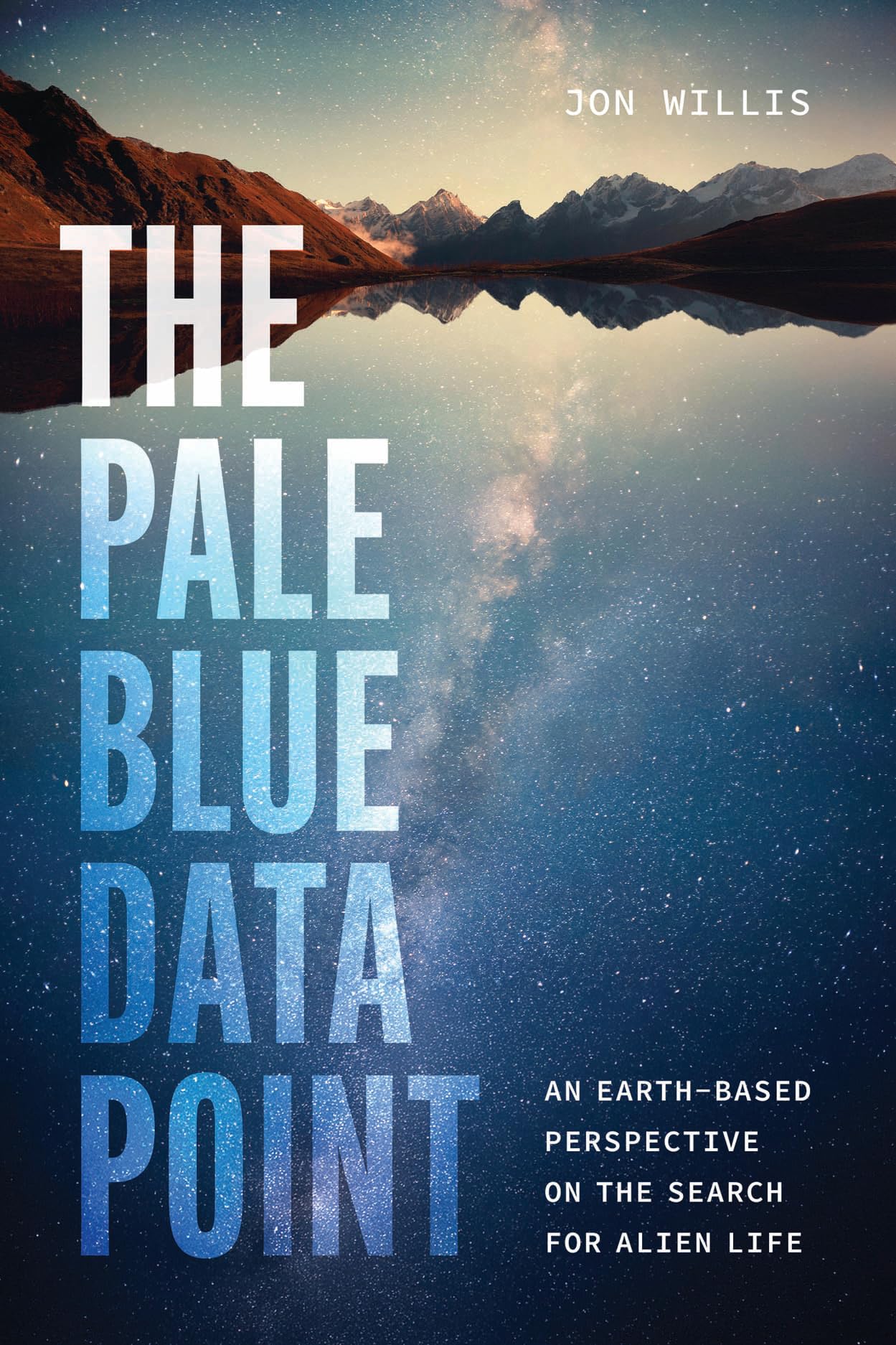
The Pale Blue Data Point: An Earth-Based Perspective on the Search for Alien Life
$21.59
by Jon Willis



“Here is Willis’s fundamental argument: The more we learn about Earth―our one ‘pale blue data point’ for a planet on which life has definitively arisen―the more qualified we will be to recognize signs of life elsewhere. . . . [A] joyful account.”―Steven Poole, The Wall Street Journal A thrilling tour of Earth that shows the search for extraterrestrial life starts in our own backyard. Is there life off Earth? Bound by the limitations of spaceflight, a growing number of astrobiologists investigate the question by studying life on our planet. Astronomer and author Jon Willis shows us how it’s done, allowing readers to envision extraterrestrial landscapes by exploring their closest Earth analogs. With Willis, we dive into the Pacific Ocean from the submersible-equipped E/V Nautilus to ponder the uncharted seas of Saturn’s and Jupiter’s moons; search the Australian desert for some of Earth’s oldest fossils and consider the prospects for a Martian fossil hunt; visit mountaintop observatories in Chile to search for the telltale twinkle of extrasolar planets; and eavesdrop on dolphins in the Bahamas to imagine alien minds. With investigations ranging from meteorite hunting to exoplanet detection, Willis conjures up alien worlds and unthought-of biological possibilities, speculating what life might look like on other planets by extrapolating from what we can see on Earth, our single “pale blue dot”―as Carl Sagan famously called it―or, in Willis’s reframing, scientists’ “pale blue data point.” "[Willis's] book brilliantly explains the technical details of astronomy and robotic space exploration―including missions to retrieve samples of asteroids, and the discovery of vast subsurface oceans in the frozen moons of Jupiter and Saturn―but he also wants to show what his science looks like ‘in the field,’ and so he takes the reader with him to marvel at large observatory telescopes in the Andes, to Morocco to scour the desert for meteorites, and on board a ship that uses submersibles to probe hot volcanic vents in the deep ocean floor. . . . Here is Willis’s fundamental argument: The more we learn about Earth―our one ‘pale blue data point’ for a planet on which life has definitively arisen―the more qualified we will be to recognize signs of life elsewhere. . . . [A] joyful account.” -- Steven Poole ― The Wall Street Journal "Five stars. . . . The most fascinating and eye-opening book about extraterrestrial life that I’ve read for a long time." -- Andrew May ― PopularScience.co.uk "Willis’s title is a play on Carl Sagan’s poignant description of how Earth appeared in a photograph taken by Voyager 1 as it was heading toward the edge of the solar system some thirty-five years ago. Sagan referred to our world as a 'pale blue dot' that covers mere pixels on that spacecraft photo. To us, of course, our planet is much more than a dot, and, as Willis emphasizes, it may tell us a great deal about possible realms, and possible life forms, in the far beyond. To that end, Willis takes us on a tour of some of Earth’s most seemingly inhospitable environments." -- Dan Falk ― Literary Review of Canada “In 1990, before it left the Solar System, Voyager 1 took an image of Earth famously described by astronomer Carl Sagan as a ‘pale blue dot.’ Astronomer Willis refers to Earth as a ‘pale blue data point’ instead, and takes the reader from deep in the Pacific Ocean to observatories in Chile that examine exoplanets. He writes about how ‘at certain places, whether they be wind-blown deserts, the ocean’s depths, advanced laboratories, or mountaintop observatories, Earth also offers clues as to the prospects for life beyond it.’” -- Andrew Robinson ― Nature "Absolutely riveting. . . . If you have an interest in astrobiology, astronomy, biology, Earth science, or simply enjoy reading a book that will cause you to say 'Wow!' with great regularity whilst reading it, I very much encourage you to read The Pale Blue Data Point for yourself. After having done so, I very much doubt that you’ll ever look up into the night sky ever again and not find your mind filled with new questions, curiosities, and dreams of what may one day be found on one of those glittering―perhaps red, perhaps green, perhaps even blue―dots." -- John E. Riutta ― The Well-read Naturalist "What Willis wants to do is to look at the ways we can use facilities and discoveries here on Earth to make our suppositions as tenable as possible. To that end, he travels over the globe seeking out environs as diverse as the deep ocean’s black smokers, the meteorite littered sands of Morocco’s Sahara and Chile’s high desert. It's a lively read. . . . It’s also a heartening work, because in the end the sense of life’s tenacity in all the environments Willis studies cannot help but make the reader optimistic. " -- Paul Gilster ― Centauri Dreams “The underlying theme of the book rings true: to search for life beyond Earth, we have to understand life on Ear