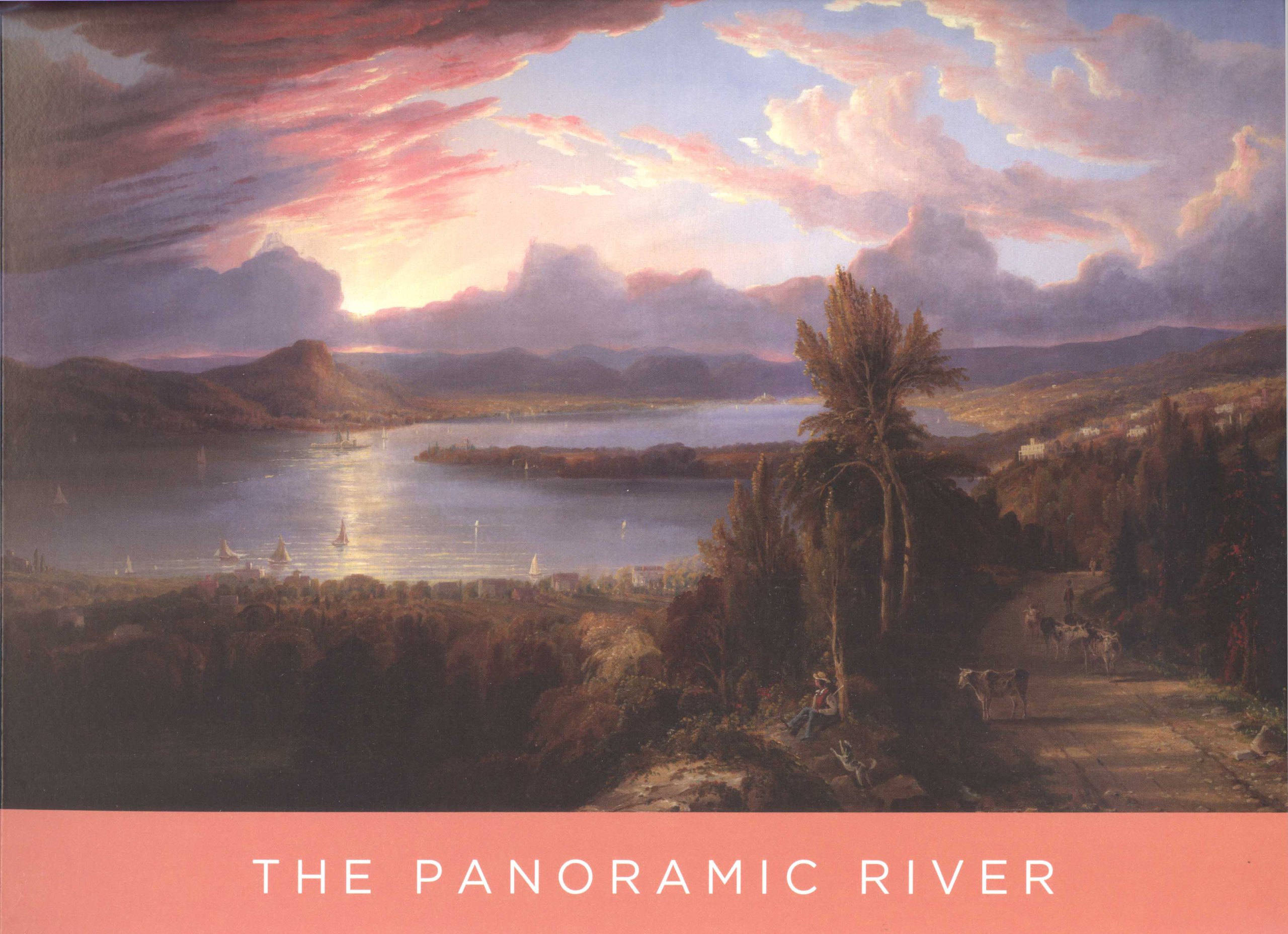



Excerpted from River Romantics by Barrymore Laurence Scherer, Wall Street Journal, April, 24, 2013. The panorama was invented in 1787 by the Scottish artist Robert Barker, whose detailed cityscape of Edinburgh was painted inside a large circular chamber and viewed from the center of that room. Such works remained popular well into the 1820s. And they exerted a marked influence on both the British Romantics and the artists of the Hudson River School, whose landscapes embody the poetic grandeur of wild nature with a rhetorical power that strives to transcend the confines of the frame. At the Hudson River Museum in Yonkers, a pencil sketch of Catskill Mountain House From North Mountain (1839-44) by Thomas Cole vividly conveys this expansive urge. Cole, founder of the Hudson River School, was so keen to do justice to the panoramic breadth of this Catskill landscape that his drawing extends across two pages of his sketchbook. That Cole drawing is but one of the more than 100 works in The Panoramic River. Handsomely co-curated by the museum's Bartholomew Bland and Laura Vookles who also contributed essays to the excellent exhibition book the show reveals how New York's Hudson and London's Thames served as focal points of this dramatic kind of imagery. On loan from major museums and private collections are paintings by such major British landscapists as John Constable and J.M.W. Turner and painters of the Hudson River School, along with watercolors, fragile hand-painted miniature panoramic scrolls, historic tinted photographs, stereographs, prints and even fragments of panoramic wallpapers. They betoken a time when artists regarded the natural landscape not just as a source of beauty, but as the visible evidence of divine order. Moreover, they document a long period during which both England and America were becoming industrialized, when artists and writers marveled at the new inventions while expressing concern over the resulting transformation of their societies. Britain had a head start. While several 18th-century views of London from the Thames show a city already crowded with centuries of development, early 19th-century views of New York and the Hudson are almost Eden-like in their comparative rusticity. The Thames of Georgian London flows past a forest of church steeples; the Hudson's banks are lined with actual forests. The Hudson Highlands around Nyack, West Point and Haverstraw are dominated by wooded hills and craggy prominences, while further south the Hudson's western bank is formed by the vertical thrust of the Palisades. This alternately bucolic and brooding landscape inspired painters not just to depict the actual topography but often to clothe it in Byronic atmosphere. The pairing of two canvases, View on the Hudson (1865) and On the Thames, Near Windsor (1868), by John Frederick Kensett, a Luminist, shows how the disparate landscapes of the two rivers inspired different approaches. In the Hudson Highlands, he composes his view from a vantage point high above the river near West Point. The painting emphasizes the drama of altitude and distance by depicting the boldly varied textures of near and distant mountains, and of a stormy sky above the still waters below. Conversely, in his Thames Valley view, it is the opalescent sky rather than the characteristically flat landscape that dominates the composition. The low vantage point at the river's edge limits the view hardly a mile away, a country steeple serves as the focal point above the tree line. Foliage, tree trunks and verdant meadow are stippled with tiny brush strokes. --Wall Street Journal Bartholomew F. Bland is Director of Curatorial Affairs at the Hudson River Museum, where he has organized a number of exhibitions related to the art and history of the Hudson Valley Region including, Westchester: The American Suburb and Dutch New York: The Roots of Hudson Valley Culture. He also curated A Field Guide to Sprawl for Arts Westchester, which examined of the impact of the suburban lifestyle on the physical environment, an exhibition that traveled to Yale University. Among his survey exhibitions for the Museum related to the Hudson River School are Paintbox Leaves: Autumnal Inspiration from Cole to Wyeth and Greener Pastures: Images of Arcadia at the Hudson River Museum. Pat Hardy practiced for many years as a City civil litigator before completing a Ph.D. in 2008 at the Courtauld Institute on 19th-century British art. She has subsequently worked as Assistant Curator at the National Portrait Gallery, Curator of Works on Paper at National Museums Liverpool and is currently Curator of Paintings, Prints and Drawings at the Museum of London. Most recently she co-curated the Dickens and London exhibition at the Museum, contributed an essay Dickens and the Social Realists to the exhibition catalogue Dickens and the Artists, Yale University Press, 2012, and is currently writing a book on the imagery of emigration. Tara Dawson is a freelance research a