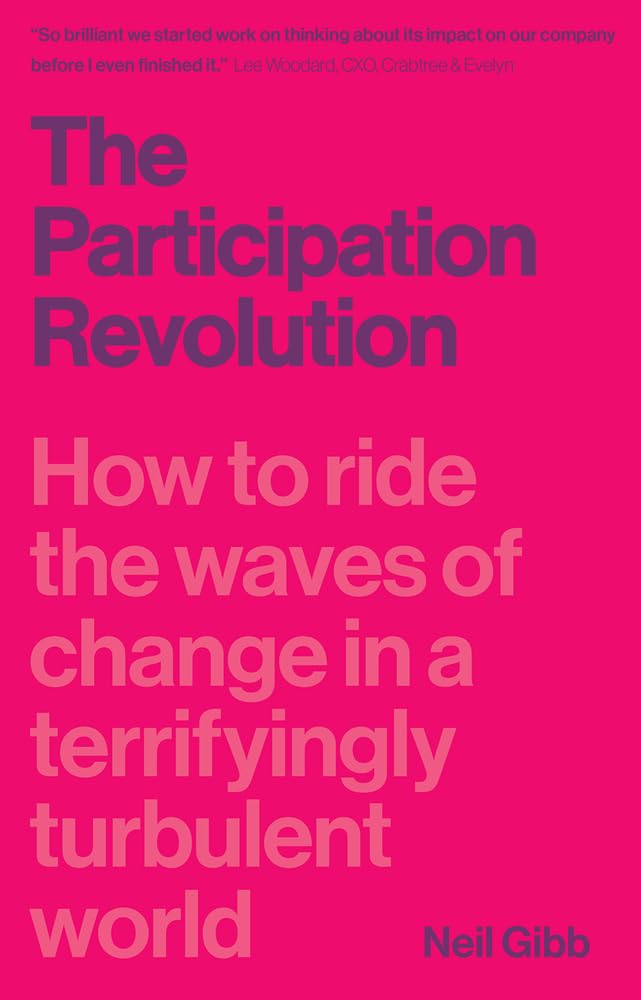



Navigate the Participation Revolution and Thrive in a Changing World Are you ready to ride the waves of change in today's turbulent world? The Participation Revolution is your essential guide to understanding and harnessing the power of social economics. This groundbreaking explores how businesses, leaders, and individuals can thrive by embracing participation, community, and purpose. Discover how to: Build a strong community - Foster authentic connections - Harness the power of participatory innovation For business leaders, entrepreneurs, and anyone seeking to make a positive impact, this is your manifesto for creating a better future. Neil Gibb, a consultant, writer, and social advocate, provides the insights and tools you need to navigate the new economic landscape and build a more meaningful and prosperous world. "So brilliant we started work on thinking about its impact on our company before I even finished it" - Lee Woodard, CXO, Crabtree & Evelyn "The Participation Revolution provides a rich and topical narrative for the changes that we sense in the world around us but may not yet have been able to verbalise. Neil Gibb's insights offer a useful framework for anyone - individual or organisation - seeking to adapt to a fast-changing landscape." - Neil Stott, Cambridge Judge Business School Neil Gibb is a consultant, writer, speaker and social advocate who has worked for over 20 years with companies large and small, helping them apply new thinking and technology to improve their businesses. His clients have ranged from Shell, Barclays, the European Space Agency and the Nationwide Building Society to dozens of small tech firms, including currently a cryptocurrency and AI start-up and a data analytics company. Along the way he has published two crime novels, trained as a Jungian therapist and played a small but crucial role in the development of Viagra. A decade in the writing, and based on research and experience across five continents, The Participation Revolution is his first non-fiction book and is being used to develop a module on digital innovation at Cambridge Business School. The Participation Revolution How To Ride The Waves Of Change In A Terrifyingly Turbulent World By Neil Gibb, John Ciavarella, Simon Edge, Clio Mitchell Eye Books Ltd Copyright © 2017 Neil Gibb All rights reserved. ISBN: 978-1-78563-055-2 Contents I. Introduction, When things fall apart, Disruption is the future calling, The great transformation, Creative destruction, How to use this book, The emergence of a new paradigm, That thing we seek, The rise of social economics, The participation revolution, Connected, Strategic shifts, The process of transformation, Architecture, II. Case stories, 1. We are United!, 2. The power of fans, 3. How to be a billionaire in three easy moves: part 1, 4. How to be a billionaire in three easy moves: part 2, 5. Generation why, 6. Vision and blindness, 7. Why we do what we do, 8. In the club, 9. The deadly serious game, 10. How to be a billionaire in three easy moves: part 3, 11. A higher calling, 12. It ain't what you do, it's the why that you do it, 13. The pursuit of happiness, 14. Together, 15. Home, III. How it works, Framework, 1. Create a cause, A new kind of leadership, Bank to the future, The non-linear business model, 2. Mobilise a movement, Weapons of mass participation, The Art of transformation, Analytics and performance metrics, 3. Build a community, Together, That thing we most seek, Social economics, IV. Into action, A call to action, Manifesto, An open-source tool kit, CHAPTER 1 When things fall apart "You can't stop the waves, but you can learn to surf" Jon Kabat-Zinn Galileo Galilei was a clever lad. He is often referred to as the founding father of modern physics, of modern astronomy, of the scientific method, and of science itself. Einstein was one of his many fans. Galileo was a geek, an engineer, a 16th-century hipster, and he could code. He was a pivotal figure in the great social and economic transformation that we now call the Renaissance. He was the inventor of one of the breakthrough technologies that enabled the discovery of the New World. He also played a pretty mean lute. So influential was Galileo that, like Madonna and Prince, he was known simply by his first name. But Galileo spent the latter part of his life under house arrest, having been very lucky to escape being executed in one of the many excruciating ways favoured by the inquisitions of the time. The reason for this is worth remembering as we seek to navigate our way through a period of societal transformation very similar in scale and magnitude to the Renaissance. Galileo said something that challenged the fundamental beliefs of the time – that the Sun, not Earth, was at the centre of the universe. Like all great insights, it seems crazy with hindsight that people could be so resistant to something that now s