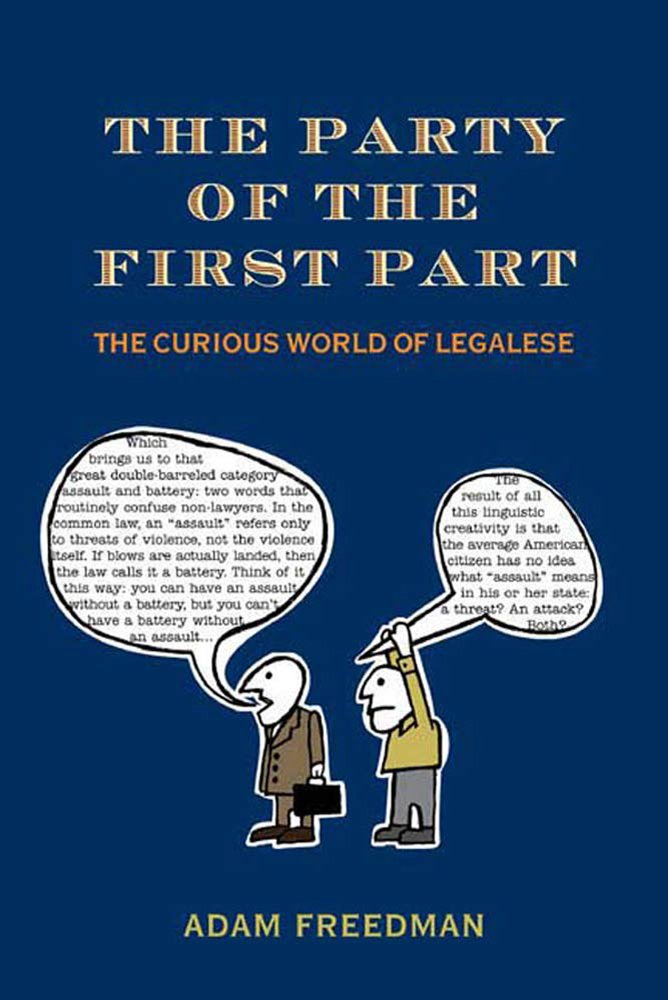



The Eats, Shoots & Leaves of legalese, this witty narrative journey through the letter of the law offers something for language lovers and legal eagles alike This clever, user-friendly discourse exposes the simple laws lurking behind decorative, unnecessary, and confusing legal language. For better or for worse, the instruction manual for today's world is written by lawyers. Everyone needs to understand this manual--but lawyers persist in writing it in language no one can possibly decipher. Why accuse someone of making "material misstatements of fact," when you could just call them a liar? What's the point of a "last" will and testament if, presumably, every will is your last? Did you know that "law" derives from a Norse term meaning "that which is laid down"? So tell your boss to stop laying down the law--it already is. The debate over Plain vs. Precision English rages on in courtrooms, boardrooms, and, yes, even bedrooms. Here, Adam Freedman explores the origins of legalese, interprets archaic phrasing (witnesseth!), explains obscure and oddly named laws, and disputes the notion that lawyers are any smarter than the rest of us when judged solely on their briefs. (A brief, by the way, is never so.) “If you ever wanted to go to law school but thought it would be painful and dull, you were right. Fortunately, Adam Freedman's wit and insight will give you in an afternoon what you need to navigate a lawyered-up world—and more laughs than you'd find in class, too.”—Kermit Roosevelt, Professor, University of Pennsylvania Law School and author of In the Shadow of the Law " The Party of the First Part is a terrific achievement—a hugely entertaining book about a subject that is normally anything but. Against all odds, it makes legal language come to life. It's the kind of book I wish I'd read before law school, and the perfect read for non-lawyers who wonder what they're missing."—Jeremy Blachman, author of Anonymous Lawyer "A lighthearted but lucid explanation of legalese."—William Safire, The New York Times “A gem of a book: bright, lucid, and compelling. I found myself laughing out loud, and wondering why lawyers can’t just eat their torts and go home.”—Cameron Stracher, author of Double Billing and publisher of the New York Law School Law Review Adam Freedman writes the "Legal Lingo" column for the New York Law Journal Magazine , and was a litigator before joining a major investment bank where he earns his living decoding policies and procedures into plain English. He holds degrees from Yale, Oxford, and the University of Chicago and has written for Newsweek International and Slate.com, among others. He lives in Brooklyn, New York. The Party of the First Part 1THE GLORY OF LEGALESE "Incorporeal" means "without a body." However, when a company is "incorporated" it is given a body. --CENTRE FOR PLAIN LEGAL LANGUAGE, 1995At 2:30 A.M. on March 22, 1997, a convicted felon named Anthony Dye was racing his Corvette through the streets of Elkhart, Indiana. The police were in hot pursuit. Dye pulled into his mother's driveway, got out of the car, and made a run for it. When the police caught up with him, Dye took a semiautomatic pistol from his waistband and opened fire. At that critical moment, a valiant police dog named Frei leapt into action, fastened onto Dye's leg, and, as it were, took a bite out of crime. Dye was arrested.Having been injured in the course of his arrest, Dye did what any red-blooded American would do. He brought a lawsuit--against Frei the police dog. Dye argued that dogs are "persons" who can be sued, at least when they work for the police. Dye fought his way to the second highest court in the land, the United States Court of Appeals, which dismissed his claim.Dye's theory that a dog is a person is not as far-fetched as you might think. In fact, he wasn't even the first person to sue a police dog. And some very respectable lawyers have argued that the legal definition of person ought to be expanded, at least to include other primates. Laurence Tribe, Harvard's leading constitutional scholar, has maintained for years that chimpanzees should be considered persons under the Constitution.That the country's best legal minds can be consumed with questions about whether the word "person" includes dogs or chimpanzees tells us a lot about lawyers. But it also tells us something about the language of the law. Nothing in the realm of legalese is quite what it seems.Consider the fact that Congress once passed legislation declaring that "September 16, 1940 means June 27, 1950." In New Zealand, the law says that a "day" means a period of seventy-two hours, while an Australian statute defines "citrus fruit" to include eggs. To American lawyers, a twenty-year-old document is "ancient," while a seventeen-year-old person is an "infant." At one time or another, the law has defined "dead person" to include nuns, "daughter" to include son, and "cow" to include horse; it has even declared white to be b