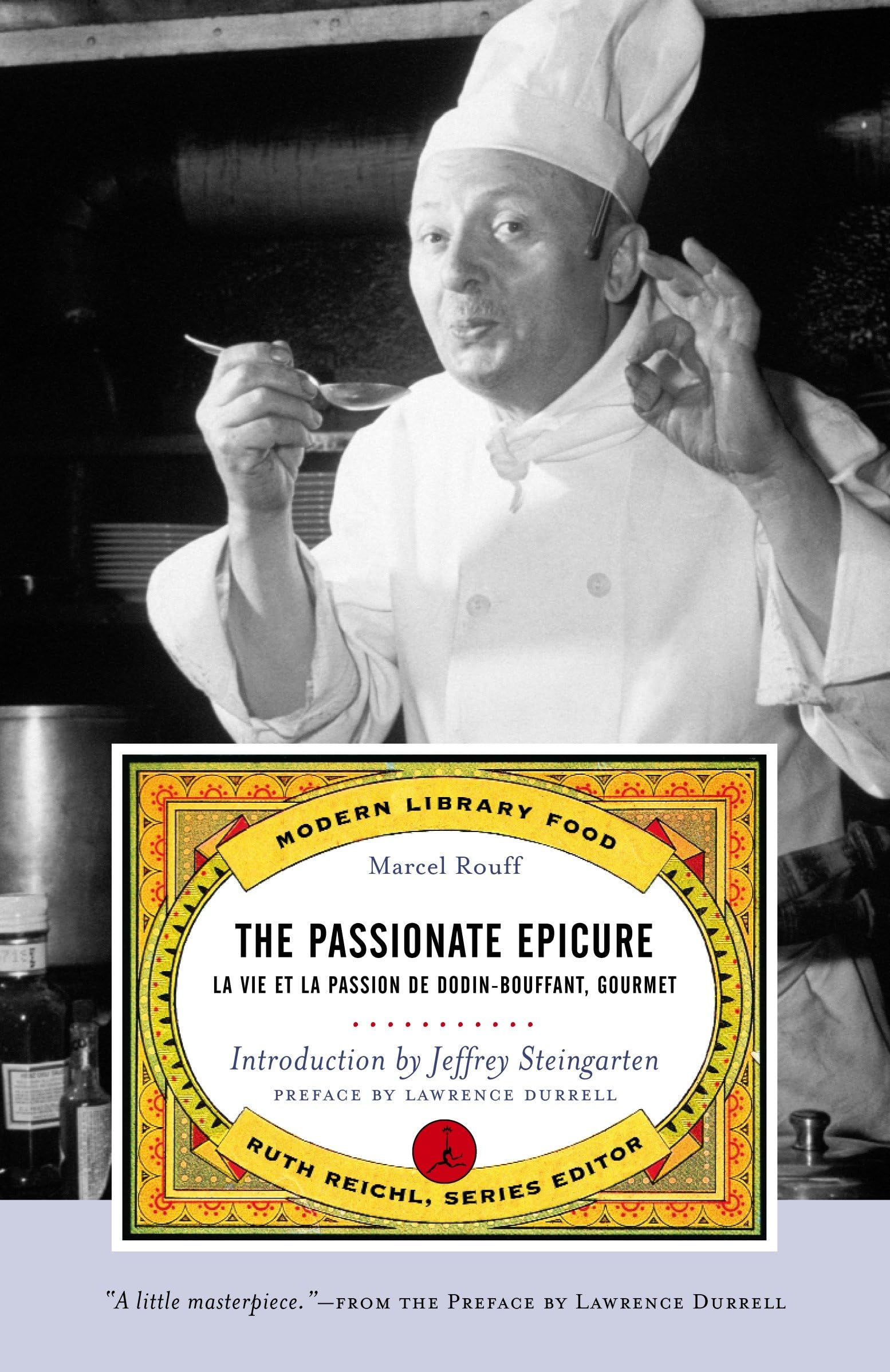
The Passionate Epicure: La Vie et la Passion de Dodin-Bouffant, Gourmet (Modern Library (Paperback))
$13.34
by Marcel Rouff



In the classic French novel The Passionate Epicure , Marcel Rouff introduces Dodin-Bouffant, a character based loosely on Anthelme Brillat-Savarin, an infamous bachelor and epicure dedicated to the high arts: the art of food and the art of love. This edition contains a Preface by Lawrence Durrell and a new Intro-duction by Jeffrey Steingarten, the food critic for Vogue magazine and author of the bestselling book The Man Who Ate Everything . “A little masterpiece.” —from the Preface by Lawrence Durrell “Some of the finest and most enticing writing about food you’ll ever find.” —From the Introduction by Jeffrey Steingarten In the classic French novel The Passionate Epicure , Marcel Rouff introduces Dodin-Bouffant, a character based loosely on Anthelme Brillat-Savarin, an infamous bachelor and epicure dedicated to the high arts: the art of food and the art of love. This edition contains a Preface by Lawrence Durrell and a new Intro-duction by Jeffrey Steingarten, the food critic for Vogue magazine and author of the bestselling book The Man Who Ate Everything . In the classic French novel The Passionate Epicure, Marcel Rouff introduces Dodin-Bouffant, a character based loosely on Anthelme Brillat-Savarin, an infamous bachelor and epicure dedicated to the high arts: the art of food and the art of love. This edition contains a Preface by Lawrence Durrell and a new Intro-duction by Jeffrey Steingarten, the food critic for "Vogue magazine and author of the bestselling book The Man Who Ate Everything. Marcel Rouff was born in Geneva in 1877. He is the author of The Psychology of Taste and had a distinguished career as a gourmet writer, poet, dramatist, essayist, literary critic, chronicler of rural as well as Parisian society, and historian, collaborating with such luminaries as Jean Jaurès. He died in Paris in 1936. From the Introduction Jeffrey Steingarten This delightful little classic was probably the first gastronomic novel ever written, printed in a tiny edition in 1920, then properly published in 1924. The charming translation by “Claude” is the only one into English. It was first published in London in 1961 and a year later in New York City, and has been out of print for a generation. We are very lucky to have it back. Our hero, Monsieur Dodin-Bouffant, is a distinguished jurist, now retired and living with one servant in a small, comfortable house in his ancestral town. He has dedicated his life, every waking hour, to the refinements of cuisine, which is to say French cuisine–eating and cooking, thinking and talking about it. Though word of Dodin’s gastronomic genius has spread throughout the world, he remains “unpretentious, kindly, simple; devoting with ever more conscientious gravity and more concentrated ardour, the powers and meditations of his riper years to the subtle and magnificent art to which he considered he owed, for the traditional glory of his country, the best of himself and the whole of his active genius.” For Marcel Rouff, Dodin’s creator, eating is an art, an act of patriotism, and much more. Dodin-Bouffant (we never learn his given name) is surely the most famous character in gastronomic fiction. He is pleased, though perhaps not completely surprised, when the Crown Prince of Eurasia, vacationing in the Jura to take the waters, invites him to dinner. The Prince’s motive is both to display his own epicurean abilities and to win a return invitation to Dodin-Bouffant’s table. These dueling dinners are the central event of the book, the scenes with which The Passionate Epicure is always identified in France. One passage, a page or two, right in the middle of one of the dinners is surely the most quoted. Why should this be? There are, after all, a multitude of wonderfully mouthwatering eating scenes throughout the book; they draw us from beginning to end like a truffle tied to a pole, even when the plot itself slackens. The book brims over with nice apothegms and culinary word-paintings both sensitive and vivid. And for sheer suspense, satire, and sensual satisfaction, we would surely turn to the scene of Dodin-Bouffant’s covert meeting, toward the end of the book, with a beautiful, young, rich, blond female worshiper who, on top of everything else, proves to be an even greater gastronomic genius than he. Then why the two dinners with the Prince of Eurasia? The reason is simple. The reason is pot-au-feu. For the French, La Vie et la Passion de Dodin-Bouffant, Gourmet is about the pot-au-feu Dodin serves the Prince–a common and simple dish, but for centuries very close to the soul of France, the foundation of empires, it has been called. Perhaps that is why several epicurean friends in Paris assigned this book to me ten years ago as required reading. My command of French, once sufficient to subdue Corneille and Racine, had by then become a blunt, corroded tool, and so I limited myself to the famous Chapter 4. And there it was–not only the most inspired description ever writ