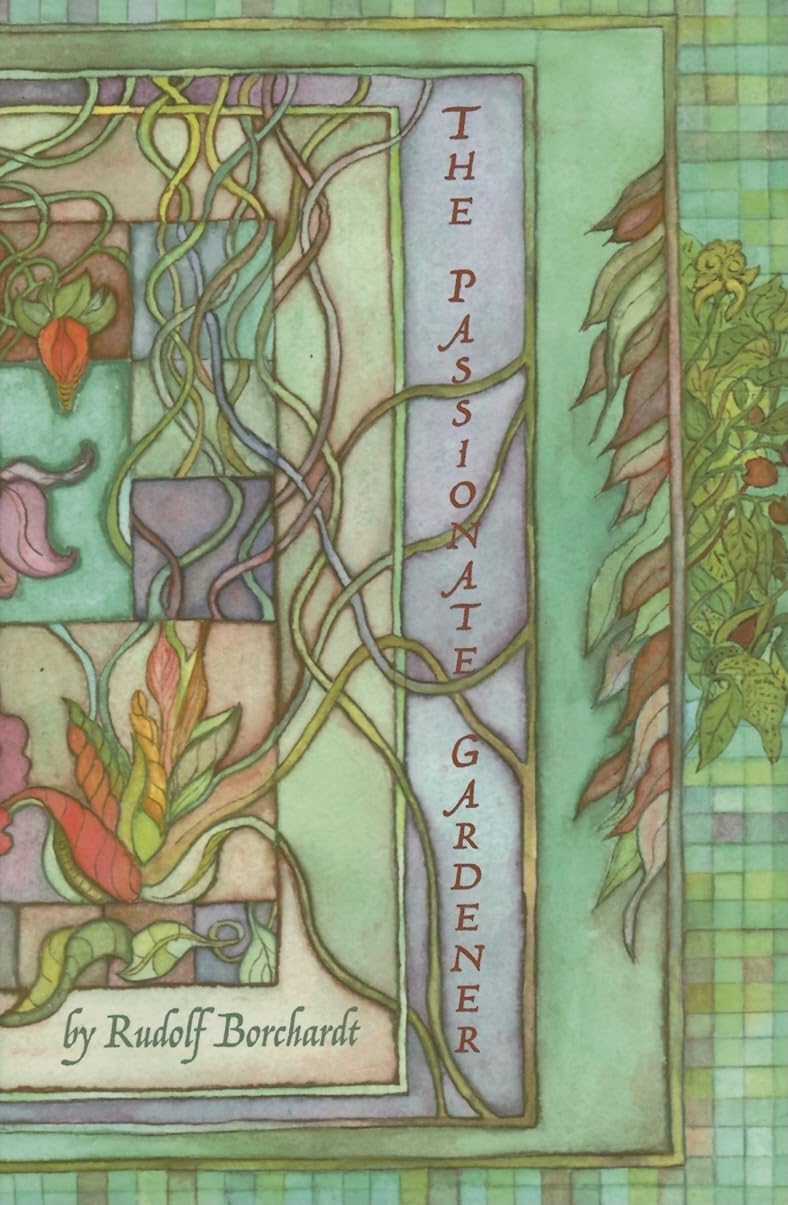



Among books about flowers and gardening, The Passionate Gardener is a rare and exemplary hybrid. Part essay, part handbook, part treatise, part quest, it is presented with the practiced eye of a naturalist, the disciplined understanding of a philosopher, and the inspiration of a poet. Rudolf Borchardt was, in fact, all of these, and a novelist, dramatist, and renowned translator as well. In the first six chapters he rediscovers the centrality of the garden as image, symbol, concept and metaphor in the development of human consciousness. And through a careful consideration of the flower, he describes the historical, literary, botanical, psychological, sociological and environmental perspectives of the eighteenth- and nineteenth-century reinvention of landscape gardening. Borchardt's intention is nothing less than to articulate the complex continuities and discontinuities through which Nature and the human being relate to one another. He perceives the flower, the human being, and the garden in which they meet to be works in progress, each an expression of the inherent possibilities of the others. The Passionate Gardener is also the story of the intrepid explorers who searched the world for new, unknown flowers; of the botanists who studied them; of the horticulturists who then refined their forms and colors; and finally of the collaboration and fusion of Roman, Persian, Oriental, Italian, French, Austrian, English, African, and American garden traditions in the service of a common, humanistic ideal. In addition, Borchardt shares his first-hand practical experience of scores of “new, lost, rare, misunderstood and singular” plants, and offers valuable guidance about soils and planting: his book is a marvelously erudite work of literature, while equally, and quite self-consciously, down to earth. This book is no mere gardening how-to, though it contains a wealth of practical information for every serious gardener. Rather, The Passionate Gardener is a unique book about a celebrated German poet's remarkable search for the relationship between human society and the vegetable kingdom. As Borchardt pursues his image of the garden, the reader becomes entranced by the quest. The first few chapter titles suggest the dimensions of Borchardt's undertaking: "The Flower and the Human Being," "The Garden and the Human Being," "The Garden and the New Flowers," etc. At one level, this history of plants and gardens becomes a fascinating tale of how they were brought from their original locales to those in which we find them today, and the colonial empires that sent botanists and collectors across the earth in search of new, rare, incomparable flowers. Moreover, it is a story of the breeding of plants, and of the hybridization of their forms and colors: a story of human respect for natural givens, but equally of the human ability to grasp and further the development of natural possibilities. Finally, it is about the Roman, Persian, Oriental, Medieval, Baroque, Italian, French, Austrian, English, American and African garden traditions that have collaborated and fused with one another in the service of a common and higher ideal. Yet amidst all this, Rudolf Borchardt detects a still larger story concerning the inescapable connection between the garden and the fundamental structures of civilization, and that is the genius of this book. Rudolf Borchardt was born in 1877 in Königsberg, in Eastern Prussia, and died in 1945 in the Tyrolean village of Trins, in southern Austria. Borchardt's presence in Tyrol in 1945 resulted from his forced evacuation from Italy where he had lived near Lucca since 1903, except for the period of the First World War during which he served in Berlin and Alsace as an officer in the German army. (Borchardt not only was an anti-Nazi, but as well, in earlier years, had made no secret of his family's Jewish origins: he dates his family's conversion to Evangelism to the first third of the nineteenth century, though partly it may have taken place in the 1870s.) Borchardt writes in his autobiography that the story of his life was the story of the collapse of German tradition, and he somehow shaped the desperate idea that he himself might rescue it. He was educated in archaeology, theology, and classical and oriental philology at universities in Berlin, Bonn and Göttingen, and one of the decisive turning points in his literary career was his meeting in 1898 with Stefan George and Hugo von Hofmannsthal. Borchardt while alive was both famous and obscure. He was intensely involved with the ins and outs and conflicting directions of German literary life, especially in the period before the 1930s, as is seen in his copious correspondence with Hofmannsthal, Benedetto Croce and Martin Buber, among others. His thinking was always conservativehe was a part of what was known as “the conservative revolution,” though he himself preferred to write about the need for a &ldquocreative restoration” and the terms on which he looked