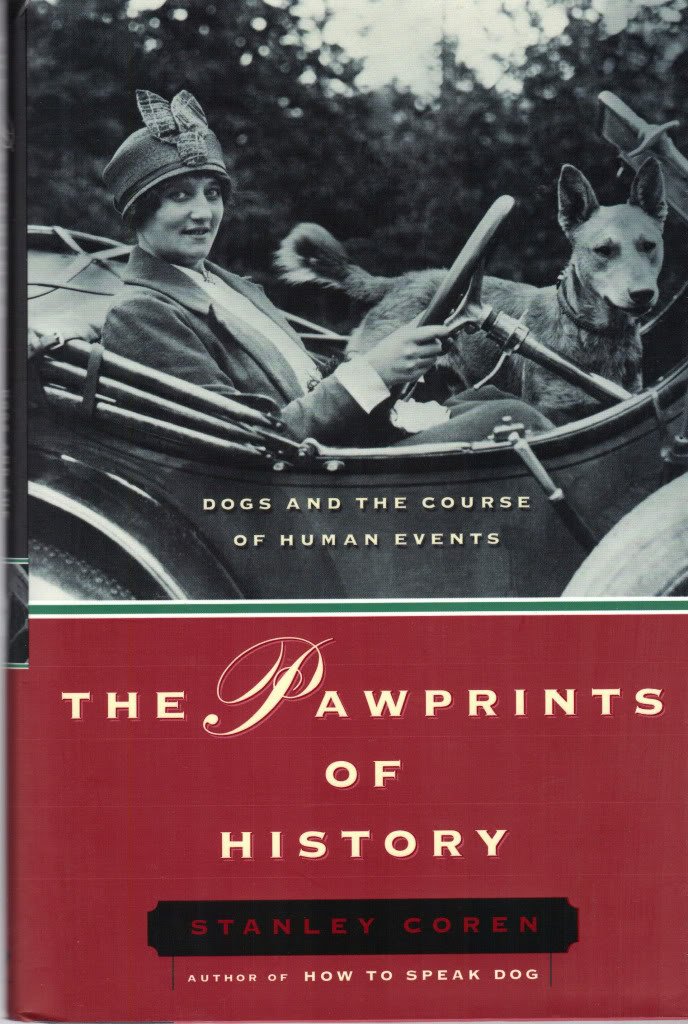



A professor of psychology shares a lifetime of dog stories, interspersing his own loving stories of canine companionship with a fascinating survey of the human/dog relationship through history. 40,000 first printing. Humans and canines have been living together for about 14,000 years. That's amazing enough, but Coren and Bartlett take it one step further, showing that the world we live in today might have been a very different place if it hadn't been for a few dogs in the right place at the right time. Take Napoleon, for instance. He hated dogs, but one day in 1815, as he was sailing away from the island of Elba, he fell into the icy water and probably would have drowned except for a plucky Newfoundland dog that plunged into the water and rescued him. Napoleon, of course, went on to reclaim his throne and wage bloody war against the British at Waterloo. This delightful chronicle offers a rich and surprising cavalcade of canines who touched the lives of such famous people as Richard Wagner, Alexander Pope, Alexander Graham Bell, Frederick the Great, and Sigmund Freud. These engaging, even touching stories will be a real treat for dog lovers, history buffs, and trivia addicts. David Pitt Copyright © American Library Association. All rights reserved Stanley Coren is a professor of psychology at the University of British Columbia and author of The Left-Hander Syndrome, The Intelligence of Dogs, Sleep Thieves, What Do Dogs Know?, Why We Love the Dogs We Do, and How to Speak Dog. He lives in Vancouver, British Columbia. The book has been illustrated with lighthearted drawings by the highly talented artist, animator, and animation director Andy Bartlett, who also lives in Vancouver, British Columbia. Chapter One: Sentinels and Symbols How many times has the fate of a man, or even a nation, hung from the collar of a dog? Had it not been for dogs, the last imperial house of China might not have fallen; Columbus's first attempts at colonizing the Americas not have been so successful; some of Wagner's operas might never have been written; the American Revolution might not have been fought; the freeing of the American slaves might have been delayed for decades; the way that we educate deaf children might be different; and great and well-loved books like Ivanhoe might never have been written. Most people know and accept in a general way the fact that dogs have changed human history by fulfilling needed functions in human activities such as hunting, herding, exploration, or the waging of war. When it comes to political, social, or cultural history, however, few people would expect any evidence of canine influences. Yet there are many instances where the actions of a single dog changed the life of a single human, who in turn went on to shape human history. These seldom-told stories are the most fascinating. Consider, for example, the case of Alexander Pope, the brilliant satirist who is considered by many to be the greatest English poet of the eighteenth century. One of the most quotable poets of all time, Pope is the source of such familiar epigrams as "A little learning is a dangerous thing," "To err is human, to forgive, divine," and "Fools rush in where angels fear to tread." Many of his poems, such as The Rape of the Lock and The Dunciad, as well as his Essay on Man and Essay on Criticism, are still popular classics and required reading for anyone seeking a degree in literature in most universities. Pope was born in London in 1688. His interest in literature and writing was probably in part the result of his poor physique. While still quite young, Pope developed a form of tuberculosis that affects the spine. This condition stunted his growth; his full-grown height was only four feet six inches. In addition, Pope was condemned to suffer from headaches throughout his life, and he was abnormally sensitive to pain. His spinal condition made bending and physical exertions a source of agony. He often needed assistance to rise from his bed or chair and was obliged to have a servant help him dress and undress. Nevertheless, Pope could be a charming social companion and host. Despite his lack of height, he had a handsome face and an attractive appearance so that people did not feel uncomfortable in his presence. At his large estate at Twickenham on the Thames (only a short distance from London), Pope entertained many celebrated guests, from poets and philosophers to high government officials, society belles, and even royalty. On any visit to him one might have met the likes of Jonathan Swift, the satirical author of Gulliver's Travels; Henry St. John the Viscount Bolingbroke, a statesman and orator who later became an author; Robert Harley, the first earl of Oxford, who would one day be the Lord Treasurer; and even Frederick, the Prince of Wales. Pope's many visitors would often convene in the great garden that he had carefully designed, and then the whole party would spend hours in sprightly co