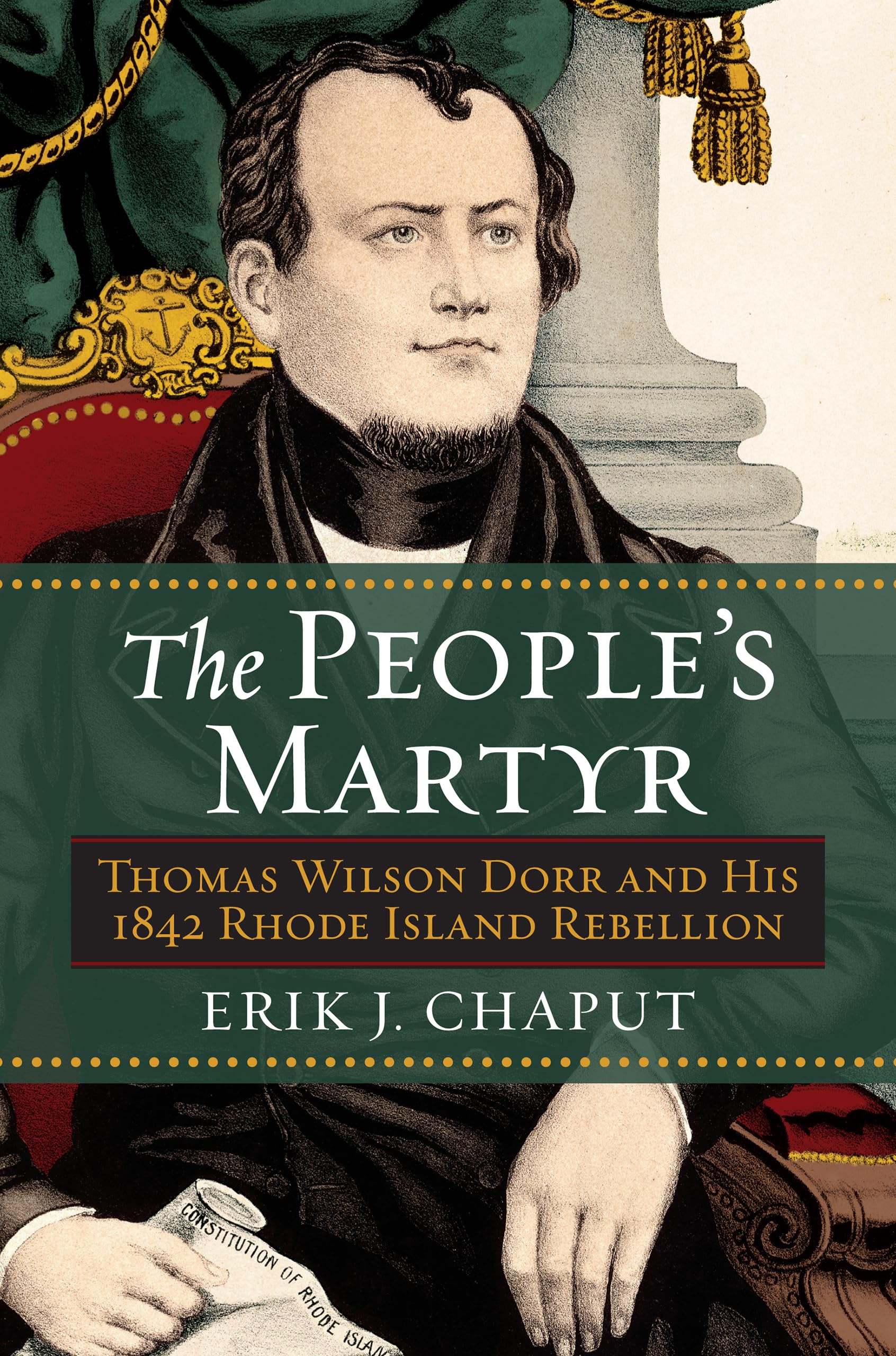
The People's Martyr: Thomas Wilson Dorr and His 1842 Rhode Island Rebellion
$39.99
by Erik J. Chaput



In 1840s Rhode Island, the state’s seventeenth-century colonial charter remained in force and restricted suffrage to property owners, effectively disenfranchising 60 percent of potential voters. Thomas Wilson Dorr’s failed attempt to rectify that situation through constitutional reform ultimately led to an armed insurrection that was quickly quashed—and to a stiff sentence for Dorr himself. Nevertheless, as Erik Chaput shows, the Dorr Rebellion stands as a critical moment of American history during the two decades of fractious sectional politics leading up to the Civil War. This uprising was the only revolutionary republican movement in the antebellum period that claimed the people’s sovereignty as the basis for the right to alter or abolish a form of government. Equally important, it influenced the outcomes of important elections throughout northern states in the early 1840s and foreshadowed the breakup of the national Democratic Party in 1860. Through his spellbinding and engaging narrative, Chaput sets the rebellion in the context of national affairs—especially the abolitionist movement. While Dorr supported the rights of African Americans, a majority of delegates to the “People’s Convention” favored a whites-only clause to ensure the proposed constitution’s passage, which brought abolitionists such as Frederick Douglass, Parker Pillsbury, and Abby Kelley to Rhode Island to protest. Meanwhile, Dorr’s ideology of the people’s sovereignty sparked profound fears among Southern politicians regarding its potential to trigger slave insurrections. Drawing upon years of extensive archival research, Chaput’s book provides the first scholarly biography of Dorr, as well as the most detailed account of the rebellion yet published. In it, Chaput tackles issues of race and gender and carries the story forward into the 1850s to examine the transformation of Dorr’s ideology into the more familiar refrain of popular sovereignty. Chaput demonstrates how the rebellion’s real aims and significance were far broader than have been supposed, encompassing seemingly conflicting issues including popular sovereignty, antislavery, land reform, and states’ rights. The People’s Martyr is a definitive look at a key event in our history that further defined the nature of American democracy and the form of constitutionalism we now hold as inviolable. "The‘rebellion’ was an interesting, revealing moment in American history, which Erik J. Chaput establishes clearly and thoroughly in his book."— The Historian “…based on wide and deep research into archives; Dorr’s writings, correspondence and diaries; newspapers and political tracts; and court records and cases. One of its great strengths is that it shows why the Dorr Rebellion was more than a tempest in Rhode Island’s teapot. It had national implications and repercussions, influencing sectional politics, the controversy over slavery, and political party development in the 1840s and 1850s.”— J. Stanley Lemons , HNN: History News Network “Though certainly a glut for Rhode Island regionalists, Chaput’s book is no provincial monograph. Using Thomas Dorr’s 1842 near-overthrow of Rhode Island’s government as a centrifuge, “The People&8217;s Martyr” seeks to better understand constitutional intent, or at least how difficult that endeavor can be. In addition, it stations Dorr’s rebellion as critical to fomenting the Civil War, and while most historians are gifted researchers, Chaput earns top tier accolades by looming his acquired facts into an engaging story relevant to both Dorr’s time and our own.”— The Providence Journal "Successfully shows how Dorr’s Rebellion posed large questions about the nature of our democracy, and had an impact beyond what conventional wisdom indicates. The fact that it’s a compelling story only adds to the pleasure of reliving this piece of regional history."— The Sun Chronicle "Erik J. Chaput’s deeply researched, beautifully written, insightful, and revelatory biography of Dorr’s populist opposition to the state’s oligarchy and, by extension, to the government that it controlled proves conclusively that the ideology underpinning his rebellion had far-reaching implications for the nation in grappling with the meaning and legacy of the American Revolution."— Journal of American History " The People’s Martyr is a vivid and nuanced narrative of the meaning of Dorr’s rebellion for American constitutionalism and political culture."— American Historical Review Listed as one of Mike Freeman’s top five books of 2013 in the Providence (RI) Journal. “Deeply researched and clearly written, Chaput’s book is the fullest and most balanced account of Thomas W. Dorr and his extraordinary 1842 Rhode Island rebellion.”— Gordon S. Wood , Pulitzer Prize-winning author of The Radicalism of the American Revolution “In writing the fullest biography yet of the fascinating Thomas Dorr, Chaput has also rewritten the history of the Dorr War, a singular and, as he shows anew, pivotal epi