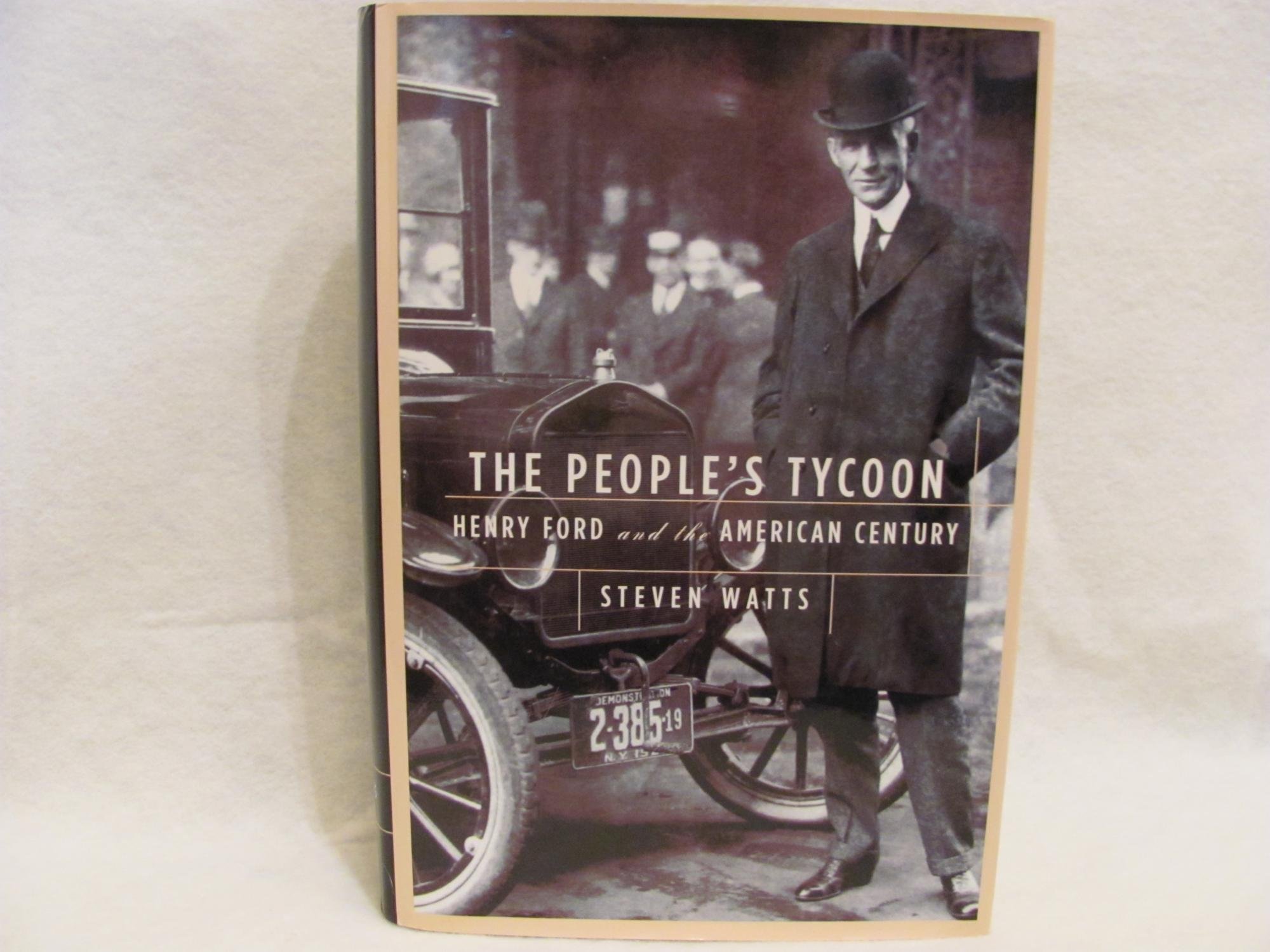



Henry Ford, a major architect of modern America, has lived on in the imagination of his fellow citizens as an enduring figure of fascination, an inimitable individual, a controversial personality, and a social visionary from the moment his Model T brought the automobile to the masses and triggered the consumer revolution. But never before has his outsized genius been brought to life so vividly as by Steven Watts in this major new biography. Watts, the author of the much acclaimed The Magic Kingdom: Walt Disney and the American Way of Life , has produced a superbly researched study of a man who was a bundle of contradictions. Ford was the entrepreneur who first made the automobile affordable but who grew skeptical of consumerism’s corrosive impact on moral values, an employer who insisted on a living wage for his workers but stridently opposed unions, who established the assembly line but worried about its effect on the work ethic, who welcomed African Americans to his company in the age of Jim Crow but was a rabid anti-Semite. He was the private man who had a warm, loving marriage while siring a son with a mistress; a father who drove his heir, Edsel, so relentlessly that it contributed to his early death; a folksy social philosopher and at one time, perhaps, the most popular figure in America, who treated his workers so harshly that they turned against him; creator of the largest, most sophisticated factory in the world who preferred spending time in his elaborate re-creation of a nineteenth-century village; and the greatest businessman of his age who haplessly lost control of his own company in his declining years. Watts poignantly shows us how a Michigan farm boy from modest circumstances emerged as one of America’s richest men and one of its first mass-culture celebrities, one who became a folk hero to millions of ordinary citizens because of his support of high wages and material abundance for everyday workers and yet also excited the admiration of figures as diverse as Vladimir Lenin and Adolf Hitler, John D. Rockefeller and Woodrow Wilson. Disclosing the man behind the myth and situating his achievements and controversies firmly within the context of early twentieth-century America, Watts has given us a comprehensive, illuminating biography of an American icon. By the early nineteentwenties, half of all cars on the road were Ford Model Ts, and Henry Ford was one of the most widely quoted men in America. This sturdy biography credits Ford with having, more than anyone else, "created the American Century," spearheading a vast consumer revolution by his mastery of "the mechanisms of modern publicity." When his first attempts at auto production failed, Ford captivated the nation with a series of audacious publicity stunts. His maverick populism made him the first tycoon to be a hero to ordinary Americans, but it was a short step from his early tirades against East Coast bankers and intellectuals to the anti-Semitic crusades that now mar his legacy. Watts somewhat underplays recently discovered evidence of Ford's collaboration—through a German subsidiary—with the Nazi regime, preferring to concentrate on the man who embodied the maxim "To make a sensation, be one." Copyright © 2005 The New Yorker Henry Ford distinguished himself from other great industrialists by being a populist who manufactured on a grand scale, not to create wealth for himself but to raise the standard of living for all by creating an inexpensive, dependable car that could be purchased by anyone. Uneducated yet outspoken, Ford was a man of contradictions: champion of consumerism and a farmer at heart who believed that we would all be better off living off the land. An advocate of Victorian morals, he rallied against tobacco and liquor yet kept up an extramarital affair for nearly 30 years and sired a love child. A master of publicity, he denounced advertising as a waste of money. In contrast to Douglas Brinkley's Wheels for the World (2003), which charts the course of the Ford Motor Company over the course of four generations, Watts' book concentrates on Ford himself, taking us back and then forward through time with each supporting character we encounter. His penchant for completeness makes for a book that should be savored over time. David Siegfried Copyright © American Library Association. All rights reserved “The implicit claim of Watts’s admirable book is almost inarguable–that it’s impossible to understand 20th-century America without knowing the story of Henry Ford.” – The New York Times “Ford has had many biographers. . . . None, however, comes close to Steven Watts. . . . He brilliantly reveals the nature of Ford’s genius.” – Chicago Tribune “Steven Watts attempts the most integrated understanding to date of Ford’s enormous influence and varied appeal. . . . The fascinating result may change the way Henry Ford is remembered.” – San Francisco Chronicle From the Trade Paperback edition. Steven Watts is a pr